
Night-feeding pests
Slugs and snails in a greenhouse
Find the source of greenhouse slug and snail damage, protect vulnerable trays and use proportionate non-chemical controls without promising a pest-free structure.
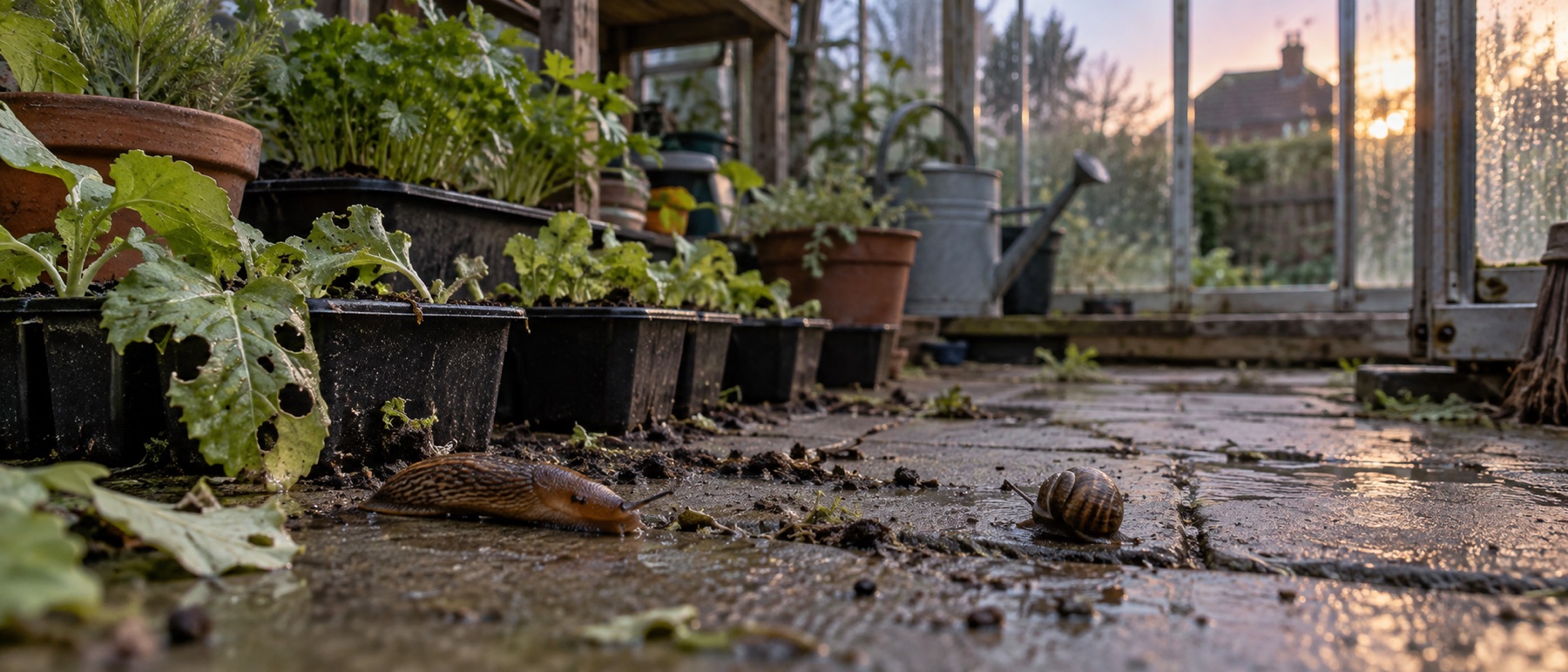
Look for irregular holes, missing seedlings and slime trails.
Inspect at dusk or early morning, including under pots.
Move vulnerable trays where they can be seen and checked.
Avoid indiscriminate pellets and preserve useful garden wildlife.
Confirm the night visitor
Missing young seedlings, ragged holes in leaves and slime trails are classic clues, but look for the animal before blaming every hole on a slug. Check after dark with a torch or early in the morning, and lift pots, trays and loose boards. The RHS slugs-and-snails guide notes that feeding often occurs at night, leaving damage visible before the animal is found. Caterpillars and other pests can also chew leaves, so use several clues.
The smallest seedlings are the highest priority. A mature pepper may lose a little leaf area without consequence, while a tray of newly emerged salad plants can be erased overnight. Move vulnerable trays to a clean, stable bench where you can inspect underneath and around each pot. This improves access but is not a barrier: slugs can climb and hide in a tray that was already infested.
Remove hiding places and inspect arrivals
Clear fallen leaves, old cardboard, spare pots and wet debris from the floor and beneath staging. Keep paths and drainage in good condition; persistent puddles create shelter and a slip hazard. Check the bottoms of outdoor pots before bringing them into the greenhouse, including saucers and plant labels. A clean greenhouse is not slug-proof, but fewer hidden damp niches make early detection easier. The greenhouse hygiene guide includes this routine.
Collect slugs or snails found around valuable plants by hand if you are comfortable doing so, and follow local humane handling practice. Check repeatedly after damp evenings. A single night of collection is rarely an end to the problem because eggs and more visitors may remain. Use traps only if you will inspect and empty them; unattended wet traps can become new attractants or hazards in a narrow aisle.
Use biological controls selectively
The RHS describes a slug nematode, Phasmarhabditis hermaphrodita, that can be watered into suitable moist soil when the temperature meets supplier conditions. It affects slugs, including species that are not damaging your crops, and is much less likely to contact snails. It may be poorly suited to a paved greenhouse with plants solely in pots, or to cold or dry soil. Do not buy a nematode pack without a suitable application area, target and timing. The biological-controls guide explains this choice in context.
The RHS advises against slug pellets, including some marketed as organic, because of wildlife impacts. We do not recommend a pellet here. If considering any pesticide, check the current HSE amateur database and exact product label for crop, use situation and safety restrictions. A marketplace description is not authorisation.
Keep vulnerable crops growing
Sow a few extra seeds where losses have been recurring, but do not accept repeated damage as inevitable. Move trays, inspect incoming plants, water for crop need rather than leaving a wet floor, and look after dusk. If a plant fails without chewing or slime, reconsider damping off or root problems. The best response follows the evidence at the plant, not the first pest product in a search result.
Helpful products
Make night checks and seed-tray inspections easier
A head torch frees both hands for a careful dusk inspection. Stable staging can lift vulnerable trays to an easier checking height, but it is not a slug barrier; inspect beneath every tray and pot.

Petzl TIKKA 350 head torch
Best for: hands-free night inspection
A hands-free head torch with a broad close-range beam and red-light mode, useful for calm-evening inspection under benches and around pots. It is not a reason to work on glazing or electrics after dark.
What stands out
- Leaves both hands free
- Useful for checking beneath pots
- Compact to keep with garden tools
Keep in mind
- No substitute for daylight structural inspection
- Confirm the live listing's exact variant and included batteries
- 350-lumen maker rating
- wide beam
- red-light mode
- AAA batteries included on maker specification

Woodside two-tier galvanised greenhouse staging
Best for: a sturdy potting and staging bench
A 115cm-wide galvanised-steel bench with a full worktop and lower shelf. Its published 75kg combined capacity and wipe-clean surfaces make it the most workbench-like option in this shortlist.
What stands out
- Full-width working surface
- Useful lower shelf
- Galvanised finish suits humid spaces
Keep in mind
- Fifty-centimetre depth needs a generous aisle
- Published capacity assumes correct assembly and level support
- 115 × 50 × 80cm
- two tiers
- galvanised steel
- 75kg total stated capacity
Common questions
Frequently asked questions
How do slugs get into a greenhouse?
They can enter through doors, gaps and drainage routes, or arrive beneath pots and materials brought inside. A greenhouse cannot be assumed sealed.
Do slugs and snails eat the same plants?
Both can feed on tender growth, but the species and local conditions vary. Identify the actual visitor before deciding on a control.
Will a raised bench stop slugs?
No. It makes trays easier to inspect and can remove some hiding places, but slugs and snails can climb and may arrive with pots.
Do slug nematodes control snails?
They target slugs in moist soil; the RHS says snails are less likely to be affected because they often remain above the soil surface.
Should I use slug pellets in a greenhouse?
The RHS recommends avoiding pellets because of wildlife impacts. Any pesticide would also require current HSE authorisation and exact label checks for the crop and situation.