
Safe installation
How to assemble a greenhouse safely
Plan a safe greenhouse build with a stable base, calm weather, correct manual, careful glazing handling, helpers and final anchoring checks.
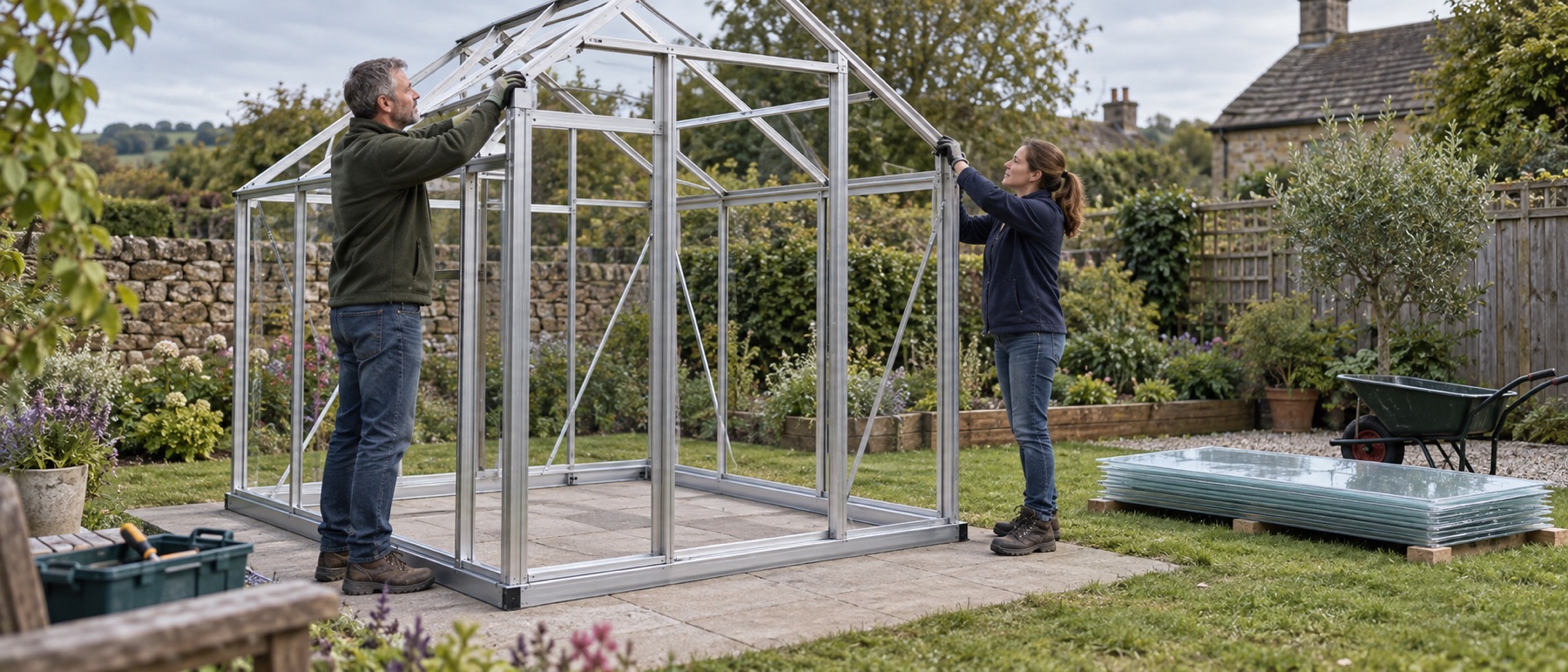
Follow the manufacturer's sequence and safety instructions.
Work on a clear, stable site and stop in gusty conditions.
Protect hands, eyes and feet when handling frames and glazing.
Do not improvise ladders, lifting or structural fixings.
Read the exact manual before delivery
Greenhouses are not interchangeable flat-pack projects. Some bases are included, some optional; glazing clips and door tracks vary; some models specify professional installation. Download the current manual for the exact size and glazing version, then check tools, helpers, base tolerances and assembly sequence.
Walk the delivery route. Long rails and panes may not fit the gate turn even if the completed greenhouse would fit the plot. Set aside a dry, protected storage area where cartons will not be damaged or block exits. Count parts against the inventory before you start, and keep small fixings sorted.
Complete the base first
A stable, level and square foundation is a safety measure as well as a fit requirement. If the frame is forced to follow uneven ground, sections can twist and panes may not seat correctly. The base guide helps choose a support system; use the chosen model's drawing for the actual dimensions.
Keep the work area clear of children, pets, loose pots and trip hazards. Provide enough space to lay out sections without leaning panels against an unstable fence. Check for overhead cables or branches before lifting long frame pieces. Do not damage buried services while preparing anchors.
Pick calm weather and enough people
Part-built greenhouses have little stiffness and light panels catch the wind. Choose a calm, dry day. Agree who holds, lifts and fastens each section, and avoid leaving a partially assembled frame standing unsecured overnight. If a gust begins to move a panel, stop rather than trying to wrestle it into place.
HSE guidance on glass handling describes cuts and injuries from moving panes; its workplace duties are not a domestic assembly manual, but the hazards are relevant. HSE manual-handling guidance also highlights awkward loads and uneven ground. Use the product manual's lifting instructions and arrange help for anything too large or awkward to control.
Handle glazing deliberately
Store panes as directed, protected from impact and away from the working route. Keep glass upright or flat only as its packaging and manufacturer instructions permit; do not stack it where it can slide or fall. Wear suitable gloves, eye protection and footwear. Avoid resting body weight on glazing or using a pane as a temporary shelf.
Check each panel's orientation and retaining system before insertion. Tightening clips or screws incorrectly can crack glazing or deform a frame. Damaged panes, missing retainers or mismatched parts are reasons to stop and contact the supplier, not to improvise a substitute.
Use safe access and correct fixings
Do not stand on staging, buckets or the greenhouse frame to reach the roof. Use appropriate access equipment on firm ground with a helper where needed. Work only within a height and lifting task you can control; a professional installer is a sensible choice for a large or difficult build.
Use the specified anchors and connection points. A greenhouse may look finished while still vulnerable to wind uplift. The anchoring guide explains the final checks, but the product manual governs the actual fasteners and order of work.
Finish with a walk-round
Before moving plants in, check frame alignment, door travel, glazing retainers, vent movement, sharp exposed edges and all anchor points. Remove packaging and offcuts from paths. Keep the manual and spare parts labelled for future glazing replacement. Reinspect after the first strong wind and as part of regular maintenance.
Helpful products
Check the installation arrangement
Flat-packed and professionally installed greenhouses create different jobs for the homeowner. Confirm exactly what delivery, base preparation and assembly include.
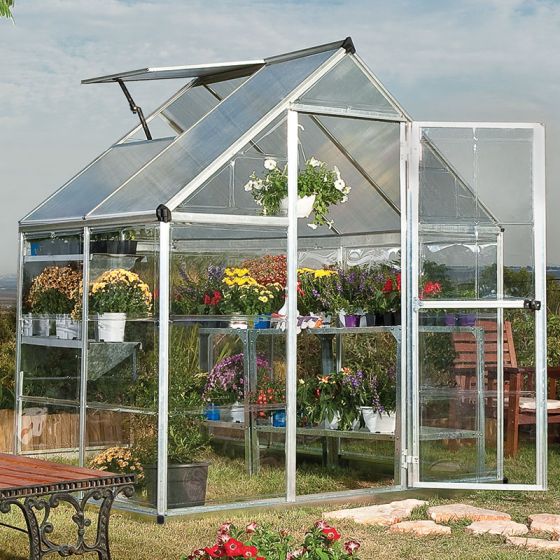
Palram Canopia Hybrid 6 × 4 greenhouse
Best for: a compact first walk-in greenhouse
A compact walk-in with a 1.85 × 1.25m base, diffusing twin-wall roof panels and clear polycarbonate sides. It is the most balanced fit here for a small garden that can still keep a central path.
What stands out
- Compact walk-in footprint
- Clear sides and diffusing roof
- Steel perimeter base included
Keep in mind
- Single 565mm door
- One roof vent means summer airflow needs planning
- 1.85 × 1.25m base
- aluminium
- polycarbonate
- one roof vent
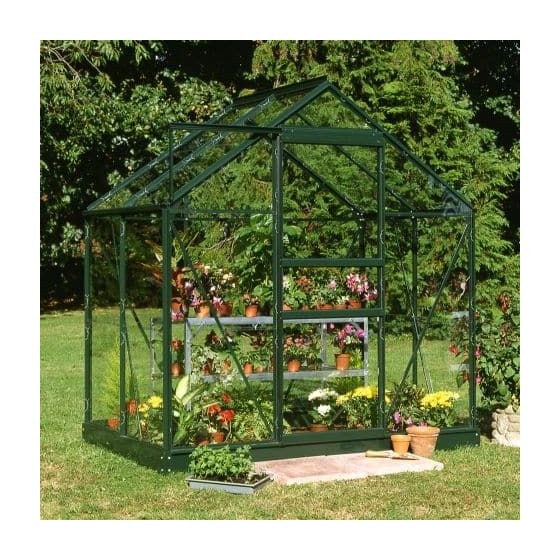
Halls Green Frame 6 × 4 greenhouse
Best for: toughened glass in a compact plot
A traditional-looking 6 × 4 with a green aluminium frame and large panes of toughened glass. It is the clearest fit if you want glass in a small footprint and accept a separate base.
What stands out
- Large-paned toughened glass
- Low-maintenance coated aluminium
- Roof vent and gutters included
Keep in mind
- Matching base costs extra
- Heavy panes need careful assembly
- 1.93 × 1.33m base
- green aluminium
- toughened glass
- optional base

Coppice Ashdown 6 × 6 wooden greenhouse
Best for: a premium full-size timber greenhouse
A full-size oiled and pressure-treated timber greenhouse with a 1.905 × 1.93m footprint, 3mm toughened glass, a 720mm hinged door, two roof vents and two-shelf staging. Professional installation is included in the listed package.
What stands out
- Professional installation included
- 720mm glazed door
- Staging and two roof vents included
Keep in mind
- Premium price level
- Wood requires annual retreatment
- 1.905 × 1.93m footprint
- pressure-treated timber
- 3mm toughened glass
- two roof vents
Common questions
Frequently asked questions
Can one person assemble a greenhouse?
Some small products may permit solo assembly, but many frames and glazing stages require helpers. Follow the exact manual rather than assuming a generic rule.
Should I assemble a greenhouse in wind?
Avoid it. Large light panels and partly built frames are harder to control in gusts. Stop and secure materials if conditions deteriorate.
Do I need gloves for greenhouse glass?
Use the protective equipment specified by the maker; suitable cut-resistant gloves, eye protection and sturdy footwear are sensible when handling glass or sharp metal edges.
Can I glaze before anchoring the frame?
Follow the manual's exact sequence. Do not leave an unanchored or partly glazed structure unattended where wind can move it.
When should I hire an installer?
Consider one if the greenhouse is large, the site is awkward, the glazing is heavy, access is limited or the maker's instructions require skills or lifting assistance you do not have.