
Greenhouse glass repair
How to replace greenhouse glass
Replace a reachable greenhouse glass pane by making the area safe, identifying the system, measuring accurately and fitting the correct glass and clips.
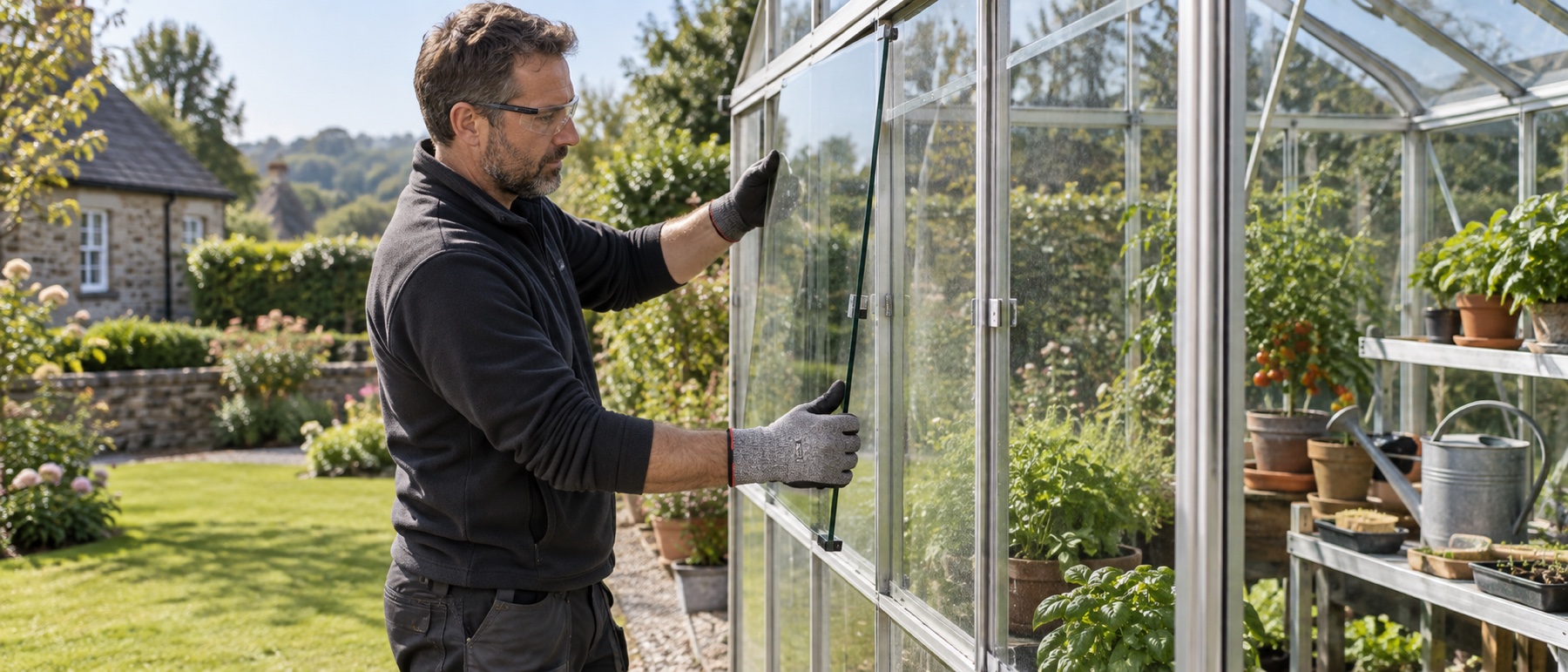
Wear cut-resistant gloves, eye protection, sturdy footwear and long sleeves.
Never cut toughened glass; order the finished size and edge treatment required.
Measure the frame and an intact matching pane, not fragments alone.
Use only compatible clips, gaskets, seals and overlap details.
First make the area safe
Keep children, pets and other people away from the greenhouse. If glass is still falling, the frame is moving or severe weather continues, do not approach. Wait for calm, dry daylight and assess from outside at a distance.
Wear cut-resistant gloves, safety glasses, sturdy closed footwear and clothing that covers arms and legs. Put a rigid container or strong box nearby for fragments; do not use a thin refuse bag that sharp glass can puncture.
Decide whether this is a DIY repair
A small rectangular side pane at comfortable standing height is the most controllable case. Stop and use a competent glazier or greenhouse specialist when the pane is in the roof, above easy reach, unusually large, bowed under load, beside a distorted glazing bar or part of a proprietary bonded system.
Multiple broken panes can indicate frame racking, base movement or wind entering through an unsecured door. Replacing glass before correcting the cause may create another failure.
Identify the greenhouse and glazing
Find the manufacturer, model and assembly manual. Record whether the pane is horticultural glass, toughened safety glass or another material; note thickness, edge finish, overlap, gasket and clip type. A nearby pane that looks similar may occupy a different bay with different dimensions.
Toughened glass usually breaks into many small pieces, while horticultural glass can form long sharp shards, but break pattern alone is not a specification. Use documentation or a professional assessment.
Remove plants and isolate services
Move plants, staging and irrigation far enough to create a stable working area. Isolate nearby power and remove portable electrical equipment. Protect the floor with a method that catches fragments without becoming a slip hazard; do not place a loose sheet where it can slide underfoot.
Have a second adult nearby for assistance and emergencies, particularly when handling any sheet too wide to control comfortably with two hands.
Remove loose glass without loading the frame
Follow the greenhouse instructions. Work from the safest accessible position and remove loose fragments one at a time into the rigid container. Never pull from beneath a hanging shard or brace yourself against another pane.
Remove compatible clips or cappings in the specified order. If a fastener is corroded, seized or inaccessible, do not twist the glazing bar until it deforms. A professional can support and dismantle the bay safely.
Vacuuming may be appropriate only with equipment designed for sharp debris and after larger fragments are lifted. Check soil, gravel, door tracks and shoes carefully. Dispose of glass according to local council guidance; window and greenhouse glass is often excluded from bottle banks.
Measure the replacement accurately
Use the manual's part size first. If that is unavailable, measure a truly matching intact pane and the glazing rebate or opening in several places. Record width, height, thickness, overlap direction and any non-square corner. A racked opening is a structural warning, not a reason to order trapezoidal glass casually.
Do not use a pile of fragments as the only template. Never apply a generic “subtract a few millimetres” rule; required clearance depends on the frame and retention system.
Order the correct finished pane
Give the supplier the exact glass type, final dimensions, thickness and any edge or corner requirement. Toughened glass cannot be cut or drilled after manufacture, so every detail must be correct before processing.
If changing from horticultural to toughened glass, confirm that weight, pane format, overlaps and retention remain compatible. Replacing one pane with a materially different system can shift loads or create an unsafe mismatch.
Inspect the empty bay
Clean the rebate gently and check glazing bars, seals and clips. Replace damaged parts with specified components. Do not pack a distorted frame with improvised cardboard, timber or excessive sealant.
Check that lower drainage routes are clear. Some systems use spring wire clips, some use cappings or gaskets, and overlapping panes may require Z clips. The correct sequence matters.
Fit a reachable side pane
Follow the manufacturer's instructions and the glass supplier's handling guidance. With protected hands, hold the pane by its sides and keep it vertical. Use a second person when necessary; glass handling aids must be suitable for the sheet and used correctly.
Seat the pane without forcing its edges against metal. Install the exact number and pattern of clips, gaskets or cappings specified. For overlapping horticultural panes, preserve the designed upper and lower overlap and use the correct separators.
Do not test retention by pushing hard on the centre. Inspect that the sheet is evenly seated and that no clip bears incorrectly on an edge.
Final checks
Count tools and inspect the entire work area for fragments. Open and close the door and adjacent vent gently while watching the repaired bay. From outside, confirm that clips are seated and the pane is not contacting the frame at an unintended point.
Recheck after a calm day and again before severe weather. If the pane shifts, rattles or chips at an edge, isolate the area and seek advice rather than adding random clips.
Sources and related guides
The RHS greenhouse-cleaning guide advises gloves around glass and warns against leaning on glazing or over the roof. HSE work-at-height guidance covers safe planning where access is not at ground level. Use our replacement-glazing guide to compare glass and polycarbonate before ordering.
If the failed fitting is unfamiliar, compare W and Z clips with the frame manual and check glazing seals before ordering. A pane that will not sit without pressure may indicate alignment or system incompatibility, not a need for more force.
Helpful products
Compatible fixings and grip gloves
The mixed spares pack is not universal; compare its clips with the greenhouse manual and an intact fitting. The cut-resistant grip gloves can help with sharp edges but are not puncture-proof or a substitute for eye protection, safe handling and a second person for large panes.

Homgaty 240-piece greenhouse repair kit
Best for: compatible clips, bolts and nuts
A mixed pack of W clips, Z overlap clips, aluminium bolts and nuts. It is a useful spares box only for frames and glazing systems that use these exact types and sizes.
What stands out
- Covers several common repair consumables
- Compact spares-box format
- Enough duplicates for routine replacement
Keep in mind
- Not universal
- Incorrect clips or bolts can leave glazing insecure or damage a frame
- 240 pieces
- 60 W clips
- 60 Z overlap clips
- 60 bolts and 60 nuts

NoCry CutGuard+ grip-dot cut-resistant gloves
Best for: hand protection around sharp edges
Flexible cut-resistant gloves with grip dots. They add a layer of hand protection for compatible small-pane and metal-fixing work but are not puncture-proof and cannot make unsupported glass safe to handle.
What stands out
- Grip when handling small parts
- Adds protection against incidental sharp contact
- Reusable for compatible jobs
Keep in mind
- Cannot prevent all cuts or punctures
- Fit and task suitability must be checked
- grip-dot palms
- cut-resistant fabric
- selected Amazon size L
- not puncture-resistant
Common questions
Frequently asked questions
Can I replace greenhouse glass myself?
A small reachable side pane may be manageable for a competent person with the correct glass, protective equipment and instructions. Use a professional for roof glazing, large panes, awkward access, a distorted frame or any job you cannot control safely.
What type of glass should I use in a greenhouse?
Match the greenhouse design and current safety requirements. Horticultural glass, toughened safety glass and laminated options behave differently and use different retention details. Ask the manufacturer or a competent glazier rather than substituting by thickness alone.
Can toughened greenhouse glass be cut to size?
No. Toughened glass must be manufactured to the finished dimensions; attempting to cut or drill it will cause it to break. Order the exact size and any required edge finish or holes in advance.
How much smaller should replacement glass be than the opening?
There is no universal deduction. Frames need clearances for the particular glazing system and thermal movement. Use the greenhouse manual, manufacturer dimensions or a matching intact pane; do not invent an allowance.
Are greenhouse W clips universal?
No. Wire gauge, shape, pane thickness and glazing-bar geometry vary. Match the specified part or compare with an undamaged original and confirm with the manufacturer.