
Holiday watering plan
Watering a greenhouse while away
Build a reliable greenhouse holiday-watering plan with crop triage, measured drip output, reservoir sizing, timer testing and a human backup.
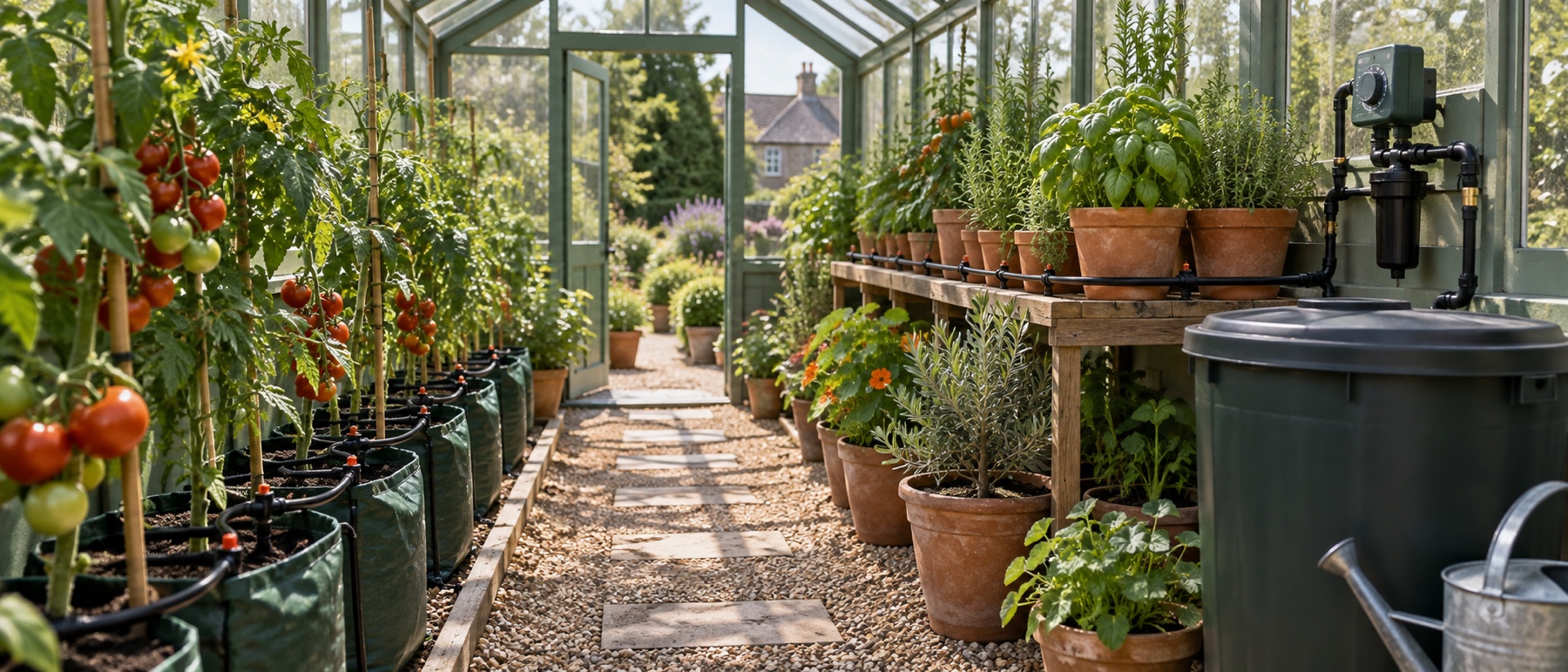
Prioritise seedlings, small pots, cucumbers, tomatoes and other fast-drying crops.
Measure emitter output and reservoir capacity; do not rely on timer minutes alone.
Test the installed layout with plants in place and inspect the furthest outlets.
Leave written instructions and arrange a check for longer or hot-weather absences.
Start with a plant-risk list
Not every greenhouse plant needs the same holiday plan. Seed trays, plug plants, small terracotta pots and fruiting crops in containers can dry quickly. Established plants in a deep border usually have a larger root reserve. Succulents and dormant plants may suffer more from automatic overwatering than from a short dry interval.
Write down each group, its container or bed, and the moisture it needs. Put crops with similar demand on the same irrigation zone. A row of mature tomatoes should not share one fixed output with newly pricked-out seedlings simply because both fit along the same bench.
If a plant is irreplaceable or needs daily judgement, move it to a cooler managed location or ask a knowledgeable person to care for it. Automation is strongest when it repeats a known routine, not when it tries to replace observation.
Reduce water demand before adding equipment
Check that roof vents and louvres open freely and that the door can be secured in its intended ventilating position. Keep established seasonal shading in service if it is suitable for the crop and forecast. Remove weeds, dead leaves and fruit that will over-ripen while you are away.
Move compatible containers out of the fiercest afternoon sun and group them without crowding foliage. The RHS advises grouping and shading portable containers to slow moisture loss while away. Do not make a major light change on departure morning; rearrange several days earlier and watch how quickly the compost dries.
Mulch greenhouse borders where appropriate and water them deeply rather than repeatedly wetting only the surface. For pots, make sure drainage holes work. Standing every container in a deep tray of water is not a universal answer: some plants tolerate a short reserve, while others quickly develop waterlogged roots.
Choose the system by water source
Pressurised outdoor tap
A timer-and-drip kit is convenient when the tap, pressure range, connectors and backflow protection are all suitable. Route the main tube where it cannot be kicked, pin each emitter securely and keep the controller accessible. Water Regs UK notes that hose-connected irrigation can create backflow risks; the required protection depends on the installation and water category.
Water butt
Gravity systems need products designed for low pressure. Raising a butt increases head, but a domestic stand does not create mains-like pressure. Use a stable, level base rated for the full weight, a close-fitting lid and a filter. Where a pump is required, it should be compatible with stored water, protected against running dry and supplied safely.
Separate reservoir
A lidded reservoir with a purpose-made pump can serve a greenhouse away from a tap. Place it where a leak cannot damage a building or undermine the greenhouse base. Avoid open tubs that collect debris or present a risk to children and wildlife.
Calculate capacity from measured output
Run the final system with a measuring jug or equal catch cups beneath representative emitters. Record the volume delivered in a fixed interval at the first, middle and final outlet. If the last dripper receives much less, shorten the run, improve pressure regulation or split the layout into zones.
Add the measured output of all emitters to estimate water per cycle. Multiply by the planned cycles and days away, then add a margin for hotter weather and water that sits below the pump or outlet. For example, a measured 18 litres per day over seven days is 126 litres before any reserve is added. This exercise often shows that a decorative small butt cannot cover a full greenhouse for a week.
Do not respond by overwatering in advance. Saturated compost contains less air and can damage roots. The aim is a controlled root-zone supply that reflects normal plant use.
Set zones and emitter positions
Put individual drippers close to active roots and use two lower-flow points for a large pot if one point leaves half the root ball dry. A continuous row line suits evenly spaced plants in a bed. Capillary matting can support grouped small pots, but the pots must make reliable contact and the reservoir must not run dry.
Keep tubing off hot heater surfaces, away from sharp aluminium edges and out of the central path. Provide a service loop at doors or moving staging rather than stretching a connection. Label valves or zones so a helper can follow your instructions without tracing every line.
Test in the conditions that matter
Commission the system at least a week before a longer absence. Observe several watering cycles, including a bright day. Check soil moisture below the surface, drainage from pots, filter condition, battery status and the last emitter in every run.
Simulate common failures. Briefly close and reopen a valve to confirm the timer resumes correctly. Check what happens when the reservoir approaches its lowest usable level. Make sure a power or battery interruption does not leave a valve permanently open. Follow the product instructions rather than inventing a test that could damage equipment.
The departure checklist
The day before leaving, harvest ripe produce, remove diseased material, top up and secure the reservoir, clean filters and inspect every connection under pressure. Confirm the forecast and adjust only within the range already tested. Photograph the final valve and controller positions for reference.
Leave a watering can, spare battery or compatible connectors together with short written instructions. Tell the helper which plants are highest priority, how to isolate the water and who to contact if the greenhouse is flooded or damaged. For a longer absence, schedule a visit early enough that a fault can be corrected before plants reach permanent wilting.
What a helper should check
A useful inspection takes minutes: confirm the water source is available, look for a wet patch or spraying connection, feel the root zone of one plant in each group and inspect the last outlet on each run. They should not change every emitter because one pot looks dry; a blocked line or changed pressure may affect the entire zone.
In a severe heatwave, crop water use can exceed the tested schedule. A helper can add a supervised watering or move vulnerable pots, while a basic timer cannot interpret the plants. This is why a human backup remains valuable even with a good automatic system.
When you return
Inspect before immediately running an extra cycle. Some pots may be wet even when leaves have wilted from heat. Check the root ball, restore any moved plants gradually to brighter positions and flush lines if sediment has accumulated. Record what worked so the next trip requires adjustment rather than a complete redesign.
Sources and related guidance
The RHS watering-methods guide compares hand watering, drip systems and other irrigation approaches. The RHS water-storage guide covers water-butt lids, filters and pump needs. For system design, continue with our greenhouse drip-irrigation guide and watering-system comparison.
Helpful products
Watering systems for planned greenhouse zones
Choose by water source and plant layout. A tap-fed complete kit, a compact adjustable kit and a row system solve different problems.
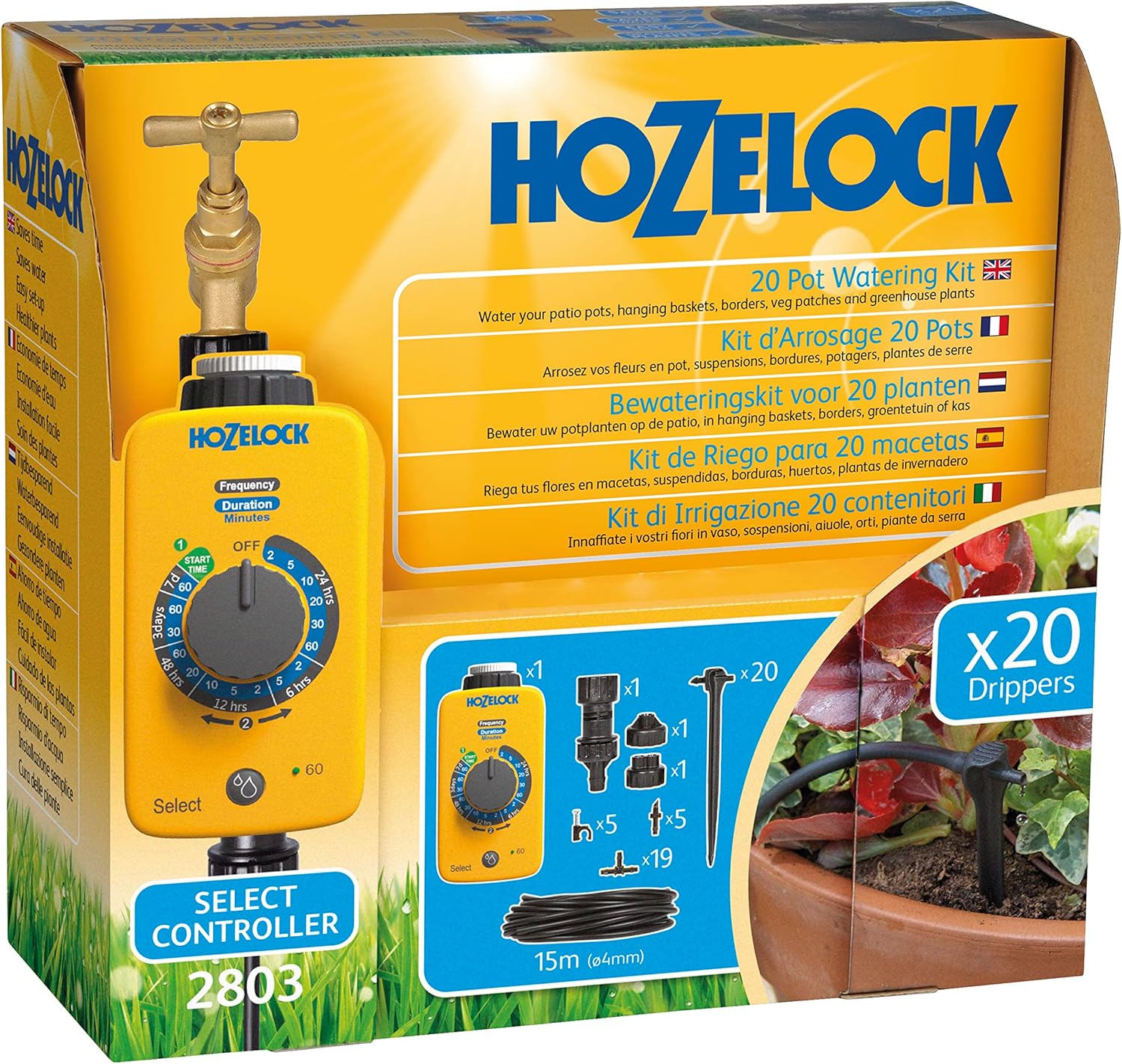
Hozelock 20-pot drip watering kit with Select Controller
Best for: timed watering for up to 20 pots
A complete mains-water drip kit for up to 20 containers, with a tap controller, supply pipe and individual drippers. The controller offers preset schedules while emitters place water close to roots.
What stands out
- Timer and distribution parts included
- Flexible cut-to-fit tubing
- Manual watering function
Keep in mind
- Requires a compatible pressurised tap supply
- Backflow protection and pressure must be checked
- up to 20 containers
- Select Controller
- 16 preset programmes
- root-zone drippers

MIXC 15m drip-irrigation kit
Best for: small pot-watering zones
A compact micro-irrigation kit for distributing water between pots or short greenhouse rows. It is most useful after the crop layout and water source are decided.
What stands out
- Flexible layout around pots
- Compact length limits excess tubing
- Emitters can be checked individually
Keep in mind
- Needs pressure and compatibility checks
- Lines and emitters need flushing
- 15m tubing
- adjustable emitters
- DIY layout
- small greenhouse scale

Gardena Micro-Drip rows-of-plants starter set
Best for: a greenhouse bed or planting row
A starter system designed to drip along short rows of kitchen-garden or ornamental plants. Its stated 1.6 litre-per-hour drip points suit a planned row better than a mixed collection of containers with very different demands.
What stands out
- Purposeful row layout
- Slow root-zone delivery
- Expandable system family
Keep in mind
- Less adaptable for scattered pots
- Supply pressure and filtration still matter
- row-watering starter set
- 1.6L/h stated flow
- Micro-Drip format
- self-cleaning labyrinth design
Common questions
Frequently asked questions
How can I water greenhouse plants for a week away?
Water thoroughly, reduce unnecessary heat, group pots by demand and use a tested drip, capillary or reservoir system. Run it several times before departure and ask someone to inspect it if conditions are hot or the plants are valuable.
How big should a holiday-watering reservoir be?
Measure the system's total daily output, multiply by the number of days and add a sensible margin for warmer conditions and unusable water below the outlet. Never guess from container volume alone, and secure the reservoir with a lid.
Can I leave a greenhouse tap timer unattended?
A suitable timer can automate routine watering, but it cannot guarantee against a flat battery, closed tap, burst connection or blocked dripper. Test it under normal pressure, use compliant backflow protection and arrange an inspection where practical.
Should I shade the greenhouse before going on holiday?
Existing seasonal shading and reliable ventilation can reduce water demand, but do not suddenly plunge established crops into deep shade. Keep vents operating, secure all covers and make changes early enough to observe the plants.
Is a water butt suitable for automatic greenhouse watering?
Yes, if the irrigation is designed for the available gravity pressure or uses a compatible pump and filter. Many tap-fed micro-drip products will not distribute evenly from a low water butt without equipment designed for that source.