
Greenhouse buying costs
How much does a greenhouse cost in the UK?
Build a whole-project greenhouse budget with our quote-based calculator, covering the kit, foundation, delivery, installation and equipment, with missing costs flagged.
Get a written quote for groundwork and installation if you will not do both yourself.
Check whether the listed model includes its perimeter base, floor, vents and gutters.
Allow a contingency for uneven ground, access and overlooked fittings.
Buy optional equipment for a real growing plan, not an imagined fully equipped greenhouse.
Start with an installed, growing-ready figure
“How much does a greenhouse cost?” has no useful single answer without a site and a growing plan. The same kit can be placed on an existing sound paved area or require excavation, a new foundation and paid assembly. A better comparison is the amount needed to get each option safely installed and ready for the first crop.
Make a separate line for the greenhouse structure, foundation, assembly and initial equipment. Do not use a temporary sale price as the centre of a long-term guide: take current figures directly from the retailer and local tradespeople when you are ready to buy. The checklist below is designed to stay useful when those figures change.
Your complete setup
Greenhouse project budget calculator
Add the actual amounts for your chosen greenhouse and site. Use quotes that include VAT where applicable and check whether delivery, anchoring or equipment is already bundled. Count each item once. The calculator covers setup and your chosen reserve, not future water, electricity or maintenance bills.
A blank field stays unresolved. Enter 0 only after confirming that the item is included elsewhere or unnecessary for your plan. A contingency is a separate reserve you choose, not a substitute for a missing foundation or installation quote.
Your project budget
Check what each quote includes before comparing totals. A complete set of amounts is not confirmation that the site or installation is suitable.
Cost-group worksheet and calculation method
Known subtotal = the sum of entered amounts, including a contingency only if entered. The subtotal becomes a planned setup budget only when all eight groups have an amount. Missing entries remain listed; the calculator does not estimate them or add VAT.
| Cost group | What to record |
|---|---|
| Structure and selected options | Exact kit, glazing upgrades and any optional perimeter base. |
| Foundation and site preparation | Groundwork, drainage, foundation materials and associated labour. |
| Delivery | Charge to your postcode; enter 0 only if confirmed included. |
| Assembly and anchoring | Installation labour, compatible anchors and any extra assembly costs. |
| Staging, climate and watering equipment | The benches, monitoring, shading, ventilation and water equipment you need. |
| First-season growing supplies | Pots, trays, compost, supports and seeds or plants. |
| Other setup costs | Removal, waste disposal or other work not counted elsewhere. |
| Chosen contingency reserve | An amount you decide to hold back; it does not fill gaps in missing quotes. |
Save the quoted model, package and exclusions with your own notes, then repeat for the next shortlist option. Use what is included with a greenhouse to identify extras and the size guide and aisle calculator to check whether paying for more space solves your actual constraint.
The six parts of a greenhouse budget
1. Structure and selected options
Record the exact model, glazing version, colour and door arrangement. A horticultural-glass listing with optional toughened glazing is not equivalent to a model supplied with toughened glass. Ask whether the perimeter base, gutters, opening vents, shelving and door lock are standard, optional or unavailable. Our included-components guide gives a comparison method.
The Forest mini growhouse, for example, has shelves, double doors and opening lids, but is not a walk-in. The Palram Hybrid 6 × 4 includes a steel perimeter base, but still needs level supporting ground and anchoring. The Halls Blockley 8 × 10 includes an integral base and more ventilation, yet its much larger glass structure changes delivery, foundation and assembly planning. These are different projects, not just three prices on one scale.
2. Foundation, drainage and site work
Measure the manufacturer's base dimensions, then decide what foundation is suitable for your ground and anchoring instructions. Include any removal of turf or an old base, aggregate, paving or concrete, labour and drainage. A perimeter base is a frame component; it is not automatically a finished floor or a substitute for sound groundworks. Our base guide helps compare options.
An uneven or wet site can cost more to prepare than expected. Mark the route for wheelbarrows and glazing, and allow room to maintain the outside. If a wall greenhouse is involved, assess the wall, fixings, rainwater details and any obstruction before accepting a low installation estimate.
3. Delivery and assembly
Check the delivered cost to your own postcode, not an assumed national rate. Some long panels or large glass panes require a clear unloading space and safe storage before assembly. If paying an installer, get the quote to specify whether it includes the foundation, assembly, anchoring, glazing, disposal of packaging and a return visit for missing parts.
Self-assembly still has costs: appropriate fixings, protective equipment, help from another adult and enough time in calm weather. Do not cut corners on anchoring to protect the initial budget; a poorly secured greenhouse can be expensive and dangerous later.
4. Climate control and water
An opening vent is not the same as a fully managed summer climate. Depending on site and crops, allow for a compatible automatic opener, shading, a max/min thermometer and perhaps water storage or simple irrigation. An unheated greenhouse may meet your plans without the purchase and running costs of a heater. If electrical equipment is needed, use a properly designed outdoor supply rather than an improvised lead.
5. The first growing season
Budget for trays, pots, suitable peat-free compost, supports, staging and seeds or plants. Buy for a realistic first season. A gardener growing tomatoes and salads may need a clear aisle, supports and watering equipment before adding a second bench; a seed-raising grower may value trays and a propagator more than full-height staging.
6. Maintenance and contingency
Leave room for replacement clips or panels, cleaning tools, seals and timber care where relevant. A contingency is particularly sensible when the base is not yet exposed or an old greenhouse must be removed. Note what that reserve covers rather than hiding every uncertain item in one vague figure.
Compare quotes on the same basis
Create one row per shortlisted structure and columns for delivered kit, selected glazing, base and site work, installation, anchoring and first-season equipment. Mark every unknown as “quote needed” rather than zero. This prevents a model with an optional base from seeming cheaper than one with an included base simply because a necessary item was omitted.
If your budget is fixed, reduce size or postpone optional equipment before weakening the foundation. A slightly smaller greenhouse with a safe base, functioning ventilation and usable path is a better working space than a larger kit you cannot finish properly. The size guide and 6 × 4 guide help test that trade-off.
The manufacturer's instructions are useful when checking which costs sit outside the kit. For example, the Canopia Hybrid documentation distinguishes the supplied structure from its foundation and suitable fixings. Use your chosen model's instructions to complete the quotation worksheet.
Helpful products
Structures with different cost profiles
A low growhouse, a compact walk-in and a large glass greenhouse imply very different base and installation work. Compare complete projects, not just kit prices.
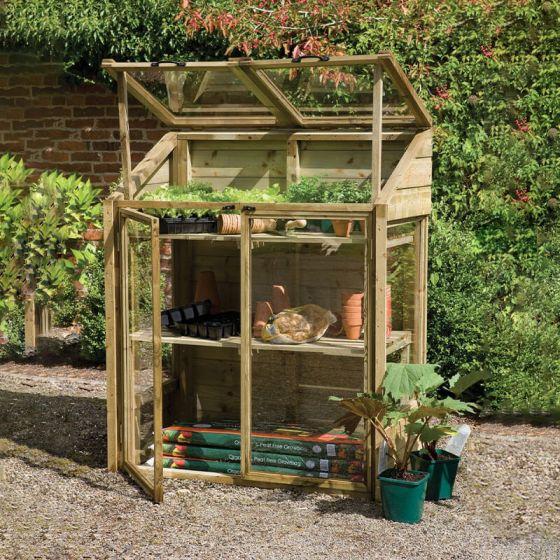
Forest Wooden Mini 4 × 2 growhouse
Best for: the smallest fixed footprint
A 1.2m-wide timber growhouse with two front doors, two independently opening glazed lids and two internal shelves. It trades walk-in access for a genuinely shallow 0.62m footprint.
What stands out
- Very shallow footprint
- Shelves and growbag-level space
- Independent lids for flexible access
Keep in mind
- Not walk-in
- Capacity falls quickly as plants grow tall
- 1.20 × 0.62m
- pressure-treated timber
- two shelves
- split lid
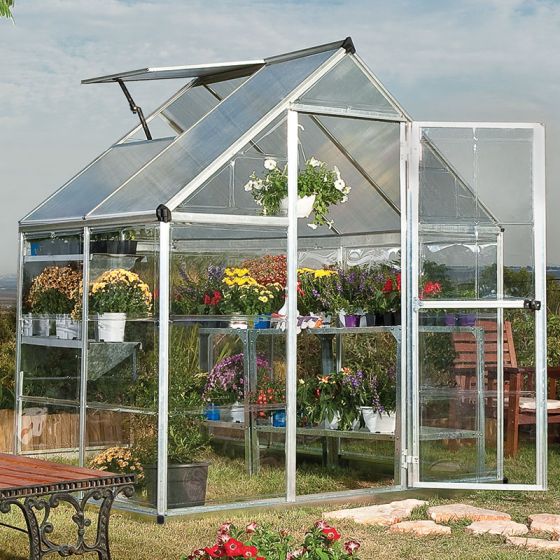
Palram Canopia Hybrid 6 × 4 greenhouse
Best for: a compact first walk-in greenhouse
A compact walk-in with a 1.85 × 1.25m base, diffusing twin-wall roof panels and clear polycarbonate sides. It is the most balanced fit here for a small garden that can still keep a central path.
What stands out
- Compact walk-in footprint
- Clear sides and diffusing roof
- Steel perimeter base included
Keep in mind
- Single 565mm door
- One roof vent means summer airflow needs planning
- 1.85 × 1.25m base
- aluminium
- polycarbonate
- one roof vent

Halls Cotswold Blockley 8 × 10 greenhouse
Best for: a roomy toughened-glass layout
A larger aluminium greenhouse with a published 2.56 × 3.17m size, toughened glass, integral base, low-threshold sliding door, four roof vents and guttering.
What stands out
- Four roof vents
- Low-threshold sliding entry
- Integral base and gutters
Keep in mind
- Requires a large level foundation
- Large glazing demands careful installation
- 2.56 × 3.17m published size
- toughened glass
- integral base
- four roof vents
Common questions
Frequently asked questions
What is the cheapest type of greenhouse to set up?
A small growhouse on an existing suitable level surface can involve less groundwork than a walk-in greenhouse. It also provides far less growing height and access, so compare the cost against the space you will actually use.
Is the greenhouse base included in the price?
It depends on the exact model. Some include a metal perimeter base, others offer one as an extra; neither necessarily includes the level supporting foundation or a floor. Check the chosen kit's component list and drawings.
How much should I allow for installation?
Obtain a quote for the exact model and site. Ground preparation, old structure removal, access, glazing and anchoring can change labour far more than the nominal greenhouse size suggests.
Do greenhouse prices include delivery?
Do not assume so. Delivery charges and availability can vary by retailer, model and postcode. Check the live checkout or request a quote before using a delivered price in your budget.
What recurring costs should I expect?
Allow for replacement panels or seals, cleaning supplies, timber care where needed, water and any electricity used for heating or propagation. A cold, unheated greenhouse has a different running-cost profile from a heated one.
Does the calculator treat missing quotes as zero?
No. Blank amounts remain unresolved and the result is labelled as a known subtotal, not a complete project budget. Enter zero only after confirming an item is included elsewhere or not needed. Your chosen contingency does not replace a missing quote.