
Greenhouse foundations
Greenhouse perimeter-base guide
Understand what a greenhouse perimeter base does, what it must sit on, how to keep it square and level, and how to plan soil beds and access.
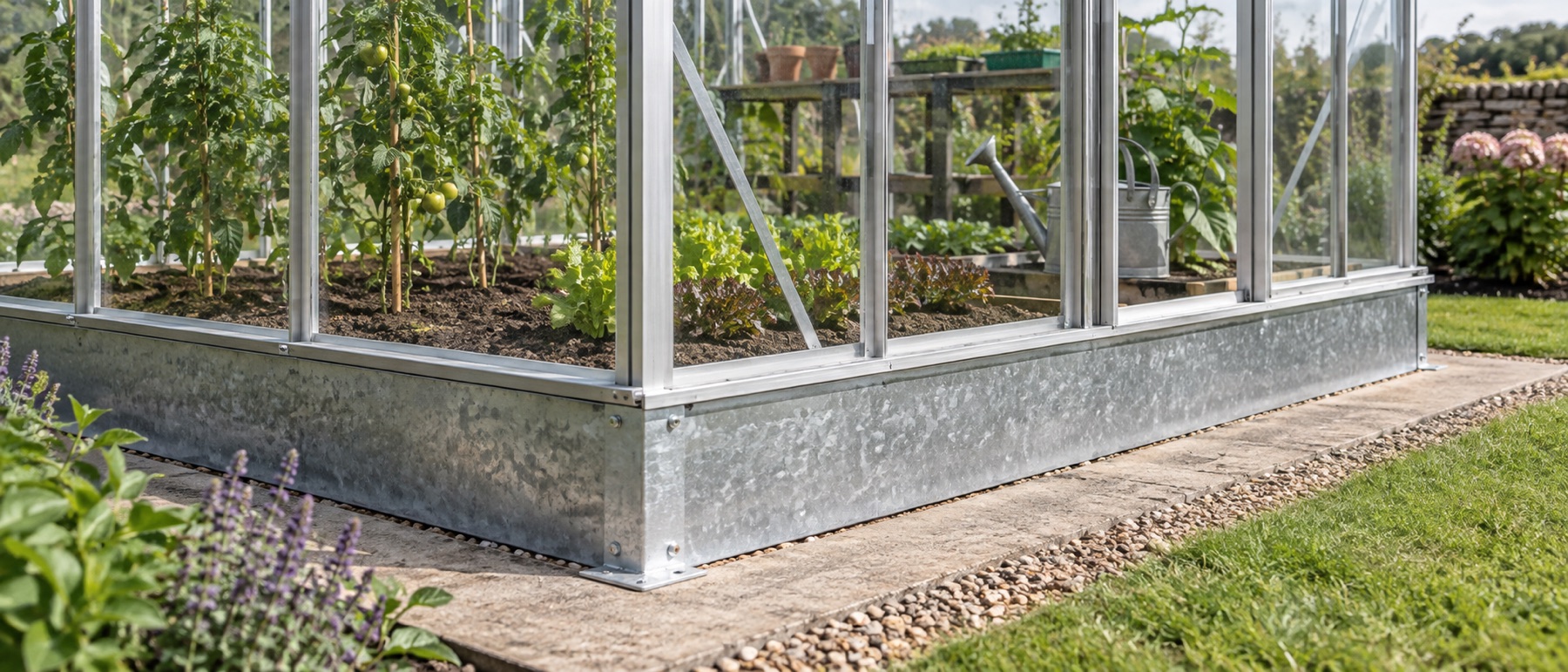
Confirm whether the exact greenhouse includes a base frame.
Match the foundation to the maker's base and anchor drawings.
Keep the perimeter square, level and continuously supported.
Plan the door threshold and in-ground beds together.
Understand the three layers
A greenhouse needs a stable relationship between ground, base and frame. The ground or built foundation carries the loads. The perimeter base may raise, align and connect the greenhouse. Anchors tie the assembly to something that can resist wind. A metal plinth on loose soil does not automatically provide that resistance.
Product terminology is confusing: “base included” might mean a galvanised frame, not a paved or concrete foundation. Our guide to what is included helps separate the delivered kit from the site work.
Match the exact product system
Start with the installation manual and technical drawing for your version. Record the base dimensions, required support points, ground-fixing method, door arrangement and whether the base is integral, supplied separately or optional. Nominal feet labels are not accurate construction dimensions. The dimensions guide shows why.
For example, the Palram Hybrid 6 × 4 listing includes a galvanised steel perimeter base, while the Halls Green Frame 6 × 4 listing treats its base as optional. Those distinctions can change the project budget and finished doorway level. Always reconfirm the current listing and manual before ordering.
Choose how to support the perimeter
A perimeter can be carried by a level paved strip, concrete edge, correctly designed timber or another manufacturer-approved ground system. The appropriate choice depends on soil, drainage, wind exposure and anchor requirements. Avoid isolated blocks under corners unless the maker's design explicitly allows them; unsupported runs can sag and rack the greenhouse.
Where soil beds are wanted, keep the interior open but prepare the support line properly. Do not bury the base rail in wet topsoil unless the maker intends that detail. If the site is sloping, soft or waterlogged, seek a groundworker's advice rather than shimming one corner.
Set square, level and at the right height
Measure the two diagonals of the rectangular base; they should agree before the upper frame is assembled. Check long runs with a straightedge, not just a short level at each corner. An out-of-square base can make doors bind and glazing difficult to fit.
Plan finished surrounding path height, the entry threshold and any ramp before setting the base. Raising the structure can create useful headroom but may also create a step. A later path that bridges above the door sill may stop a sliding door or trap water.
Plan anchoring as part of the foundation
Fixings must connect the approved base points to a substrate capable of carrying the relevant loads. The maker may specify ground anchors, masonry fixings or a proprietary system. Do not substitute a convenient bolt merely because it fits the hole. In exposed sites, a professional may need to assess uplift and foundation design.
The anchoring guide explains the practical checks. If you want a solid floor rather than in-ground planting, compare a concrete base or proper paving. The best base is the one that supports the chosen greenhouse and the way you will garden inside it.
Refer to the exact instructions before setting out the support. Halls' foundation guide demonstrates one proprietary approach, but its anchor-leg detail should not be copied into a different frame or ground-base system.
Helpful products
Supplied bases differ
These products illustrate included and optional base arrangements. Check the current specification and manual before assuming any frame or fixing is in the box.
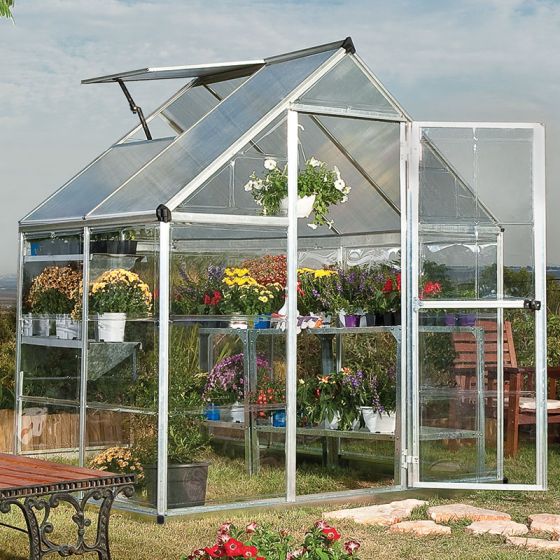
Palram Canopia Hybrid 6 × 4 greenhouse
Best for: a compact first walk-in greenhouse
A compact walk-in with a 1.85 × 1.25m base, diffusing twin-wall roof panels and clear polycarbonate sides. It is the most balanced fit here for a small garden that can still keep a central path.
What stands out
- Compact walk-in footprint
- Clear sides and diffusing roof
- Steel perimeter base included
Keep in mind
- Single 565mm door
- One roof vent means summer airflow needs planning
- 1.85 × 1.25m base
- aluminium
- polycarbonate
- one roof vent
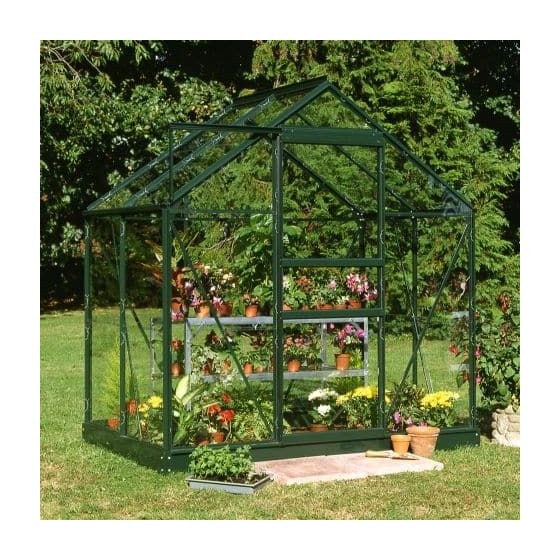
Halls Green Frame 6 × 4 greenhouse
Best for: toughened glass in a compact plot
A traditional-looking 6 × 4 with a green aluminium frame and large panes of toughened glass. It is the clearest fit if you want glass in a small footprint and accept a separate base.
What stands out
- Large-paned toughened glass
- Low-maintenance coated aluminium
- Roof vent and gutters included
Keep in mind
- Matching base costs extra
- Heavy panes need careful assembly
- 1.93 × 1.33m base
- green aluminium
- toughened glass
- optional base

Halls Cotswold Blockley 8 × 10 greenhouse
Best for: a roomy toughened-glass layout
A larger aluminium greenhouse with a published 2.56 × 3.17m size, toughened glass, integral base, low-threshold sliding door, four roof vents and guttering.
What stands out
- Four roof vents
- Low-threshold sliding entry
- Integral base and gutters
Keep in mind
- Requires a large level foundation
- Large glazing demands careful installation
- 2.56 × 3.17m published size
- toughened glass
- integral base
- four roof vents
Common questions
Frequently asked questions
Is a greenhouse base frame the same as a foundation?
No. The frame or plinth is a component of the structure. Its foundation is the prepared ground, paving, concrete or other approved support beneath it.
Can a metal base sit directly on grass?
Not as a finished installation unless the maker explicitly details a stable, level, anchored ground system for that site. Grass and topsoil can move, hold water and give unreliable support.
Do all greenhouses include a perimeter base?
No. Some include an integral or supplied base, some offer one as an option and others specify a separate foundation arrangement. Check the exact product version.
Can I grow in soil inside a perimeter base?
Often, if the foundation and anchor design leave soil beds inside. Keep soil and wet compost from blocking the door track or burying parts that should remain accessible.
Can I use a different brand's base?
Do not assume compatibility. Anchor spacing, frame geometry, door detail and warranty requirements can differ. Seek explicit approval from the greenhouse maker.