
Positioning guide
Greenhouse orientation in the UK
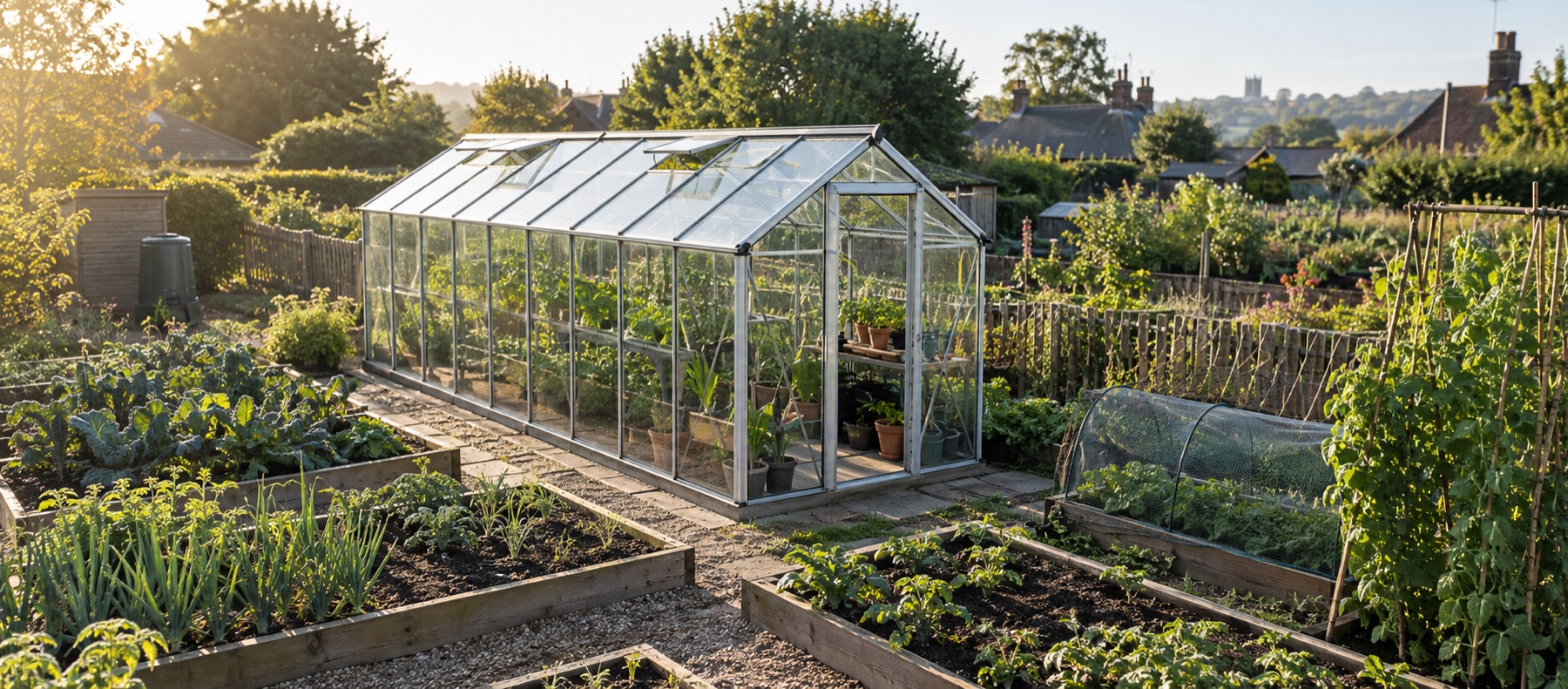
Decide whether to orient a UK greenhouse east–west or north–south based on winter light, summer crops, shade, wind and the constraints of your garden.
Our recommendations
Orientation across common formats
Freestanding greenhouses offer the most freedom to rotate; long lean-tos are usually dictated by the available wall.
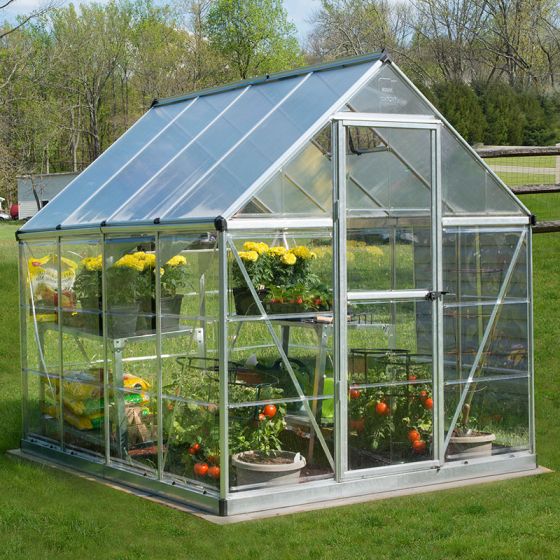
Palram Canopia Hybrid 6 × 8 greenhouse
Best for: more useful growing length
The same 1.85m width extended to 2.46m at the base. The extra length makes a more workable layout for staging plus floor crops if the site can spare the footprint and access around it.
What stands out
- Length for staging and tall crops
- Clear walls and diffusing roof
- Perimeter base included
Keep in mind
- Needs much more prepared base
- Door remains 565mm wide
- 1.85 × 2.46m base
- aluminium
- polycarbonate
- integrated gutters

Halls Green Frame 6 × 8 greenhouse
Best for: a traditional 6 × 8 glass greenhouse
A 1.93 × 2.57m aluminium greenhouse with large-paned toughened glass, a 600mm sliding door, roof vent and integral gutters. It brings a traditional glass finish to the more useful 6 × 8 format.
What stands out
- Large panes of toughened glass
- 600mm sliding door
- Roof vent and integral gutters
Keep in mind
- Matching base costs extra
- Large glass panes require careful handling
- 1.93 × 2.57m base
- green aluminium
- toughened glass
- optional base
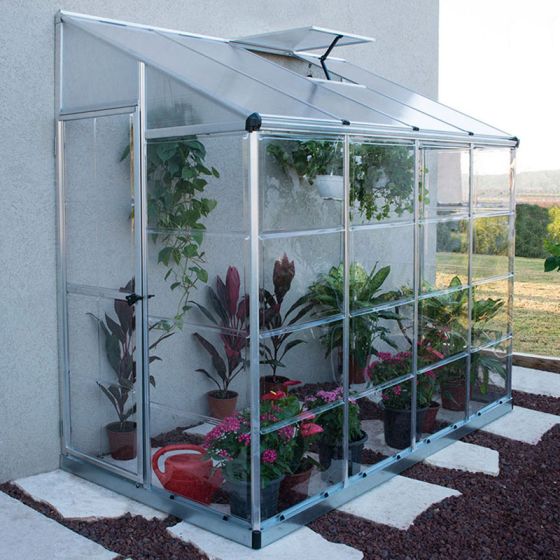
Palram Hybrid Lean-To 8 × 4 greenhouse
Best for: a long, narrow wall-side plot
A long, shallow walk-in lean-to with a side door, diffusing twin-wall roof and clear side panels. It turns roughly 1.25m of projection into a useful 2.44m run against a suitable wall.
What stands out
- Makes use of wall length
- Side door suits the narrow layout
- Perimeter base and wall kit included
Keep in mind
- Needs a suitable wall
- 1.21m width limits two-sided staging
- 2.44 × 1.25m overall
- lean-to
- polycarbonate
- wall-mount kit
| Priority | Usually favour | Why | Important caveat |
|---|---|---|---|
| Winter and early spring light | East–west ridge | Long side can face the low southern sun | Nearby shade may cancel the benefit |
| Summer tomatoes and cucumbers | North–south ridge | Both sides receive sun during different parts of the day | Ventilation and shading still matter |
| Lean-to greenhouse | Best suitable wall | Wall aspect and fixings govern the layout | Check heat, shade and roof runoff |
| Exposed garden | Safest sheltered alignment | Reduces structural stress | Anchoring remains essential |
Ridge direction is the useful measurement
When gardeners ask which way a greenhouse should face, they often mean the door. The more important line is the ridge running along the roof peak. A greenhouse with an east–west ridge presents one long side towards the south; a north–south ridge lets sun move across both long sides during the day.
Use a compass or map to establish direction, then look at the real horizon. Houses, trees and fences alter when sunlight reaches the glazing. A perfectly oriented greenhouse behind a garage can receive less usable light than a slightly rotated greenhouse in an open part of the plot.
East–west for lower winter sun
The RHS orientation guidance notes that an east–west orientation can slightly extend winter light. In the UK, the sun remains low and tracks across the southern sky in winter, so the long south-facing roof and wall can intercept more of it. This can help when winter use is the priority, provided the site is not shaded by buildings or trees.
The north side will receive less direct sun and can stay cooler or damper. Keep glazing clean, avoid tall storage on that side and leave enough space outside for air and maintenance. In summer, the south side may receive intense exposure and need shading.
North–south for summer crops
With a north–south ridge, the east side receives morning sun and the west side receives stronger afternoon sun. Light moves across the greenhouse rather than remaining concentrated on one long face. The RHS identifies this as a good orientation for summer crops such as tomatoes.
That movement can distribute growth more evenly across opposing beds. It does not guarantee uniform conditions: the west side may run hotter in late afternoon, and nearby boundaries can still create persistent shade.
Orientation cannot repair a poor site
Do not sacrifice drainage, safety or usable access to achieve an exact compass bearing. A greenhouse should not be placed under branches, in a waterlogged hollow or in a severe wind funnel simply because the ridge points east–west.
Rank the decisions in this order:
- a stable site with open light and safe clearance;
- shelter from severe wind and a secure anchoring route;
- convenient door, water and maintenance access;
- the best seasonal ridge orientation that fits those constraints.
Our greenhouse positioning guide explains the full site survey.
Lean-to orientation
A lean-to is governed by the available wall. A south-facing wall captures strong light and stores heat, which can help in cooler months but increase summer overheating. An east-facing wall receives gentler morning sun. A west-facing wall is exposed to stronger afternoon heat, while a north-facing wall may be too shaded for many demanding crops.
Assess the wall itself: overhanging eaves, windows, vents, downpipes and neighbouring buildings alter light and installation. Masonry can release stored warmth after sunset, but only if the greenhouse is designed and fixed for that wall.
Wind direction and doors
Ridge orientation also changes the surface presented to prevailing wind. A gable may shed wind differently from a long glazed side, but product design and local turbulence make simple rules unreliable. On an exposed plot, choose the orientation that reduces risk without creating deep shade, then follow the manufacturer's anchoring requirements.
Avoid directing an outward-opening door into the strongest wind. Provide a positive catch and keep roof vents closed during storms. A door placed for easy daily access is more valuable than one moved to satisfy a compass rule.
Slopes and local microclimates
South-facing slopes and walls receive more solar energy; north-facing areas remain cooler. Low points can collect cold air, while urban walls create warm pockets. These site effects may be stronger than the difference between two ridge directions.
Observe frost, dew and snowmelt patterns. An area that stays frosty long after the rest of the garden warms is a poor choice for early propagation. An area that dries immediately but is exposed to hard wind may need porous shelter.
Crop layout inside the greenhouse
Orientation should influence staging. Avoid putting permanent tall shelves or opaque storage where they shade the main growing bed. Place tall summer crops so they do not block every tray behind them, and rotate movable plants as the sun changes.
In an east–west greenhouse, taller crops are often best managed towards the north side so they do not shade lower plants to the south. In a north–south house, divide vigorous crops between sides or train them so light can move through the canopy.
Final orientation check
Mark the footprint, stand at each end and trace the sun's likely path. Check the view again in morning and afternoon, then imagine the lower winter sun. If rotating the greenhouse creates a narrow door approach, inaccessible gutter or weaker base, choose the practical alignment. Orientation improves a good site; it does not rescue a bad one.
Compare orientation with the clearance needed around the greenhouse and the space occupied by nearby trees. A useful seasonal alignment still needs a safe and maintainable site.
Common questions
Frequently asked questions
Which way should a greenhouse face in the UK?
Think about the direction of the ridge rather than the door. East–west can improve winter light; north–south distributes summer sun more evenly. Site shade, wind, access and drainage can be more important than either rule.
Should the greenhouse door face south?
Door direction is secondary to ridge orientation, wind and access. Avoid placing a frequently opened door directly into the strongest prevailing wind, and make sure the path is safe and convenient.
Is a south-facing greenhouse too hot?
Any well-lit greenhouse can overheat in summer. South-facing exposure increases solar gain, so adequate roof vents, door use and removable shading are essential. Do not solve summer heat by accepting deep year-round shade.
Can a greenhouse face north?
A door or gable can face north without making the whole greenhouse unsuitable. What matters is how much open sky reaches the glazed surfaces, especially the roof and long sides, through the seasons.
Does orientation matter for a small greenhouse?
It still affects light, but local shadows can dominate a very small structure. Moving a mini greenhouse half a metre away from a wall or tree may matter more than rotating it precisely.