
Greenhouse climate control
Greenhouse ventilation guide
Plan greenhouse ventilation with roof vents, low-level inlets, doors, automatic openers, monitoring and seasonal routines for UK conditions.
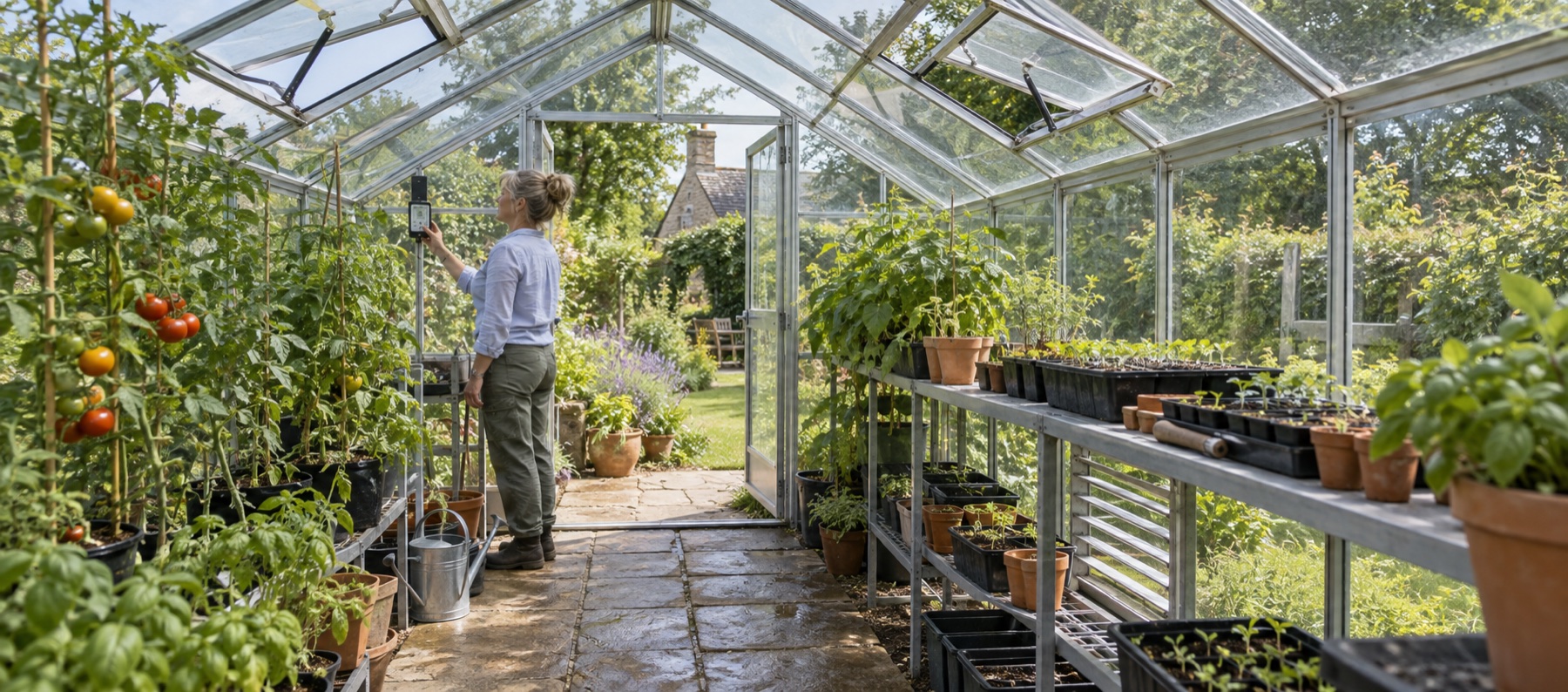
Roof vents release rising hot air; low inlets provide replacement air.
The RHS uses roughly 20% of floor area as ridge ventilation guidance for larger glasshouses and notes small greenhouses may need proportionally more.
Monitor plant-level maximum and minimum temperatures rather than relying on one midday reading.
Add the least shade needed only after all available ventilation is working.
What greenhouse ventilation has to achieve
Ventilation removes excess solar heat, replenishes air around leaves and helps prevent prolonged high humidity. Those jobs overlap, but they do not always require the same opening pattern. A wide-open door may cool a small greenhouse quickly in summer, while a narrow roof vent may be enough to clear damp air on a mild winter day.
The starting point is passive airflow. Warm air becomes buoyant and rises toward roof vents. Cooler outside air replaces it through a door, side vent or louvre. If the greenhouse has only high outlets or only a door, the path is incomplete and more dependent on wind direction.
Roof vents do most of the heat-release work
Ridge or roof vents sit where the hottest air gathers. Openings on both roof slopes can work across changing wind direction, but exact performance depends on the greenhouse shape and surroundings. A vent partly blocked by staging, insulation or shade fabric cannot deliver its designed area.
The RHS describes one square metre of ridge ventilation for every five square metres of floor area in larger glasshouses and notes that small greenhouses ideally require an even higher proportion because they have more glazing relative to floor area. Use that as design context rather than forcing a precise calculation onto a compact hobby model. Count the real clear opening, not the outside dimensions of a closed vent.
Low-level air has to get in
An open doorway is the largest inlet on many small greenhouses. A louvre adds controlled low-level ventilation when the door cannot remain fully open, and opposing low vents reduce the distance replacement air must travel.
Keep crops, pots and stored compost away from louvre blades. A mesh guard may deter pests but also reduces free area and needs cleaning. If an automatic louvre mechanism is added, verify that the blades move freely through their full travel before adjusting its temperature response.
How to use automatic openers
Wax-cylinder openers expand as they warm and contract as they cool. They require no mains electricity, but they do not respond instantly. The RHS specifically advises providing alternative ventilation because damaging temperatures can build before the wax has expanded enough to open the vent.
Choose an opener by compatibility first:
- vent weight and maximum opening load;
- bracket geometry and frame material;
- required opening travel;
- clearance from glazing and roof bars;
- whether the opener must be removed or disconnected in winter;
- replacement-cylinder availability.
After fitting, observe the greenhouse through several bright and overcast days. Adjust in small steps according to the manufacturer’s instructions. Never force a warm cylinder closed by hand.
Measure the temperature plants experience
A thermometer against sunlit glazing can report a much higher temperature than the leaves experience. Place a max/min thermometer around plant height in a shaded, ventilated position away from the heater, doorway and direct glass.
Record the overnight low and daytime high, then reset at a consistent time. The pattern is more useful than a single number: a high that occurs only during one hour of direct sun suggests ventilation or shade; a cold dawn reading points toward insulation, crop grouping or frost protection.
The RHS says plant damage can occur when greenhouse temperatures are allowed to build above about 27°C. Treat this as a warning point, not a universal target: crops differ, and leaf temperature, root moisture and humidity change the result.
Ventilation through the seasons
Spring
Bright days can overheat a greenhouse while nights remain cold. Open vents early rather than waiting for the air to feel oppressive, then close them before the temperature drops sharply. Automatic openers are particularly helpful during this swing season.
Summer
Use the full designed vent area and open the door on warm days. Remove obstructions, water plants at the root and introduce removable shade only when ventilation alone cannot control heat. Keep openings secure in gusty conditions.
Autumn
Gradually remove shade and reduce opening duration as light falls. Continue airing the greenhouse on mild days so dying leaves and wet compost do not create a stagnant humid environment.
Winter
An unheated greenhouse still benefits from brief ventilation in suitable mild weather. A heated greenhouse needs deliberate fresh-air management because insulation and closed vents trap moisture as well as warmth. Open only as conditions allow and avoid exposing tender plants to a direct cold draught.
Humidity, damping down and disease
In hot, dry weather, wetting a hard path can raise humidity and provide evaporative cooling. It is not a substitute for watering roots or opening vents, and it should not put water near electrical equipment. In cool weather, routinely wetting surfaces can worsen condensation and disease risk.
Remove dead leaves, give plants space and water early enough for foliage and paths to dry. A humidity reading helps reveal persistent damp, but leaf wetness and poor air exchange matter as much as the displayed percentage.
When a fan helps
A small purpose-suitable circulation fan can reduce cold or humid pockets and distribute heater output. It needs a safe electrical supply and positioning that does not create a harsh continuous blast across seedlings.
Fans supplement natural or powered air exchange; they do not replace it. If every door and vent is closed, a fan simply recirculates the same warm, humid air.
Shade after ventilation
External shade intercepts solar energy before it passes through the glazing and is generally more effective than internal shade. Use the minimum coverage and density that controls peak heat, keep vents free, and remove or retract shade during dull periods. Our greenhouse shading guide covers mesh, blinds and paint in detail.
A practical daily routine
Read the max/min thermometer in the morning, inspect the forecast, open high and low vents before the greenhouse heats, and check that automatic mechanisms are unobstructed. In the evening, reassess wind and overnight temperature rather than automatically closing everything at the same hour.
Weekly, clean vent channels and louvres, test latches and inspect cylinders and brackets. At the end of the hot season, remove shade that is no longer needed and follow the opener manufacturer’s winter instructions.
Sources and further reading
The RHS guide to greenhouse ventilation and shading explains vent area, automatic openers, temperature monitoring and shade. Its greenhouse heating guide also covers winter ventilation and damp control.
If the greenhouse is still too hot with the openings working, follow the overheating checklist before adding removable shade. For someone who cannot adjust vents during the day, the automatic-opener comparison helps check a compatible mechanism rather than assuming one suits every window.
Helpful products
Useful ventilation and monitoring options
These options address different parts of the airflow system: roof automation, a low-level louvre and temperature-plus-humidity monitoring.

Gardening Naturally automatic vent opener
Best for: automatic daytime ventilation
A heat-responsive vent opener that works without electricity and begins opening as the greenhouse warms. Confirm its brackets, lifting force and range suit the exact vent before ordering.
What stands out
- Responds while you are away
- No mains supply or battery
- Fits many common roof vents
Keep in mind
- Compatibility must be checked
- Does not replace door and low-level airflow
- heat responsive
- no electricity
- up to 7kg opening force
- adjustable response
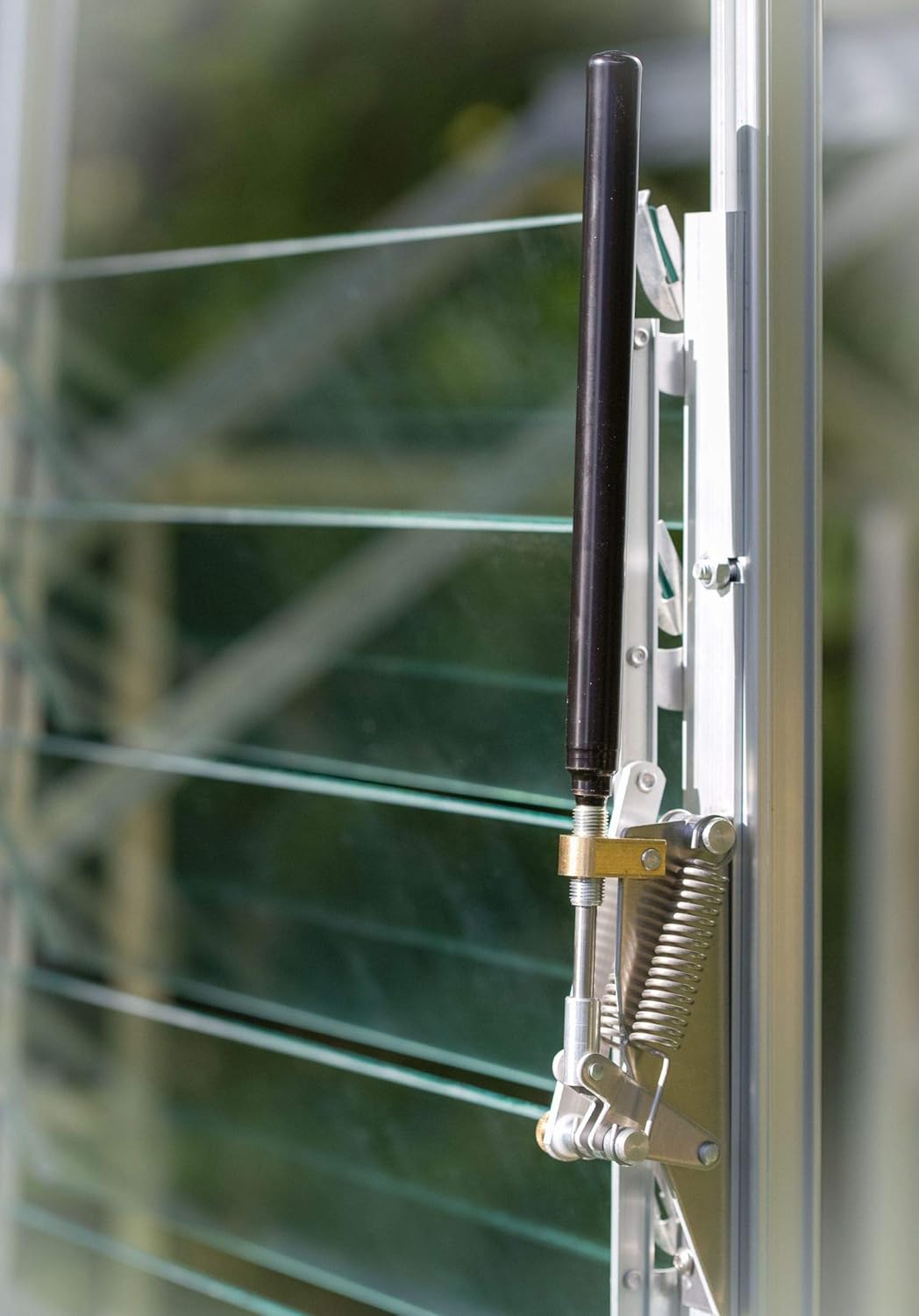
Gardening Naturally automatic louvre vent opener
Best for: automating a compatible louvre
A wax-cylinder opener made for many standard greenhouse louvre vents. It automates low-level air intake rather than lifting a roof window, so it can support a more complete high-and-low ventilation path.
What stands out
- Automates low-level inlet air
- No battery or mains supply
- Made for standard louvre mechanisms
Keep in mind
- Does not operate a roof vent
- Louvre compatibility must be confirmed
- louvre-vent format
- wax cylinder
- 17–25°C stated range
- no electricity

Brannan max/min thermometer and hygrometer
Best for: temperature plus humidity at a glance
An analogue dial instrument combining current humidity with current, maximum and minimum temperature. It adds a quick humidity indication without requiring an app, account or wireless connection.
What stands out
- No app or pairing
- Shows humidity as well as temperature
- Easy to scan from the aisle
Keep in mind
- Humidity is current rather than logged
- Manual reset and reading required
- analogue display
- max/min temperature
- current humidity
- wall mountable
Common questions
Frequently asked questions
How much ventilation does a greenhouse need?
There is no single number for every small greenhouse, but the RHS describes one square metre of ridge ventilation for five square metres of floor area in larger glasshouses and says smaller structures ideally need a higher percentage. Doors and low vents supplement that high-level area.
Should I leave a greenhouse door open all day?
On warm sunny days an open door can provide a large low-level inlet, especially in a small greenhouse. Close and secure it before strong winds, when temperatures fall or when animals and security are concerns.
Are automatic vent openers worth it?
They are useful when nobody is present to respond to rapid warming. They react with a delay and only operate the vent they are fitted to, so the door, louvres and total vent area still matter.
Does a fan replace greenhouse vents?
No. A circulation fan moves air within the greenhouse but does not by itself remove heat or bring in fresh outside air. It can reduce still pockets only when used with an adequate ventilation route.
When should greenhouse vents be closed?
Close them when falling temperature, strong wind or the crop’s needs require it. In a heated winter greenhouse, brief ventilation on mild days can still reduce dampness; do not seal the structure permanently.