
Stored-rainwater systems
Water-butt greenhouse irrigation
Calculate water-butt duration from usable litres and measured daily consumption, compare capacity scenarios and choose suitable gravity or pump greenhouse irrigation.
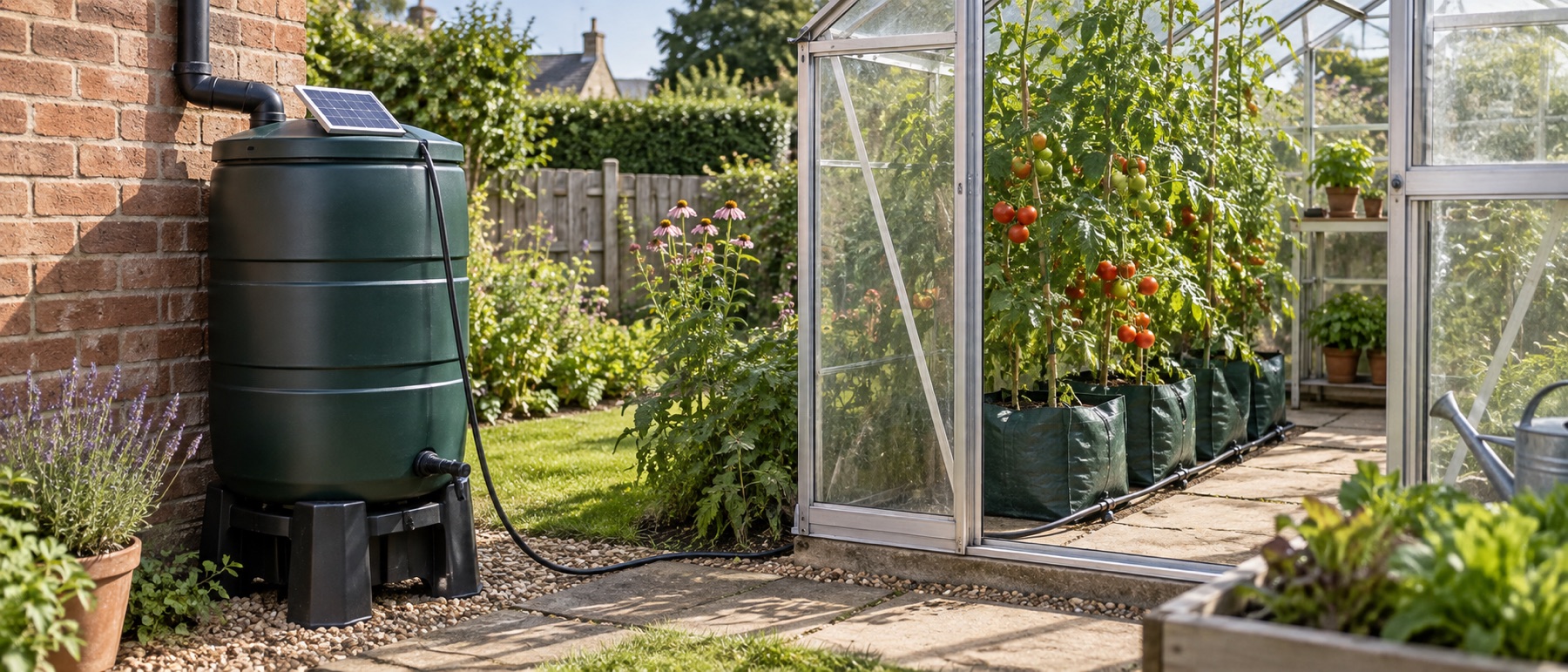
Collect from a suitable roof into a covered, stable butt.
Choose gravity-compatible parts or a kit with its own pump.
Measure actual output at the furthest dripper.
Plan for an empty butt and an independent holiday backup.
Start with the water source
Rainwater from a greenhouse or nearby roof can be a useful greenhouse supply, but the collection and storage system must be planned first. The RHS guidance on collecting and storing water recommends a secure, level stand and a close-fitting lid. Fit a suitable diverter and filter, keep insects and debris out, and make the overflow discharge safely away from foundations and paths. A large full butt is heavy: its stand must be designed for the filled weight, not just the empty container.
Stored rainwater is not automatically clean enough for every task. Keep the lid on, inspect for debris and follow the RHS guidance on using stored water safely. It advises avoiding water-butt water for seedlings because of damping-off risk; use fresh mains water for those trays. If crops or equipment have a higher hygiene requirement, use the water source the guidance specifies.
Choose a butt that fits the site and watering demand
The Charles Bentley 100L slimline kit below has a published 95 × 36 × 32cm butt body, plus a separate stand. It suits a narrow wall-side position, but 100 litres may disappear quickly across thirsty summer containers. The 210L round kit has a 97 × 57 × 57cm body and provides a larger reserve, at the cost of a wider footprint and substantially greater weight when full. Both kits include a tap, lockable lid, stand and downpipe filler, according to the maker's 100L specification and 210L specification.
Measure the whole installation, not only the butt body: allow room for the stand, downpipe connection, overflow, lid removal and a route to clean the tank. Confirm the supplied diverter fits your actual downpipe. Put the stand on a level load-bearing surface; 210 litres of water alone weighs about 210kg before the container and fittings. A stand that makes it easier to fill a watering can does not guarantee enough head for gravity drippers. Equally, a pump kit may draw from a butt without using its tap, so confirm its intake can pass through the lid or an approved opening before buying the pair.
Storage meets consumption
Water-butt reservoir-duration calculator
The number on a butt is its nominal capacity, not the water available to your plants today. Start with the water actually stored, deduct water that the tap or pump cannot draw, then deduct any reserve you choose to keep back. Divide what remains by the measured daily use of the whole watering system.
Calculated duration = (stored water − unusable water − chosen reserve) ÷ daily consumption.
Reservoir duration
This is not a guaranteed unattended watering period. It assumes constant consumption and functioning equipment. Weather, crop growth, leaks, pressure, battery charge and solar conditions can change what happens; arrange appropriate checks and a refill plan.
Worked example: use the water you can actually draw
These are illustrative inputs, not measurements from a garden: 100L stored − 10L below the usable intake − 10L held back = 80L allocated. At an assumed 18L/day, the arithmetic is 80 ÷ 18 = approximately 4.44 days, displayed conservatively as 4.4 days.
Compare two capacities under the same assumptions
The 100L and 210L capacities match the water-butt options below. For comparison only, both start full, lose 10L to an unusable intake zone and keep 10L in reserve. The two daily-use figures are scenarios, not prescribed watering amounts or promises of product performance.
| Starting volume | Water allocated | At 18L/day | At 27L/day |
|---|---|---|---|
| 100L | 80L | 4.4 days | 2.9 days |
| 210L | 190L | 10.5 days | 7.0 days |
Every duration is rounded down to tenths of a day. The same storage lasts less time when consumption rises, even with unchanged equipment. A bigger butt therefore helps capacity but does not fix insufficient pressure, blocked emitters or an unsuitable watering schedule. The capacity sources are the maker's 100L specification and 210L listing.
How to choose your daily-consumption input
Measure the system's actual water use over representative days after setting it to suit your plants. Include every outlet and any manual top-ups taken from the same reservoir. Recheck when plants are larger or the weather changes; do not use the average from a cool week as a guaranteed demand for a hot spell. Do not increase watering merely to match an example in this table.
The calculation assumes no rainfall, refills or loss beyond your entered daily consumption. It does not calculate pressure, emitter uniformity, pump runtime or plant water needs. The chosen reserve is not automatically enough for delays or hotter weather.
Use the drip-irrigation guide to assess output and distribution, and the watering-while-away checklist to plan checks and a backup. Follow the RHS guidance on storing rainwater for covered storage and plant hygiene.
Choose gravity or a pump, not a generic tap kit
A simple butt outlet provides only the pressure created by the water height above the drippers. That head falls as the butt empties. Gravity-rated tubing and emitters may work for a short, low-flow layout when the reservoir is high enough, but ordinary pressure-compensating or mains-tap kits may barely flow. Check the minimum supply pressure of every timer, filter and emitter in the chain.
A pump kit draws from the reservoir and can feed a planned drip network. The Irrigatia SOL-C36Q below is a distinct example: its maker lists a solar-powered unit, water-level sensor, 15m tube and 20 included drippers. Check the exact kit contents and the required solar exposure, then test the real layout before relying on it. Do not quote a maximum plant count as a promise for large, thirsty tomato plants; pot size and weather change demand.
Draw the layout and test its flow
List each pot, bag and bed zone, then position emitters near roots. Make the longest run and height change visible on the sketch. Add filtration specified by the kit, secure tubing so it cannot kink at the door, and keep the pump inlet clear of settled debris. The drip-irrigation guide explains emitter placement; the watering-while-away guide covers reservoir trials.
Run the complete system and collect output from representative outlets at the start and far end. Check the wetting pattern in the compost—not just whether water emerges from the tube. Repeat with a lower butt level, and after a cloudy spell if using solar power. Adjust zones rather than giving seedlings and mature tomatoes identical schedules. Plan a human check during longer absences and a safe response when the butt runs dry.
If you connect to mains water instead
A tap-fed timer or complete pot kit may be easier where a suitable supply exists, but it is a different design. UK water-supply rules and local restrictions can affect permanent irrigation and backflow protection; RHS watering-methods guidance advises proper separation for permanent mains systems. Ask the water supplier or a qualified plumber about the proposed connection. The watering-timer guide compares scheduling choices without treating a butt as a pressurised tap.
Helpful products
Water-butt kits and a pump option
The 100L and 210L butts offer different storage footprints; the solar pump kit is a separate irrigation system. Check the site, downpipe and pump intake before combining them.

Charles Bentley 100L slimline water butt kit
Best for: compact rainwater storage
A compact 100-litre rainwater butt supplied with a lockable lid, tap, four-part stand and downpipe filler kit. The published butt body is 95 × 36 × 32cm; check the separate stand and filler against your site.
What stands out
- Shallow 32cm body depth
- Stand and downpipe filler included
- Lockable lid helps keep the stored water covered
Keep in mind
- Limited reserve for thirsty crops or long absences
- Stand height does not guarantee gravity-drip pressure
- 100L capacity
- 95 × 36 × 32cm butt body
- four-part stand
- tap, lockable lid and filler kit

Charles Bentley 210L round water butt kit
Best for: larger rainwater reserve
A 210-litre round rainwater butt supplied with a lockable lid, tap, three-part stand and downpipe filler kit. The published body is 97cm high and 57cm across, so allow for the stand, filler and access around it.
What stands out
- More than twice the stated volume of the slimline option
- Stand and filler included
- Covered, lockable lid
Keep in mind
- Requires a much wider site and strong level support
- The included stand does not establish irrigation pressure or pump compatibility
- 210L capacity
- 97 × 57 × 57cm butt body
- three-part stand
- tap, lockable lid and filler kit

Irrigatia SOL-C36Q solar watering kit
Best for: solar water-butt drip watering
A solar-powered water-butt irrigation kit with a pump, water-level sensor, 15m of tubing and 20 included drippers. It adjusts watering with available daylight but still needs reservoir capacity and a full-system trial.
What stands out
- Designed to draw from a water butt
- No mains tap required for the pump
- Weather-responsive scheduling
Keep in mind
- Shade and poor solar placement affect operation
- Reservoir volume and dripper layout need testing
- solar-powered pump
- 20 included drippers
- 15m tubing
- water-level sensor
Common questions
Frequently asked questions
Can I run any drip kit from a water butt?
No. Many tap-fed kits expect a pressure range a low butt cannot provide. Use components specifically rated for gravity supply or a suitable pump kit.
Does a water butt need to be raised?
A gravity-fed system needs enough height above its emitters for the specified pressure and flow. A pump-driven system has different requirements; follow its maker's reservoir and intake guidance.
Will a solar watering kit work every day?
Its output depends on the model, solar position, settings, reservoir level and weather. Test it through a realistic run of cloudy and bright conditions rather than assuming a fixed daily volume.
Is rainwater safe for greenhouse seedlings?
Collected water can carry contaminants. The RHS advises using fresh tap water for seedlings; keep the butt covered and clean, and reserve stored rainwater for suitable established plants where appropriate.
How large a water butt do I need for a holiday?
Measure the total water used by every outlet over several representative days, then allow for hotter weather and days without rain. Arrange a person to check plants and refill the reservoir if necessary.
Does the reservoir calculator tell me how long I can leave plants unattended?
No. It divides allocated water by your entered daily consumption under constant-demand assumptions. It does not guarantee plant health, pressure, emitter output or equipment reliability. Recheck demand as conditions change and arrange appropriate checks and a refill plan.