
Living pest management
Biological controls for greenhouse pests
Choose greenhouse biological controls by confirmed pest, plant, season and supplier release conditions; understand what predators can and cannot do.
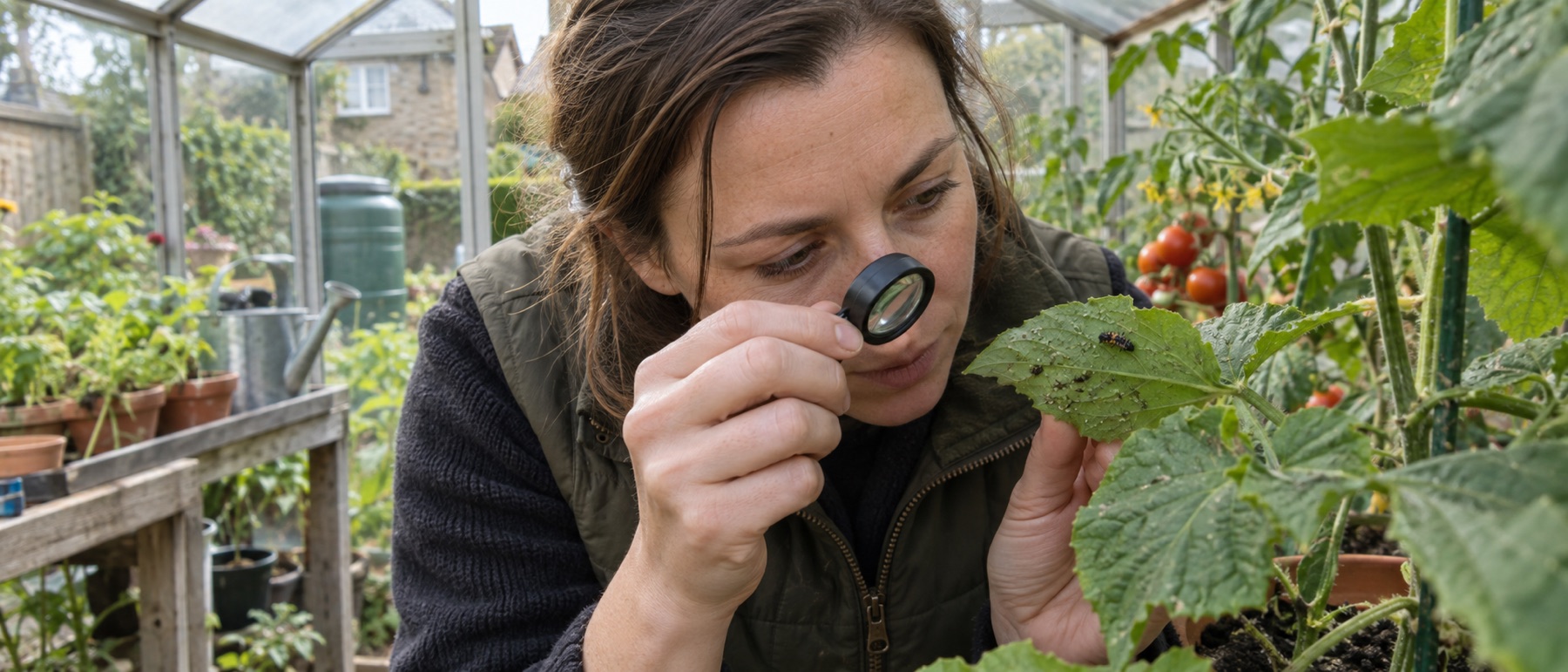
Confirm pest identity and life stage with leaf or compost inspection.
Check supplier temperature, humidity and delivery instructions.
Avoid incompatible pesticide residues and indiscriminate sticky traps.
Reinspect after release before deciding whether the population is declining.
Start with diagnosis and a realistic goal
The RHS biological-control guide lists different natural enemies for aphids, glasshouse whitefly, red spider mite, fungus gnats and slugs. Each targets a particular pest or life stage and works only when the environment supports it. A greenhouse can give a more contained release area than an open garden, but the organisms still need suitable temperature, humidity, food and time.
Turn leaves over, inspect compost, examine any webbing and compare symptoms before ordering. A tiny white flying insect might be whitefly; a small dark fly near damp media may be a fungus gnat. Their controls are not interchangeable. Use our aphid, red spider mite, fungus gnat and whitefly guides to narrow the diagnosis.
Match examples without treating them as a shopping list
The RHS identifies Encarsia formosa parasitoid wasps for whitefly, Phytoseiulus persimilis predatory mites for established glasshouse red spider mite, and several predators or parasitoids for aphids. For fungus-gnat larvae in compost, Steinernema feltiae nematodes are one option; slug-targeting nematodes use a different organism and application. These are examples of pest-specific approaches, not a recommendation to release them all together.
Many beneficial insects are shipped alive and time-sensitive. Use a specialist supplier that identifies the organism and gives current release instructions, minimum conditions, storage limits and a plan for the target crop. The supplier section of the RHS biological-control guide explains the importance of specialist sourcing and following release instructions. Ask the supplier to confirm the organism and conditions for your crop before ordering; an old supplier list is not proof of current availability.
Prepare the greenhouse for success
Check temperature extremes and current humidity where the crop grows, then compare them with the supplier's requirements for the specific organism. A general greenhouse thermometer helps measure conditions but cannot prove that a release will survive. Remove heavily infested material if the supplier advises it, while leaving enough target prey where needed for establishment. Avoid excess heat, closed stagnant air and drought-stressed plants. Correct the growing conditions that favoured the outbreak where possible.
Review any pesticide history before release. Residues from a previous spray may kill predators or parasitoids. Yellow sticky cards can also catch non-target insects; the RHS fungus-gnat guide notes that trade-off. Follow the biological supplier's directions on card removal or placement. Never apply an unidentified pesticide to “help” a biological release.
Monitor after release
Expect a lag while organisms disperse and affect pest stages. Mark a few representative leaves and inspect them at regular intervals. Count new damage or living pests, not merely the number of adults on one card. Parasitoid evidence and predator sightings vary by species. If populations keep rising, check identification, the timing and greenhouse conditions with the supplier before buying a second organism.
Biological control is part of integrated management: clean propagation material, routine inspection, ventilation and proportionate removal remain important. It does not guarantee eradication or permanent winter survival. The RHS notes that some controls die out under winter conditions and require reintroduction. If any pesticide is considered separately, the HSE database and exact product label—not an online marketing claim—determine whether that use is authorised.
Helpful products
Check the pest and release conditions
A hand lens helps confirm what is on the plant; a temperature-and-humidity instrument helps compare greenhouse conditions with a chosen supplier's release requirements. Neither is a biological control itself.

Brannan max/min thermometer and hygrometer
Best for: temperature plus humidity at a glance
An analogue dial instrument combining current humidity with current, maximum and minimum temperature. It adds a quick humidity indication without requiring an app, account or wireless connection.
What stands out
- No app or pairing
- Shows humidity as well as temperature
- Easy to scan from the aisle
Keep in mind
- Humidity is current rather than logged
- Manual reset and reading required
- analogue display
- max/min temperature
- current humidity
- wall mountable

Carson SG-10 SureGrip hand magnifier
Best for: closer pest identification
A 2× glass hand lens with a small higher-power spot for examining insects on leaves and checking whether apparent specks are living pests. It helps observation, not control.
What stands out
- Makes small insects easier to distinguish
- No batteries or app
- Useful across several pest guides
Keep in mind
- Does not identify every species
- Must be focused close to the subject
- SG-10 model
- 2× main glass lens
- higher-power spot lens
- hand-held soft-grip format
Common questions
Frequently asked questions
What is biological control in a greenhouse?
It uses a pest's natural enemy, such as a predator, parasitoid or certain nematode, to manage a correctly identified target under suitable conditions.
Is there one predator for every greenhouse pest?
No. Different pests and life stages require different organisms. A whitefly parasitoid will not solve a red spider mite outbreak.
Can biological controls be used with sticky traps?
Sometimes cautiously, but cards can catch non-target beneficial insects. Check the release supplier's directions and remove or reposition traps where needed.
Will a release survive winter?
Some populations may decline or die out as greenhouse conditions change. The RHS says reintroduction is often needed; do not assume a permanent establishment.
Can I spray a pesticide at the same time?
Many products harm beneficial organisms or leave residues. Check supplier compatibility and any pesticide's current HSE authorisation and exact crop label before use.