
Damp-compost pests
Greenhouse fungus gnats guide
Identify sciarid flies around damp greenhouse compost, decide when seedlings are at risk and manage moisture, monitoring and targeted biological control.
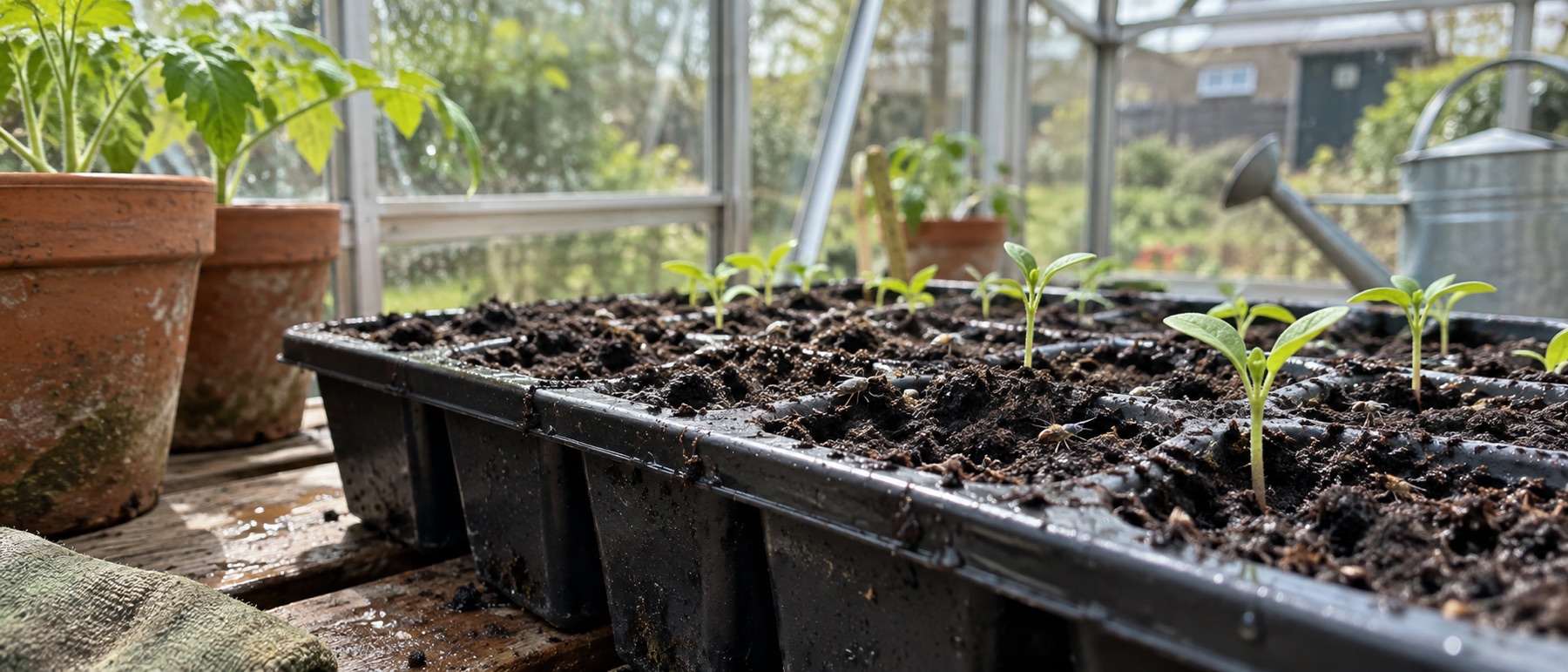
Inspect compost and roots where trays remain damp.
Separate fragile seedlings from an affected batch.
Improve drainage and avoid standing water without drying seedlings to death.
Use sticky cards sparingly for adults; they do not treat larvae.
Identify the fly and its source
Fungus gnats, also called sciarid flies, are small dark insects frequently seen around moist seed trays and potting compost. The RHS fungus-gnat guide explains that many fungus-gnat species feed on decaying matter and are harmless. Some larvae in persistently damp compost can damage vulnerable seedlings and soft cuttings. An adult fly on a greenhouse window is therefore not enough evidence that a mature tomato has a serious pest problem.
Inspect the growing medium of the affected trays. Are flies rising each time you water? Is compost permanently wet below the surface, drainage blocked or a tray holding water? Look for weak seedlings with root or stem problems, but remember that damping off and poor watering can cause similar decline. Do not infer larvae from every wilted plant.
Correct the conditions without harming seedlings
Remove standing water from saucers and trays, clear decaying plant debris and let the medium approach the moisture level required by the crop before watering again. The aim is not to desiccate a new sowing. A small cell tray can dry quickly near a sunny pane; check below the surface. Improve ventilation where it can be done without chilling tender seedlings and space trays so a damp corner is not hidden behind pots.
Use clean containers and fresh commercial seed compost for the next batch. Keep opened compost closed and away from puddles. If a tray is heavily affected and seedlings are failing, isolating or replacing it may be more practical than repeatedly moving adults around the house. The greenhouse propagation guide explains how to separate the humid germination stage from brighter, better-ventilated growth.
Monitor adults carefully
Yellow sticky cards near a suspect tray can indicate continuing adult activity. The RHS explicitly warns that they can catch non-target invertebrates, including predators. Use only a small number where the information will change what you do, and reconsider them during a biological-control release. A card is not a treatment for larvae in compost and will not correct overwatering. Check it alongside the tray rather than interpreting a count in isolation.
Where seedlings are genuinely at risk, the RHS identifies Steinernema feltiae nematodes, predatory mites and rove beetles as biological options for compost stages. These are living agents with application and storage requirements; read the supplier's current instructions and check they match the target and temperature. See the biological-controls guide before ordering. We do not recommend a pesticide merely because one is sold online; the HSE database and exact label govern any pesticide use.
Keep the response proportional
If established plants are healthy and only a few adults are seen, monitor and improve housekeeping rather than trying to make the greenhouse insect-free. The important distinction is whether young roots and cuttings are being harmed. Return to the root-zone moisture pattern after a week, not just the number of flies visible at the door. If the seedlings continue to collapse with few flies present, revisit disease and watering diagnoses instead of escalating gnat treatments.
Helpful products
Identify and monitor the adults
A hand lens can help distinguish tiny adults on trays and compost. Yellow cards show whether adults remain active, but can also catch beneficial insects and do not reach larvae in compost.

Gardening Naturally yellow sticky greenhouse traps
Best for: early whitefly monitoring
Double-sided yellow hanging cards catch some adult flying insects and provide an early warning that whitefly are present. They do not remove eggs or nymphs and can also catch beneficial insects.
What stands out
- Visible early-warning signal
- Easy to position near susceptible plants
- No pesticide application
Keep in mind
- Not a complete whitefly control
- Can catch parasitoids and other non-target insects
- yellow sticky sheets
- double-sided
- hang near plants
- replace when covered

Carson SG-10 SureGrip hand magnifier
Best for: closer pest identification
A 2× glass hand lens with a small higher-power spot for examining insects on leaves and checking whether apparent specks are living pests. It helps observation, not control.
What stands out
- Makes small insects easier to distinguish
- No batteries or app
- Useful across several pest guides
Keep in mind
- Does not identify every species
- Must be focused close to the subject
- SG-10 model
- 2× main glass lens
- higher-power spot lens
- hand-held soft-grip format
Common questions
Frequently asked questions
Do fungus gnats damage established plants?
Usually not. The RHS says concern is mainly for seedlings and soft cuttings, where some larvae can feed on tender roots or bases.
Are the adults the damaging stage?
Adults are mostly a nuisance. Larvae in compost are the stage to investigate if young plants decline.
Will yellow sticky traps solve the problem?
No. They catch some adults but not larvae and can catch non-target insects; they are best used as a limited monitoring aid.
Should I let seed compost dry completely?
No. Seedlings still need appropriate moisture. Remove persistent saturation and standing water while checking the root zone.
Is there a biological control?
The RHS lists Steinernema feltiae nematodes and certain predatory mites or rove beetles for compost-dwelling stages. Choose by the identified problem and follow supplier conditions.