
Vent maintenance
Greenhouse roof-vent repair
Diagnose a greenhouse roof vent that sticks, leaks or will not close, then identify compatible hinge, stay and opener parts safely.
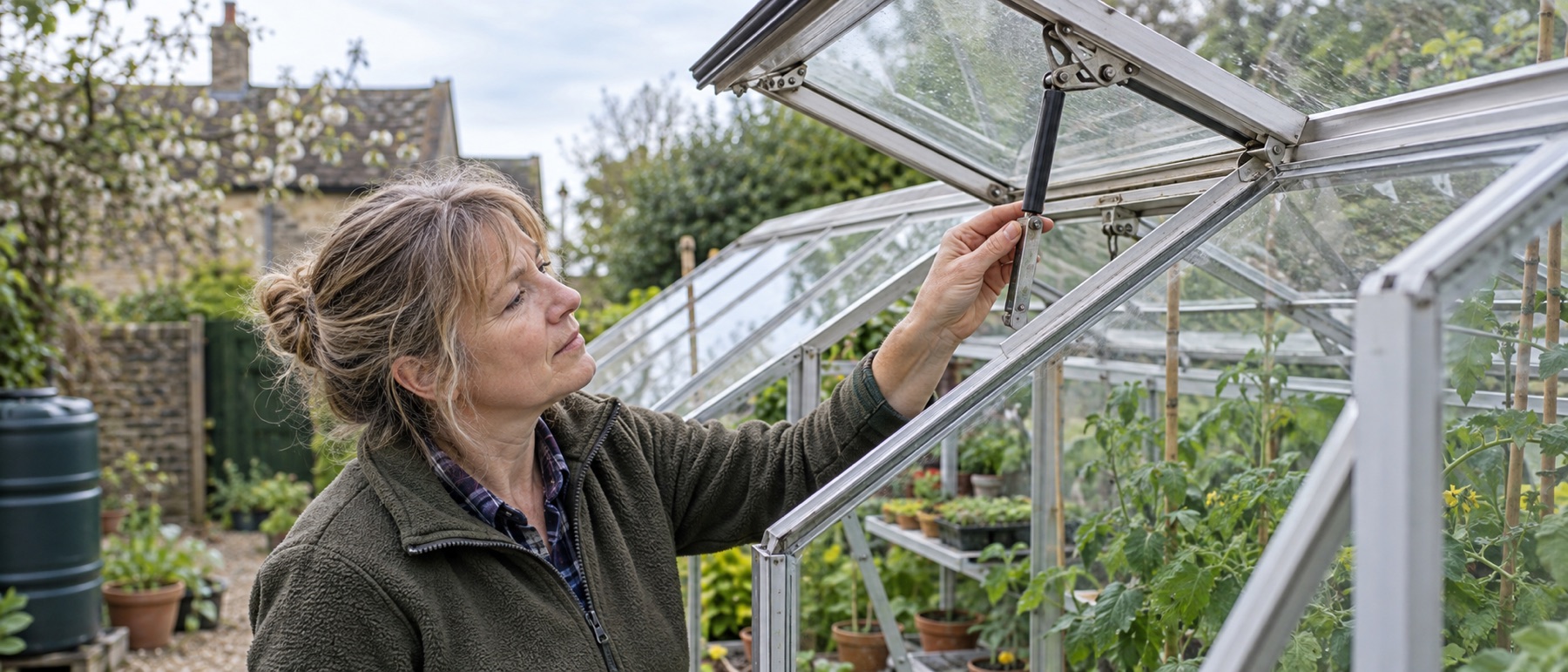
Check the vent's position and obstruction from the ground first.
Record the greenhouse and opener models, bracket pattern and vent weight.
Do not force a jammed vent or loosen a hinge while glazing is unsupported.
Close and secure the vent before forecast high winds if it is safe to do so.
Diagnose before buying a new opener
Observe the vent from a safe position while conditions are calm. Does the entire vent tilt evenly, or does one corner drag? Is the opener connected to the vent stay? Does it move freely with temperature, or is a bracket detached? A Halls Popular assembly manual shows how model-specific the roof-window frame, arm and fixings can be. Do not copy its part positions onto a different greenhouse.
If a vent stopped moving after a storm, inspect the frame, pane and hinge rather than assuming a cylinder failed. A displaced glazing panel can jam the mechanism. Clear plants or shade cloth that obstruct movement, and check the gutter or ridge channel for debris.
Make the area safe
Avoid roof work in wind, rain or icy conditions. Keep children and pets away from the area beneath the vent. Do not climb on staging, place a ladder against glazing or lean over a roof. The RHS greenhouse-cleaning advice specifically warns against body weight on glazing and leaning over the roof. If stable access and support for the vent cannot be arranged, commission a greenhouse installer.
If a vent is stuck open ahead of bad weather, close and secure it only while safe and without forcing glass or frame. Once strong wind begins, stay away. Our storm-preparation checklist separates advance work from post-storm inspection.
Check hinges, stay and frame alignment
With the vent supported as the model manual requires, inspect hinge pins or ridge engagement, the stay, brackets and fixings. Look for corrosion, bent metal, a loose connection or a broken pane. Clean visible grit from accessible moving parts. Do not remove hinge fasteners until the vent and glazing are safely supported.
A vent that closes at one side but gaps at the other may indicate a twisted sash or greenhouse frame. Compare diagonals and adjacent roof bars; investigate the base and anchors if the whole structure has moved. Adding a stronger opener does not solve structural distortion.
Check the automatic opener separately
An automatic opener usually responds to temperature through a cylinder or actuator; it is not a weather sensor. Note the exact opener model, bracket dimensions, opening stroke, mounting side and permitted vent load. Some devices need seasonal adjustment or removal in conditions outside their rated range. Follow that maker's instructions rather than using a generic temperature setting.
The opener shown here is an option only when those specifications match. It cannot repair a seized hinge, broken pane or warped vent. If a replacement cylinder is available for the exact opener, it may be preferable to discarding sound brackets; verify the part number.
Test closing and weather readiness
After a repair, check the vent opens without scraping and seats evenly when closed. Ensure the latch or stay performs as the greenhouse manual specifies. Recheck fixings after several cycles and before forecast wind. A small closing gap can drive rain onto staging and seedlings, while an uncontrolled open vent can be damaged in gusts.
For climate decisions, pair this guide with greenhouse ventilation and louvre vents. A repaired vent is part of airflow, not the only solution to summer overheating.
Helpful products
Compare compatible replacement openers
These are alternative opener examples, not universal roof-vent repairs and not parts to fit together. Confirm bracket spacing, travel, supported load and mounting position against the vent and opener manuals before choosing either.

Gardening Naturally automatic vent opener
Best for: automatic daytime ventilation
A heat-responsive vent opener that works without electricity and begins opening as the greenhouse warms. Confirm its brackets, lifting force and range suit the exact vent before ordering.
What stands out
- Responds while you are away
- No mains supply or battery
- Fits many common roof vents
Keep in mind
- Compatibility must be checked
- Does not replace door and low-level airflow
- heat responsive
- no electricity
- up to 7kg opening force
- adjustable response

Speedwellstar 15kg twin-spring automatic vent opener
Best for: a heavier compatible roof vent
A heat-responsive opener with a twin-spring mechanism and a published 15kg lifting capacity. It is intended for heavier greenhouse windows, but the vent still has to move freely and match the supplied brackets.
What stands out
- Higher published lifting capacity
- Twin springs add stability
- Adjustable temperature response
Keep in mind
- Only for a compatible freely moving vent
- Heavier-duty mechanism is unnecessary for many small vents
- 15kg published capacity
- twin-spring mechanism
- heat responsive
- no electricity
Common questions
Frequently asked questions
Why will my greenhouse roof vent not open?
The cause could be a disconnected or spent automatic opener, a jammed stay, corrosion, debris or a misaligned frame. Inspect the mechanism and manual before replacing the opener.
Why will an automatic vent not close?
Check whether the ambient temperature is still above its closing range, the cylinder or bracket is misadjusted, the frame binds or the vent has been caught by wind. Follow the opener maker's troubleshooting steps.
Can I replace only the opener cylinder?
Sometimes, if the exact opener model has a maker-specified replacement cylinder. Generic cylinders may not match the stroke or threads.
Can I oil the roof-vent hinge?
Only use a lubricant the greenhouse manufacturer permits at the specified points. First clean debris and check for loose or bent parts; oil cannot correct misalignment.
Is roof-vent repair a DIY job?
A reachable minor adjustment may be, but overhead glazing and access create serious risk. If the vent cannot be supported and reached safely, use a competent installer.