
Greenhouse equipment comparison
Best automatic greenhouse vent openers
Compare automatic greenhouse vent openers for standard roof vents, heavier windows and low-level louvres, with compatibility and setup advice.
Our recommendations
Automatic openers for three different vent jobs
These are not interchangeable upgrades. Match the mechanism to the vent type, weight, brackets and required travel.

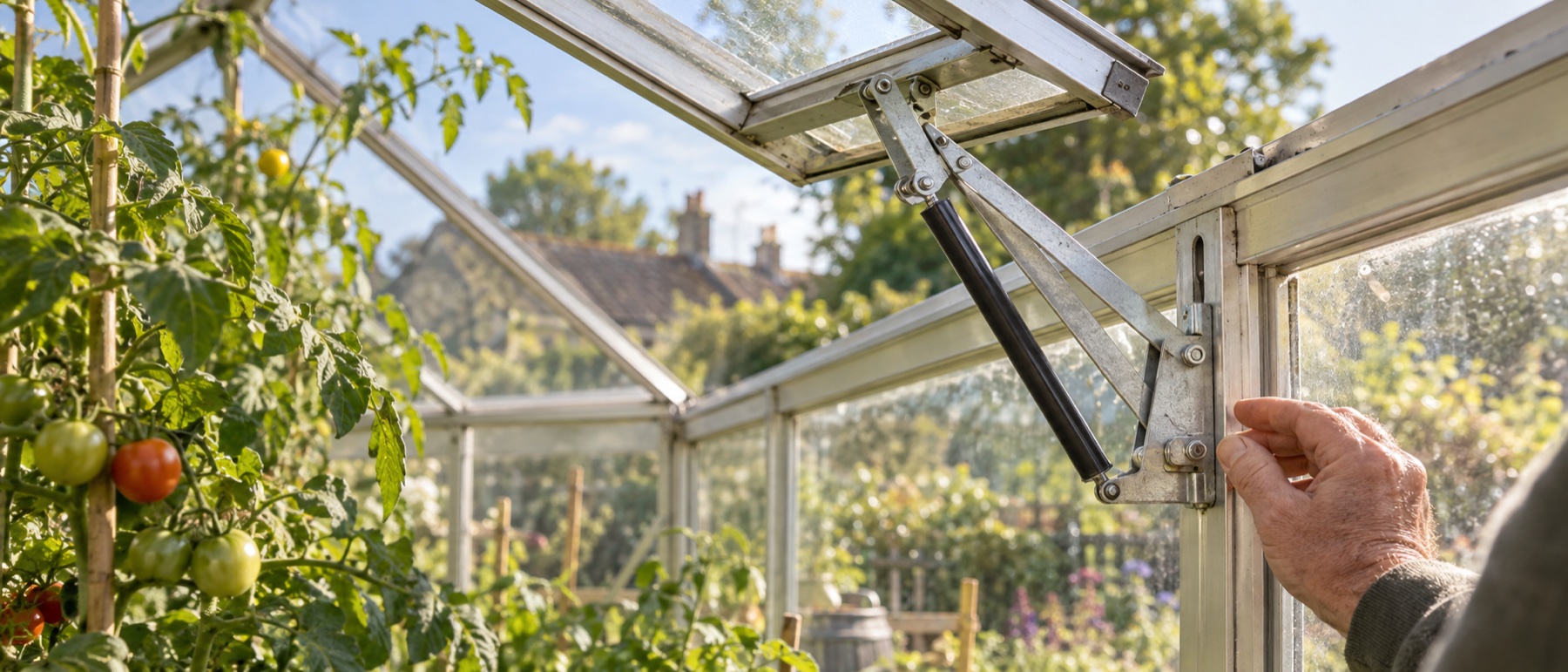
Gardening Naturally automatic vent opener
Best for: automatic daytime ventilation
A heat-responsive vent opener that works without electricity and begins opening as the greenhouse warms. Confirm its brackets, lifting force and range suit the exact vent before ordering.
What stands out
- Responds while you are away
- No mains supply or battery
- Fits many common roof vents
Keep in mind
- Compatibility must be checked
- Does not replace door and low-level airflow
- heat responsive
- no electricity
- up to 7kg opening force
- adjustable response

Speedwellstar 15kg twin-spring automatic vent opener
Best for: a heavier compatible roof vent
A heat-responsive opener with a twin-spring mechanism and a published 15kg lifting capacity. It is intended for heavier greenhouse windows, but the vent still has to move freely and match the supplied brackets.
What stands out
- Higher published lifting capacity
- Twin springs add stability
- Adjustable temperature response
Keep in mind
- Only for a compatible freely moving vent
- Heavier-duty mechanism is unnecessary for many small vents
- 15kg published capacity
- twin-spring mechanism
- heat responsive
- no electricity
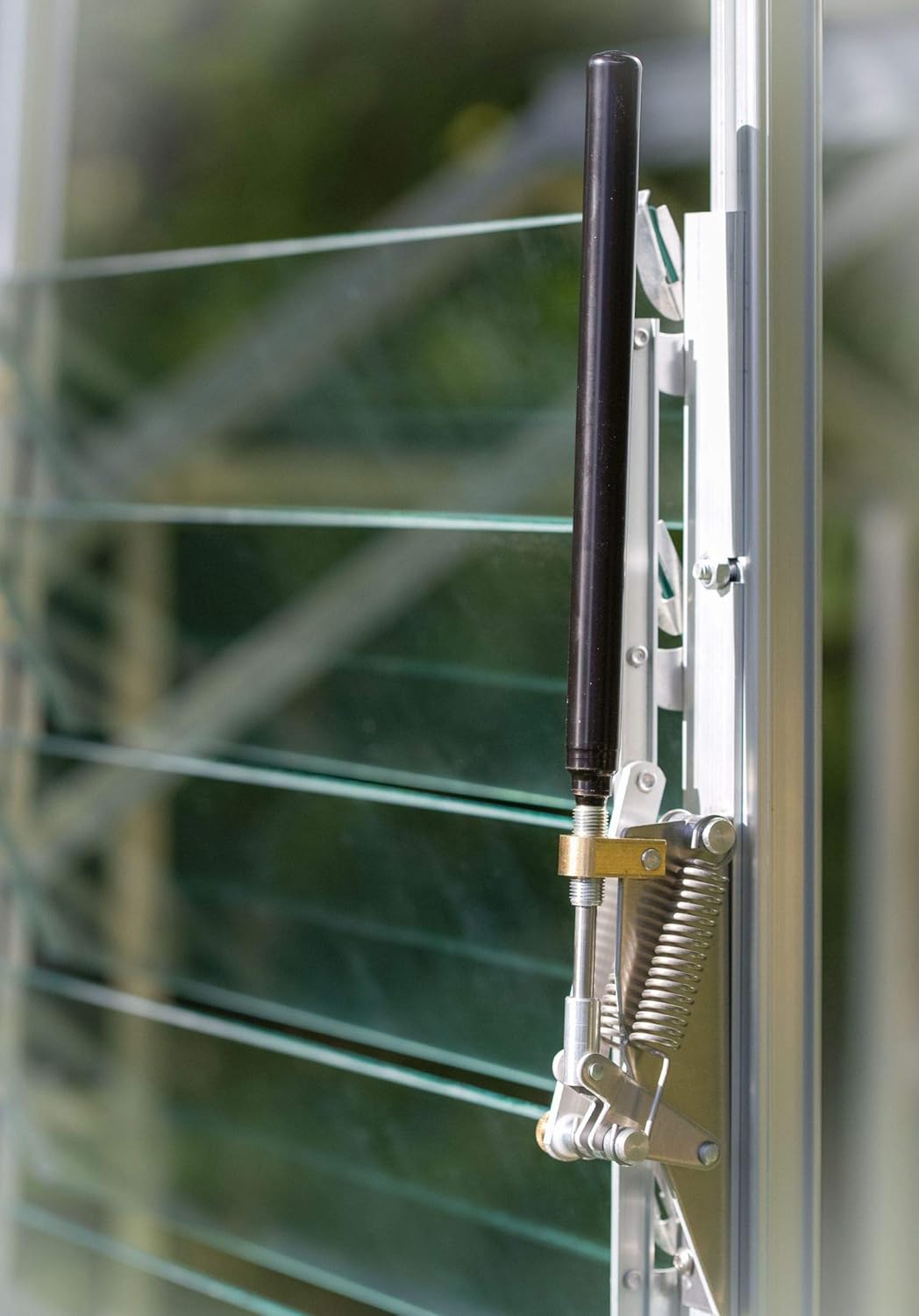
Gardening Naturally automatic louvre vent opener
Best for: automating a compatible louvre
A wax-cylinder opener made for many standard greenhouse louvre vents. It automates low-level air intake rather than lifting a roof window, so it can support a more complete high-and-low ventilation path.
What stands out
- Automates low-level inlet air
- No battery or mains supply
- Made for standard louvre mechanisms
Keep in mind
- Does not operate a roof vent
- Louvre compatibility must be confirmed
- louvre-vent format
- wax cylinder
- 17–25°C stated range
- no electricity
| Recommendation | Vent type | Published capacity or range | Mechanism | Key check |
|---|---|---|---|---|
| Gardening Naturally automatic opener | Roof vent | Up to 7kg opening force | Heat-responsive wax cylinder | Bracket and vent-weight compatibility |
| Speedwellstar twin-spring opener | Heavier roof vent | 15kg published capacity | Heat-responsive twin-spring design | Vent must move freely through required travel |
| Gardening Naturally louvre opener | Low-level louvre | 17–25°C stated response range | Heat-responsive wax cylinder | Louvre linkage and blade clearance |
How we chose these openers
We compared current UK listing information by the job each mechanism performs: a standard roof vent, a heavier roof vent and a louvre. We prioritised a stated lifting figure or operating range, no-electricity operation and a clearly defined vent format. We did not rank by customer star ratings or assume that higher lift capacity is automatically better.
An opener cannot compensate for an undersized ventilation system. It automates one opening; the greenhouse still needs enough high-level outlet area and a route for replacement air.
Best for a standard roof vent: Gardening Naturally automatic opener
This wax-cylinder opener has a published opening force of up to 7kg and begins responding as the greenhouse warms. It is the most straightforward fit in this comparison for a common lightweight roof window, provided the brackets suit the frame.
Its advantage is restraint: a standard vent does not benefit from an oversized mechanism that loads the hinges and frame unnecessarily. Confirm the vent opens freely by hand, weigh or identify it as required by the instructions, and check that no glazing clip or shade blind blocks the linkage.
The main limitation is shared by all wax openers: response is gradual. The RHS warns that wax takes time to expand, so use doors and low-level vents as alternative airflow rather than relying on one roof window.
Best for a heavier roof vent: Speedwellstar 15kg twin-spring opener
The Speedwellstar uses a twin-spring layout and states a 15kg lifting capacity. That makes it the more relevant candidate for a genuinely heavier compatible window, not the default upgrade for every greenhouse.
Before choosing it, verify the moving sash rather than the complete frame, check the available 45cm travel described by the listing and make sure the hinge line is free of distortion. A heavy vent that sticks will impose erratic loads on any opener.
The twin-spring structure takes more physical space than a light single-spring model. Measure clearances at the closed and fully open positions, particularly below low roof bars or internal blinds.
Best for a louvre: Gardening Naturally automatic louvre opener
This product is designed to move the linkage of a standard greenhouse louvre. Its listing gives a stated opening range of 17–25°C and a wax-cylinder mechanism. Used with high roof vents, an automated louvre can provide the low-level inlet that completes natural stack ventilation.
It is not a roof-window opener. Check the louvre spindle or linkage, blade movement, bracket position and the space needed behind the blades. Clean accumulated algae and grit before fitting so the new cylinder is not used to overcome neglected friction.
Compatibility checklist before buying
Identify the greenhouse and vent model if possible. Then record:
- whether it is a roof window or louvre;
- the weight and centre of gravity of the moving section;
- bracket material and hole pattern;
- fully closed and fully open positions;
- the required travel and opening angle;
- interference from gutters, shade, insulation or plants;
- manufacturer restrictions on drilling the frame.
If the greenhouse maker sells a dedicated opener, compare that first. A universal product may need approved clamps or brackets; “fits most” is not the same as confirmed compatibility.
Installation and adjustment
Work from a safe platform with the vent supported. Fit the frame and vent brackets in the exact positions shown in the instructions, then attach the cylinder and test the movement without forcing it. The window should close evenly against its seals and open without the linkage touching glass or polycarbonate.
Adjust temperature response in small increments. Allow a full warm-and-cool cycle before judging the change because greenhouse temperature and cylinder temperature do not move instantly together. Keep a max/min thermometer at plant height to see the result.
Maintenance and winter storage
Inspect pivots, springs, brackets and fasteners every few weeks during the main season. Remove debris from the vent channel and lubricate only where the manufacturer permits; oils can attract dirt or damage some seals.
Follow the manual for frost and winter shutdown. Secure vents before high winds and do not use the opener as the latch. Replacement wax cylinders can extend the life of a sound mechanism, but a bent arm or distorted bracket requires proper replacement.
What an opener cannot do
It cannot open the greenhouse door, compensate for too little roof-vent area, guarantee a chosen air temperature or respond instantly to a sudden sunny spell. It also cannot close a vent securely against a storm unless the product and greenhouse are designed for that load.
Use our greenhouse ventilation guide to plan the whole high-and-low airflow path, and the greenhouse shading guide when ventilation is working but solar gain remains excessive.
Source basis
Product details above come from the current Amazon UK listings linked in each card. The operating context follows the RHS greenhouse ventilation and shading guide, which explains the delay in wax-cylinder response and the need for alternative ventilation.
Common questions
Frequently asked questions
What is the best automatic greenhouse vent opener?
The best opener is the one approved or mechanically compatible with the exact vent. For many standard lightweight roof vents, a 7kg unit is sufficient; heavier windows may require a higher-capacity twin-spring model, while louvres need a different mechanism.
Do automatic vent openers need electricity?
These three use wax-cylinder expansion and need no mains supply, battery or solar panel. Sun warms the greenhouse air, which warms the cylinder and moves the linkage.
At what temperature should an automatic vent open?
Set it for the crops and season, then verify the real result with a shaded max/min thermometer. Published ranges describe the mechanism, but vent size, sun, airflow and cylinder position affect the greenhouse temperature.
Can an automatic opener be fitted to any greenhouse?
No. The frame and vent need suitable fixing points, clearance, travel and weight. Some branded greenhouses require model-specific brackets or openers, and drilling the frame may invalidate instructions or damage glazing channels.
Should an automatic opener be removed in winter?
Follow its manual. Some cylinders should be disconnected or stored away from freezing conditions, and a vent may need to be secured shut for severe weather. Never force the mechanism closed while it is warm.