
Compact greenhouse guide
6 × 4 greenhouse guide
Decide whether a 6 × 4 greenhouse is right for your garden, with real dimensions, layout ideas, base requirements and polycarbonate versus toughened-glass options.
Our recommendations
Two 6 × 4 greenhouse approaches
Compare a lighter polycarbonate structure with an included perimeter base against a traditional toughened-glass model with an optional matching base.
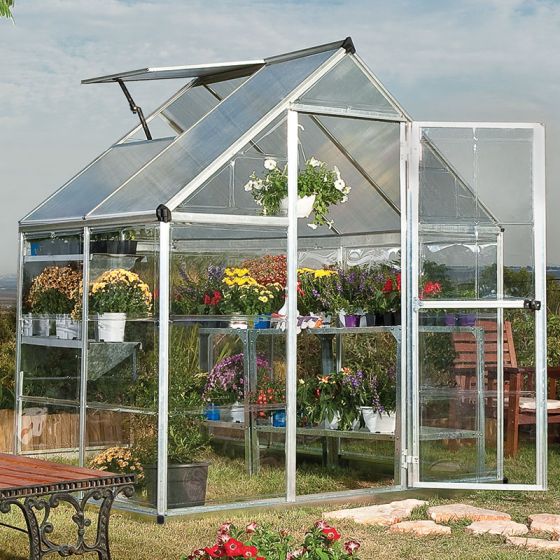
Palram Canopia Hybrid 6 × 4 greenhouse
Best for: a compact first walk-in greenhouse
A compact walk-in with a 1.85 × 1.25m base, diffusing twin-wall roof panels and clear polycarbonate sides. It is the most balanced fit here for a small garden that can still keep a central path.
What stands out
- Compact walk-in footprint
- Clear sides and diffusing roof
- Steel perimeter base included
Keep in mind
- Single 565mm door
- One roof vent means summer airflow needs planning
- 1.85 × 1.25m base
- aluminium
- polycarbonate
- one roof vent
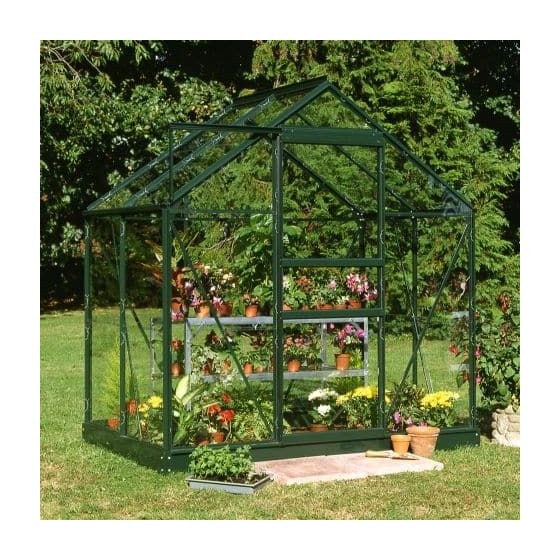
Halls Green Frame 6 × 4 greenhouse
Best for: toughened glass in a compact plot
A traditional-looking 6 × 4 with a green aluminium frame and large panes of toughened glass. It is the clearest fit if you want glass in a small footprint and accept a separate base.
What stands out
- Large-paned toughened glass
- Low-maintenance coated aluminium
- Roof vent and gutters included
Keep in mind
- Matching base costs extra
- Heavy panes need careful assembly
- 1.93 × 1.33m base
- green aluminium
- toughened glass
- optional base
| Model | Base size | Glazing | Door | Vent and base |
|---|---|---|---|---|
| Palram Hybrid 6 × 4 | 1.85 × 1.25m | Twin-wall roof; clear polycarbonate sides | 565mm single door | One roof vent; perimeter base included |
| Halls Green Frame 6 × 4 | 1.93 × 1.33m | Large-paned toughened glass | 600mm sliding door | One roof vent; matching base optional |
Is 6 × 4 big enough?
A 6 × 4 is one of the smallest common freestanding walk-in formats. It can provide a proper aisle, staging and protected height without taking over a small garden. It is big enough for a focused growing plan, but not for every crop and storage idea at once.
Think of it as a one-person workspace. The aisle has to remain clear while plants spread, and the door must accept trays, bags and pots. If you want broad staging on both sides, several full-height tomatoes and winter storage, a 6 × 8 will usually be more forgiving.
Nominal size versus real size
“6 × 4” is a category, not a foundation drawing. The Palram example has a published base of 1.85 × 1.25m, while the Halls example is 1.93 × 1.33m. Overall dimensions and roof overhangs can add more.
Mark the exact model on the ground. Add an approach to the door, an exterior cleaning strip and enough room to build the frame. Check gate widths and turns on the delivery route, particularly when the chosen glazing includes large panes.
Plan a workable interior
Begin with a central path wide enough for your boots and a watering can. A path that appears generous in an empty frame narrows when tomato leaves and trays project into it.
Three layouts are common:
- Staging on one side, floor crops on the other. This is the most adaptable plan for seed trays plus tomatoes, cucumbers or peppers.
- Narrow staging on both sides. This maximises shelf area for propagation but can restrict the aisle and tall plants.
- One full-length bed and a slim service shelf. This suits soil growing but requires careful water and crop rotation planning.
Use removable or folding shelves where possible. The space can support trays in spring and taller plants later without dismantling the entire interior.
Palram Hybrid 6 × 4: lightweight glazing and included perimeter base
This model combines an aluminium frame with a twin-wall polycarbonate roof and clear polycarbonate side panels. The roof diffuses overhead light, while the side panels keep a clear view of the crops. Its galvanised steel perimeter base is included.
The 565mm door is the tighter opening in this comparison, so check the largest pot or equipment you expect to move. One roof vent is included. Plan door use, shading and any compatible ventilation upgrade before the greenhouse is full.
Halls Green Frame 6 × 4: toughened glass and a wider sliding door
The Halls uses large-paned toughened glass and a green powder-coated aluminium frame. A 600mm sliding door saves the swing space required by a hinged design, and the roof vent plus integral gutters cover the basics.
Its matching base is optional. Include that cost and the required foundation in the project comparison. Large panes reward careful, square assembly and an uncluttered handling area.
Glass or polycarbonate in this size?
Polycarbonate is lighter and less vulnerable to shattering. Twin-wall roof panels diffuse light and can soften direct overhead sun. Clear polycarbonate sides retain visibility but can mark differently from glass over time.
Toughened glass gives a traditional clear finish and is straightforward to clean with suitable methods. It is heavier, so delivery, handling and an accurately assembled frame matter. The choice is less about a universal winner and more about the site, appearance, maintenance and build route.
Base and anchoring
Both greenhouses need a firm, level foundation. An included perimeter base defines the frame edge but does not replace ground preparation or anchors. An optional base must be selected before final dimensions and foundation heights are set.
Paving can create a clean interior, while a perimeter support can leave soil beds. Whatever you choose, maintain drainage and prevent the base from twisting. Read the exact installation manual before laying concrete, slabs or timber.
Ventilation and water
A small greenhouse can heat rapidly because it has limited air volume. Keep the roof vent unobstructed and make the door easy to use. An automatic opener may help if it is compatible with the vent, but low-level replacement air and daily observation remain important.
Integrated gutters can supply a small water butt if the outlet and capacity are suitable. Position water storage without blocking exterior access or placing excessive load on an unsupported surface.
When to choose 6 × 8 instead
Step up when the extra base length fits without losing the maintenance route, the budget covers the larger foundation and you expect mixed crops throughout the year. Stay with 6 × 4 when compactness protects the rest of the garden and your crop plan can remain disciplined.
Compare the larger format in our 6 × 8 greenhouse guide or return to what size greenhouse do I need? for the full measurement method.
For a Halls model, obtain the matching drawing from the manufacturer's assembly-instruction library. Do not transfer a base or glazing measurement from another 6 × 4: the nominal size is a category, not a universal component specification.
Common questions
Frequently asked questions
What can I grow in a 6 × 4 greenhouse?
It can support seedlings, herbs, salads, chillies and a small number of tall crops such as tomatoes or cucumbers. Capacity depends on staging depth and whether you reserve floor space for mature plants.
What are the actual dimensions of a 6 × 4 greenhouse?
They vary by model. The examples here have published base sizes of 1.85 × 1.25m and 1.93 × 1.33m. Always use the exact technical drawing for foundations and boundary checks.
Can a 6 × 4 greenhouse fit staging on both sides?
Narrow staging may fit on both sides, but it can create a tight aisle once plants overhang the shelves. Staging on one side with floor crops on the other is often more flexible.
Does a 6 × 4 greenhouse need extra ventilation?
One roof vent may not control every sunny day. Door opening, site exposure, crop density and compatible extra vents or automatic openers all affect summer temperature.
Is a 6 × 4 or 6 × 8 greenhouse better?
Choose 6 × 4 when garden area and foundation cost are the main limits. Choose 6 × 8 when the extra length fits comfortably and you want a more flexible interior for staging plus tall crops.