
Severe-weather preparation
Greenhouse storm-preparation checklist
Prepare a greenhouse for strong winds by checking warnings, closing openings, removing loose objects, inspecting glazing and planning a safe post-storm check.
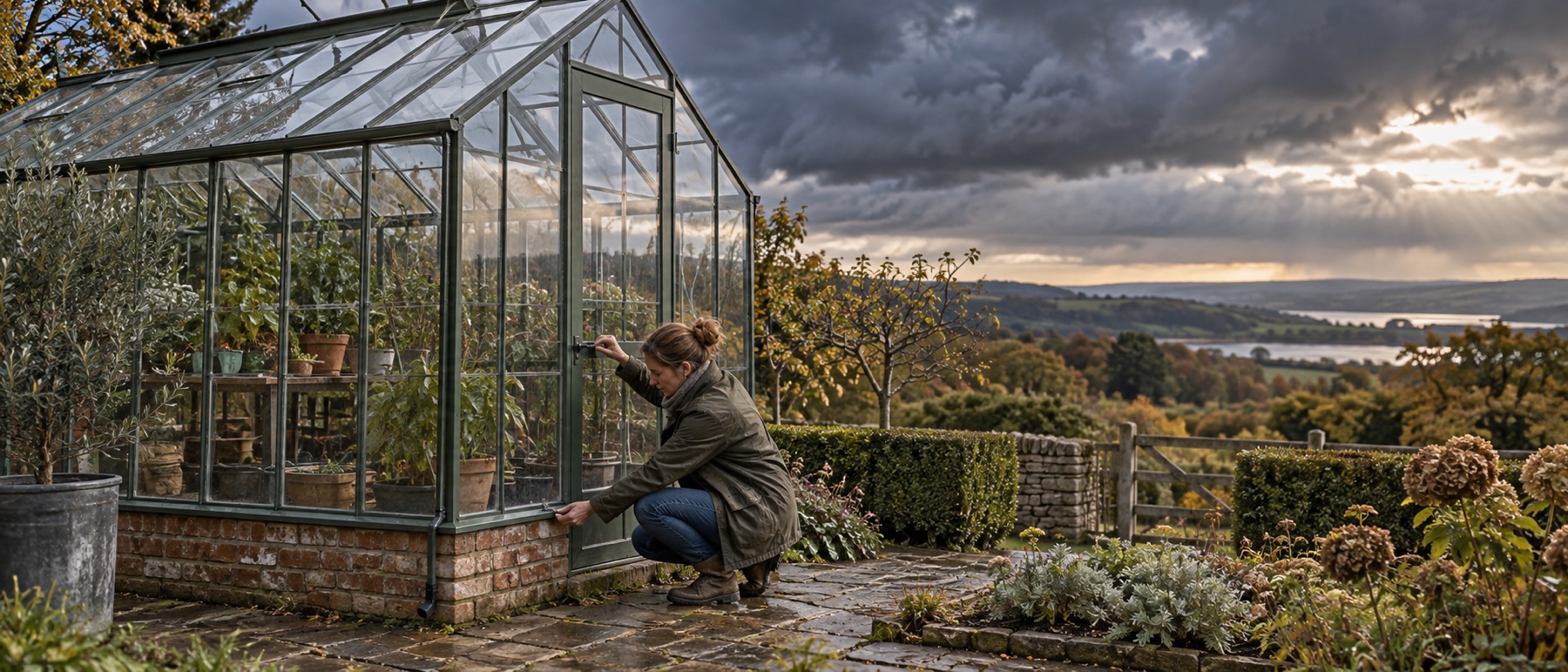
Start with doors, vents and missing panes because wind entering the structure raises internal pressure.
Move pots, tools, furniture and unsecured water equipment away from the greenhouse.
Use only manufacturer-approved anchors, braces and storm accessories.
Photograph the structure and keep people clear during and immediately after the storm.
Watch the local warning, not a national headline
Use the Met Office warnings service for your location and timing. Wind exposure varies sharply between sheltered urban gardens, coastal plots and elevated sites. Begin preparation while it is still safe and calm; the warning period is not a deadline for working outdoors.
Follow local emergency and travel advice. Greenhouse protection is secondary to personal safety, homes and vulnerable people.
48 to 24 hours before: inspect the envelope
Walk around the greenhouse from ground level. Look for slipped panes, absent clips, loose cappings, open edge tape, damaged door rollers, failed latches and vents that do not close squarely. Photograph anything uncertain and compare it with the manual.
Replace a fixing only if its type and position are confirmed. Similar W clips, Z overlap clips, bolts and gaskets are not universal. Do not overpack a pane with extra clips; concentrated contact or a distorted frame can damage glazing.
Check the base and anchors
Inspect visible base fixings for looseness, corrosion, settlement and rot. A greenhouse base must transfer wind loads into a suitable foundation. Tightening one accessible bolt cannot compensate for a moving slab, decayed timber or inadequate original anchoring.
Use only manufacturer-approved anchoring or storm-bracing methods. Never drill extra holes in light aluminium sections or loop straps over glass. If the structure has moved or is not anchored as instructed, contact the manufacturer or a competent installer before the storm.
Close every opening
Shut and positively latch doors, roof vents and louvres. Check both ends of sliding doors and make sure debris does not prevent full closure. Follow the automatic-opener instructions: some cylinders or arms need seasonal removal or a securing procedure, but improvised restraint can bend the mechanism.
An open or missing panel can admit wind, increasing pressure on the roof and leeward walls. If glazing cannot be restored safely before conditions worsen, keep away and seek professional advice; do not stand outside holding a temporary board in gusts.
Remove loose external objects
Move chairs, empty pots, bins, watering cans, spare panes, tools and decorative objects into secure storage. Lower or remove hanging baskets near the greenhouse. Tie back garden plants only with methods that will not transfer load to the greenhouse.
Secure water-butt lids and disconnect loose hoses. Check that a full butt stands on a sound level base, but do not move a heavy full container at the last minute. Clear gutters and drains so intense rain does not saturate the base.
Tidy the inside
Move heavy pots from high shelves to the floor without blocking the exit. Secure lightweight staging if the manufacturer provides a method, or dismantle it and store it. Remove sharp tools and hanging items that could strike glazing.
Do not stack objects against panels as internal bracing. Preserve a clear path to the door, then leave the greenhouse closed. There is rarely a good reason to enter during the storm.
Deal with shade and insulation
Retract blinds and remove shade cloth if this can be done safely and the product is not designed to remain fitted. A loose sheet can pull on bars or tear into surrounding property. Large-bubble insulation inside the frame should be clipped as designed and kept clear of vents and heaters.
Never climb on the greenhouse or use a ladder in rising wind to retrieve a cover. If preparation time has passed, keep away.
Record the pre-storm condition
Take dated photographs of all sides, the base, doors and existing defects from safe ground. Save the greenhouse model, receipt, installer details and insurance policy together. Documentation helps distinguish new damage and identify correct parts.
Do not describe the greenhouse as storm-proof. Even a well-anchored structure has a design limit, and debris from elsewhere can cause damage.
During the storm
Stay indoors and keep people and pets away from the greenhouse. Do not enter to close a vent, catch a panel or retrieve a tool. Do not touch a metal frame if electrical infrastructure or a fallen cable may be involved.
Report emergencies through the appropriate service. A rattling pane is not worth exposure to flying glass and debris.
The first inspection afterwards
Wait for official warnings and local conditions to ease. View the greenhouse from a distance and approach from the upwind side only if it is clearly safe. Look for hanging glass, bowed panels, a shifted frame, damaged trees and overhead hazards.
If glazing is broken, isolate the area. Wear cut-resistant gloves, safety glasses and sturdy footwear for ground-level clearing only. Use a competent specialist for roof glazing, multiple failures, large panes or structural distortion.
Repair the cause, not only the pane
Ask why the failure occurred. Was the door unsecured, a clip missing, the base moving, a branch impact involved or the frame already racked? Correcting only the visible pane leaves the next weak point unchanged.
Order components by manufacturer and model. Check neighbouring bays because a wind event can loosen retention without breaking the sheet immediately.
Sources and related guides
The Met Office warnings service provides location-based warnings for wind and other severe weather. The HSE window-cleaning guidance notes that adverse weather must be considered for access work. Continue with our maintenance checklist and glass-replacement guide once conditions are safe.
Helpful products
Supplies for calm-weather inspection and repair
A mixed clip-and-bolt pack can replenish verified fittings; grip gloves can help when handling sharp edges. Neither makes it safe to repair a greenhouse during high winds, and unfamiliar clips must not be improvised as storm reinforcement.

Homgaty 240-piece greenhouse repair kit
Best for: compatible clips, bolts and nuts
A mixed pack of W clips, Z overlap clips, aluminium bolts and nuts. It is a useful spares box only for frames and glazing systems that use these exact types and sizes.
What stands out
- Covers several common repair consumables
- Compact spares-box format
- Enough duplicates for routine replacement
Keep in mind
- Not universal
- Incorrect clips or bolts can leave glazing insecure or damage a frame
- 240 pieces
- 60 W clips
- 60 Z overlap clips
- 60 bolts and 60 nuts

NoCry CutGuard+ grip-dot cut-resistant gloves
Best for: hand protection around sharp edges
Flexible cut-resistant gloves with grip dots. They add a layer of hand protection for compatible small-pane and metal-fixing work but are not puncture-proof and cannot make unsupported glass safe to handle.
What stands out
- Grip when handling small parts
- Adds protection against incidental sharp contact
- Reusable for compatible jobs
Keep in mind
- Cannot prevent all cuts or punctures
- Fit and task suitability must be checked
- grip-dot palms
- cut-resistant fabric
- selected Amazon size L
- not puncture-resistant
Common questions
Frequently asked questions
Should greenhouse vents be open or closed in high winds?
Close and securely latch doors and vents before strong winds arrive unless the greenhouse manufacturer gives a specific alternative instruction. An opening can admit wind and increase pressure inside the structure.
Can I tie a greenhouse down with rope?
Do not loop ropes over glazing or attach them to unverified frame members. Use the greenhouse manufacturer's approved anchoring or storm-bracing system, installed in calm conditions into a suitable base.
Should I remove polycarbonate panels before a storm?
Normally panels should be correctly retained as designed. Removing them can be hazardous and may weaken the structure. Follow the manufacturer if a demountable product has a specific storm procedure.
Is it safe to repair a greenhouse during strong wind?
No. Glass, panels, tools and ladders become dangerous in gusts. Keep away, prevent access by others and wait for calm daylight before inspecting from a safe distance.
What should I do if a greenhouse pane breaks in a storm?
Stay away while conditions are dangerous. After the storm, isolate the area, wear appropriate protection, photograph the damage and use a competent professional for roof panes, widespread breakage or a distorted frame.