
Greenhouse watering guide
Greenhouse drip-irrigation guide
Design greenhouse drip irrigation by zones, then select a water source, filter, regulator, timer, tubing and emitters and test real output.
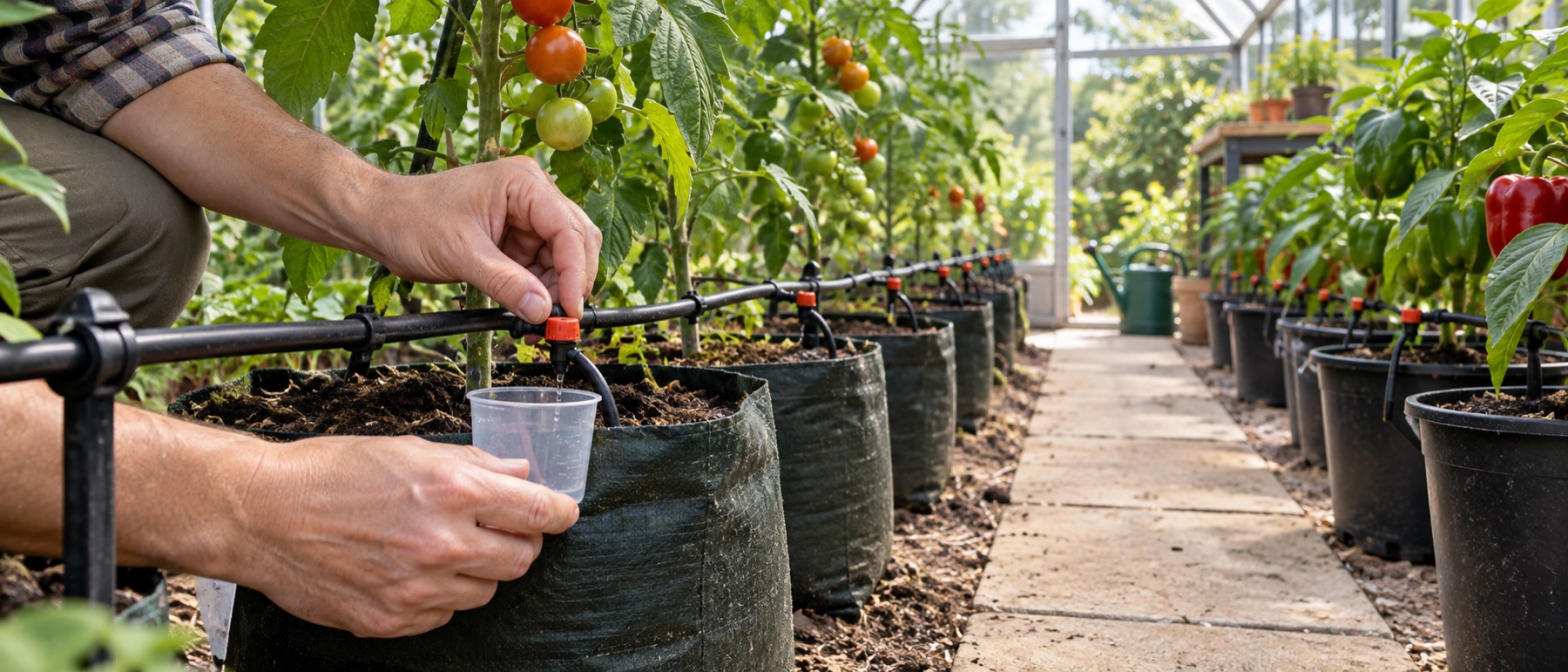
Separate seedlings, mature containers, growbags and soil beds into practical watering zones.
Check whether the selected system needs mains pressure, a gravity head or a pump.
Fit filtration and pressure control specified for the emitter system.
Use a catch-cup test at the start, middle and end of every zone.
Design the crop zones first
Drip irrigation becomes difficult when every plant is connected to one line regardless of demand. Divide the greenhouse into groups: propagation trays, small pots, mature fruiting containers, growbags and soil beds. Each group should tolerate the same watering frequency and broadly similar application.
Draw the layout at mature plant size. A clear tube route in April can become inaccessible behind tomatoes in July. Include the water source, controller, filter, regulator, isolation valves and line-end flush points.
Choose the water source
Mains tap
A mains tap offers stable pressure and suits many packaged kits. Fit the backflow protection, pressure control and connectors required for the intended irrigation use. Water Regs UK notes that risk depends on system design, setting and chemical additives, and the local water undertaker decides whether category 5 protection is required.
Never submerge an open hose in a fertiliser tank or reservoir connected to drinking water. A tap timer or trigger valve is not automatically a backflow-prevention device.
Rainwater butt
Collected rainwater is useful for greenhouse plants, but debris, algae and low pressure have to be managed. Use a covered butt, accessible filter and a drip system explicitly rated for the available gravity head. Raising a full butt introduces substantial weight, so use a stable purpose-made stand on a sound base.
If a pump is required, choose one compatible with the water, desired flow and duty cycle. Electrical installation near water needs professional planning, RCD protection and equipment suitable for the environment.
Independent reservoir
A covered reservoir with a small pump can supply a greenhouse without a nearby tap. Calculate daily demand from measured output rather than the pump’s maximum headline flow. Include a low-water cut-out or other protection if the pump must not run dry.
Filter before the small passages
Drippers rely on narrow flow paths. Fit the filter specified by the system before the distribution tube, where it can be isolated and cleaned without emptying every line. A clear housing is helpful only if it is protected from light that encourages algae.
Flush the mainline before attaching emitters, then flush each branch. Repeat after repairs, at the start of the season and whenever end-of-line output falls.
Regulate pressure
Tap pressure can exceed what small push-fit connectors and emitters tolerate. A compatible regulator protects fittings and helps outlets deliver more evenly. Place it in the sequence specified by the kit—often after the tap controller and filter—and respect flow direction.
Low pressure creates a different problem: the first emitters work while the last barely drip. Shorten the run, reduce the number of outlets, create separate zones or use pressure-compensating emitters within their stated range. Do not solve it by opening adjustable heads until the first pots flood.
Route the mainline safely
Run the larger supply tube along the staging or greenhouse perimeter and branch to plants with short micro tubes. Secure it with clips that do not crush the bore. Avoid tight bends, hot metal edges, door runners and the central path.
Where a line crosses a threshold, reroute it overhead only if properly supported and away from heads, vents and heaters; otherwise protect it in a suitable conduit. A trip hazard is a poor trade for a short route.
Select emitters for the growing medium
Adjustable drippers suit mixed pots but require balancing. Fixed-flow drippers are easier to compare. In-line drip pipe suits uniform rows, while individual stakes make container positions obvious.
Watch the wetted area during a full cycle. Peat-free and bark-rich composts can shrink from pot sides or wet unevenly. Move the emitter, split the flow between two points or slow the application so water infiltrates rather than escaping down one channel.
Seed trays often need a separate fine-control method. A dripper in one cell does not irrigate a whole module evenly, and overhead misting can raise disease pressure. Capillary matting or hand watering may remain better for propagation.
Add a timer only after the hydraulics work
First prove that water reaches every outlet at acceptable flow. Then add a timer compatible with the source pressure and desired frequency. Programme a conservative cycle and observe at least a week of normal weather.
Greenhouse demand changes quickly. Lengthen or add cycles as plant canopy and fruit load grow; reduce them during dull weather. Separate zones are better than forcing one duration to suit every crop.
Run a catch-cup test
Place identical measuring cups under at least one emitter near the start, one in the middle and one at the end. Run the system for ten or fifteen minutes and compare collected volumes. Repeat for every emitter if the system is small.
Calculate output per hour from the measured interval, then translate the schedule into approximate volume per plant. Record the result near the controller. Repeat after changing the layout, cleaning the filter or adding emitters.
Inspect soil moisture, not just surface colour
Push a finger or suitable probe into the root zone and check container weight. The surface can look wet while the lower root ball remains dry, or dry while a saucer stays saturated. Lift a representative pot after a cycle and examine drainage.
Place emitters securely so they cannot spray the stem, aisle or electrical equipment. In growbags, spread outlets across the bag rather than creating one permanently wet pocket.
Maintenance routine
Weekly, inspect each outlet while running, clean the filter and look for green algae, white mineral deposits, rodent damage and connections under tension. Monthly, compare catch-cup volumes and flush line ends.
At the end of the season, drain exposed tubing and store the tap controller or pump as directed. Label zones before dismantling. Replace hardened micro tube rather than pushing it back onto a fitting that can no longer seal.
Holiday preparation
Run the final programme for several days before leaving. Confirm reservoir capacity, fit an overflow route that cannot flood the greenhouse, secure emitters and change batteries early. Ask a trusted person to check plants and the water source; a remote alert cannot reconnect a tube.
Sources and related guidance
Water Regs UK guidance on hose union taps explains irrigation backflow risk and the role of the local water undertaker. Compare complete kits in best greenhouse watering systems and plan hot-weather demand alongside greenhouse ventilation.
Helpful products
Drip systems for containers and rows
A complete timed pot kit, a compact adjustable layout and a row-based starter cover three common greenhouse arrangements.
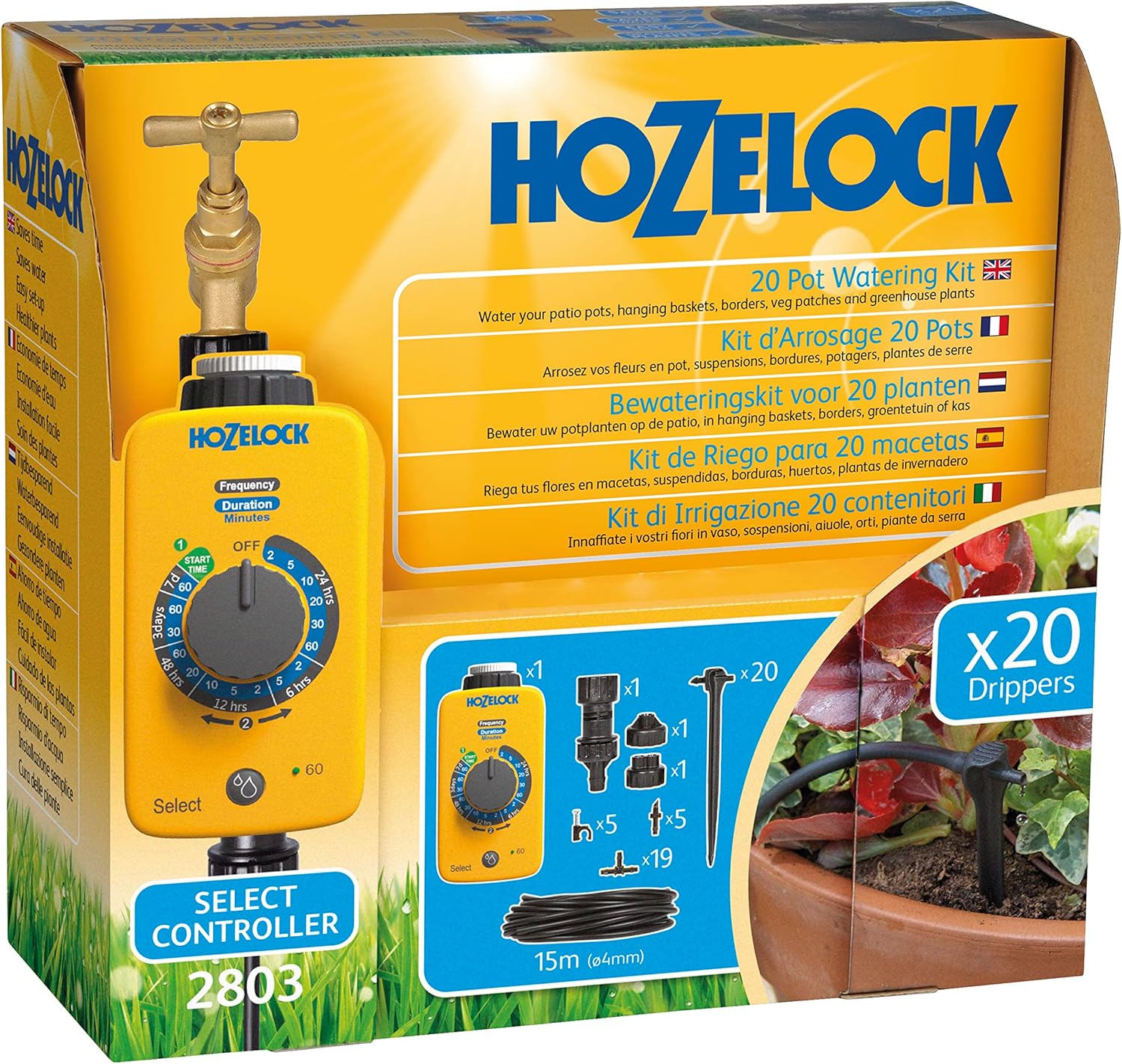
Hozelock 20-pot drip watering kit with Select Controller
Best for: timed watering for up to 20 pots
A complete mains-water drip kit for up to 20 containers, with a tap controller, supply pipe and individual drippers. The controller offers preset schedules while emitters place water close to roots.
What stands out
- Timer and distribution parts included
- Flexible cut-to-fit tubing
- Manual watering function
Keep in mind
- Requires a compatible pressurised tap supply
- Backflow protection and pressure must be checked
- up to 20 containers
- Select Controller
- 16 preset programmes
- root-zone drippers

MIXC 15m drip-irrigation kit
Best for: small pot-watering zones
A compact micro-irrigation kit for distributing water between pots or short greenhouse rows. It is most useful after the crop layout and water source are decided.
What stands out
- Flexible layout around pots
- Compact length limits excess tubing
- Emitters can be checked individually
Keep in mind
- Needs pressure and compatibility checks
- Lines and emitters need flushing
- 15m tubing
- adjustable emitters
- DIY layout
- small greenhouse scale

Gardena Micro-Drip rows-of-plants starter set
Best for: a greenhouse bed or planting row
A starter system designed to drip along short rows of kitchen-garden or ornamental plants. Its stated 1.6 litre-per-hour drip points suit a planned row better than a mixed collection of containers with very different demands.
What stands out
- Purposeful row layout
- Slow root-zone delivery
- Expandable system family
Keep in mind
- Less adaptable for scattered pots
- Supply pressure and filtration still matter
- row-watering starter set
- 1.6L/h stated flow
- Micro-Drip format
- self-cleaning labyrinth design
Common questions
Frequently asked questions
Is drip irrigation good for a greenhouse?
Yes. It can place water at the root zone, keep paths and foliage drier and automate repeatable schedules. It still needs inspection because blocked emitters and split tubes can harm plants quickly under glass.
How many drippers should I put in each greenhouse pot?
Small pots may use one suitable emitter; large containers and growbags often wet more evenly with two or more lower-flow points. Test the wetting pattern through the full root depth rather than counting outlets alone.
What pressure does greenhouse drip irrigation need?
Use the pressure range published for the exact system. Some kits are made for regulated tap pressure, while gravity systems need emitters designed for a low head. Too much pressure causes leaks and uneven spray; too little starves the final outlets.
How do I stop greenhouse drippers blocking?
Filter the source, keep the reservoir covered, flush line ends and clean or replace emitters as directed. Rainwater needs particular attention because sediment and algae can accumulate.
Can I leave greenhouse irrigation running while on holiday?
Test it over several normal cycles first, confirm the source capacity and overflow route, secure every emitter and ask someone to inspect it. Automation reduces labour but does not remove failure risk.