
Storm-damage diagnosis
Why greenhouse panels keep blowing out
Diagnose recurring greenhouse panel blow-outs by checking retention, pane specification, frame alignment, anchoring and storm damage.
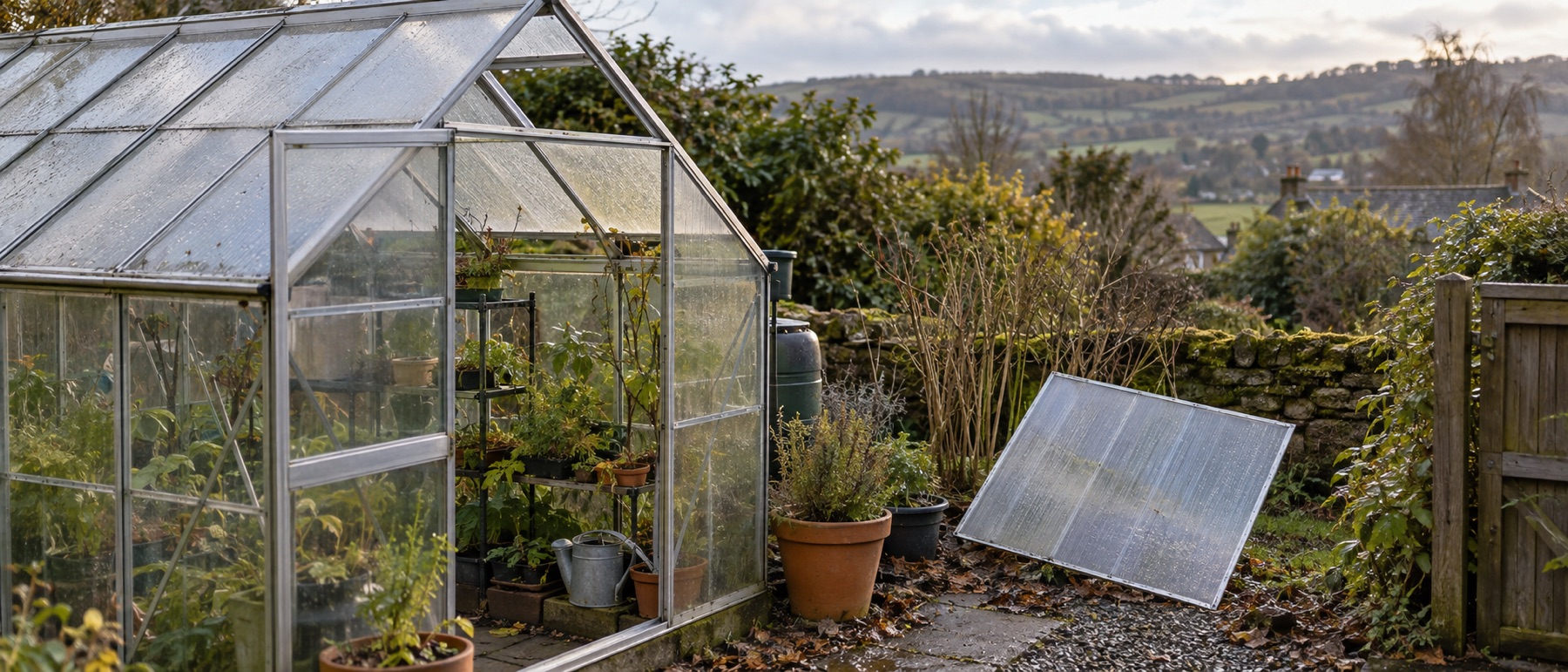
Stay clear during high winds and handle broken glass only when safe.
Record which bay fails, wind direction and condition of its retainers.
Compare pane size, thickness and edge details with the manual.
Check frame square, base fixings and door or vent closure.
Do not approach a greenhouse in strong wind
Wait until the weather is calm before collecting a blown-out panel or inspecting the opening. Broken glass, sharp aluminium and a partly detached roof sheet can fall unexpectedly. Keep children and pets away. Photograph the damage before moving parts, then store salvageable panels flat and sheltered without bending them beyond the maker's guidance. Our storm-preparation checklist explains what to do before and after a warning.
If a panel is overhead, large or surrounded by cracked glass, a competent greenhouse installer or glazier is the safer route. Do not put body weight on glazing or lean over the roof; the RHS cleaning guidance gives the same access warning for routine work.
Record the pattern of failure
Is it always the same side bay, one roof bay or several different panels? Did the door or roof vent open during the storm? Were clips left on the bars, bent on the ground or missing altogether? A single corroded clip suggests a local repair; repeated loss from multiple bays suggests a larger retention or frame problem.
Compare the affected bay with an intact equivalent. Photograph the panel edges, cappings, seals, clips and glazing bars. Look for a gap along one side, a bowed sheet, a lifted cap or a twisted bar. Note whether the pane is glass, solid plastic or twin-wall polycarbonate.
Check the panel specification
Use the greenhouse make and model to find the specified panel dimensions, thickness and glazing system. A replacement that appears to fill the opening may be too short to seat under its caps or too thin for a gasket. Twin-wall sheet also needs the correct UV-face orientation, channel direction and edge treatment. Our replacement-glazing guide provides a full measuring checklist.
The generic 4mm panels shown here are suitable only if the frame actually specifies a matching 4mm sheet and dimensions. Thicker is not automatically safer: it may prevent caps from engaging or eliminate expansion clearance.
Inspect clips, caps and seals
Traditional glass may use spring and overlap clips; other systems use snap-in strips, rubber gaskets or screwed caps. Inspect all the retainer positions the maker specifies, not only the one beside the lost pane. Do not force a generic clip into a proprietary bar. The mixed repair kit below is relevant only when the original W and Z parts match; our clip guide explains their separate jobs.
Perished seals can let a pane rattle, but replacing rubber will not correct a bent bar. The glazing-seal guide helps distinguish a seal fault from misalignment and drainage problems.
Check frame and base as one structure
Measure the frame diagonals and inspect joints, braces and anchors according to the manufacturer's instructions. A greenhouse that is no longer square can spread a glazing channel just enough to lose its grip. Check the base is level, intact and securely tied to the greenhouse. If ground movement or structural failure is suspected, obtain site-specific advice instead of tightening random bolts.
Also test door and vent latches. An opening that blows free in gusts can expose the greenhouse to unusual internal pressure. A stuck roof vent needs its own repair, not a stronger panel.
Repair, then verify in calm conditions
Order the manufacturer's panel and retainers where possible. Fit them in the specified sequence with safe support and access. Check that caps or clips are fully engaged, the pane is not bowed and the door and vents close properly. Inspect again after ordinary wind and rain. If a correctly installed pane moves or the frame flexes visibly, stop treating each lost sheet as an isolated incident and ask a competent installer to assess the whole structure.
Helpful products
Parts only for a verified compatible system
Generic 4mm polycarbonate sheets and mixed clips are examples, not universal repairs. Confirm the exact pane and retention specification before buying either.

The Fellie 4mm twin-wall polycarbonate panels, 14 pack
Best for: compatible cut-to-size twin-wall repairs
Fourteen generic 122 × 61cm twin-wall sheets in a listed 4mm thickness. They are a cut-to-size material option, not a universal replacement panel for every greenhouse.
What stands out
- Multiple sheets for several small bays
- Can be cut only with suitable methods
- Twin-wall format is light to handle
Keep in mind
- Will not fit every frame or bar system
- Edges, orientation and expansion allowance require exact installation guidance
- 14 sheets
- 122 × 61cm each
- 4mm listed thickness
- twin-wall polycarbonate

Homgaty 240-piece greenhouse repair kit
Best for: compatible clips, bolts and nuts
A mixed pack of W clips, Z overlap clips, aluminium bolts and nuts. It is a useful spares box only for frames and glazing systems that use these exact types and sizes.
What stands out
- Covers several common repair consumables
- Compact spares-box format
- Enough duplicates for routine replacement
Keep in mind
- Not universal
- Incorrect clips or bolts can leave glazing insecure or damage a frame
- 240 pieces
- 60 W clips
- 60 Z overlap clips
- 60 bolts and 60 nuts
Common questions
Frequently asked questions
Why does the same greenhouse panel keep coming out?
The pane may be undersized, too thin or retained incorrectly, but a distorted frame or faulty adjacent vent can also create movement. Inspect the whole bay and base before refitting it.
Can I add more clips to stop a pane blowing out?
Only if the maker specifies those clips and positions. Extra or incompatible clips can damage glass edges or fail to engage the glazing bar.
Will thicker polycarbonate solve the problem?
Not necessarily. A thicker sheet may not fit the capping or expansion allowance. Use the greenhouse's specified thickness and complete retention system.
Should I tape a loose panel before a storm?
Tape is not a structural repair. In calm weather, secure the greenhouse using manufacturer-approved parts; once strong winds begin, stay away and repair afterwards.
Does anchoring matter for panel retention?
Yes. A greenhouse frame that racks or shifts on its base can loosen glazing. Inspect anchors and base condition, following the model instructions and site-specific structural advice where necessary.