
Low-level air intake
Greenhouse louvre-vent guide
Understand what a greenhouse louvre vent does, where a low inlet helps, and how to check an automatic louvre opener against the exact frame and vent.
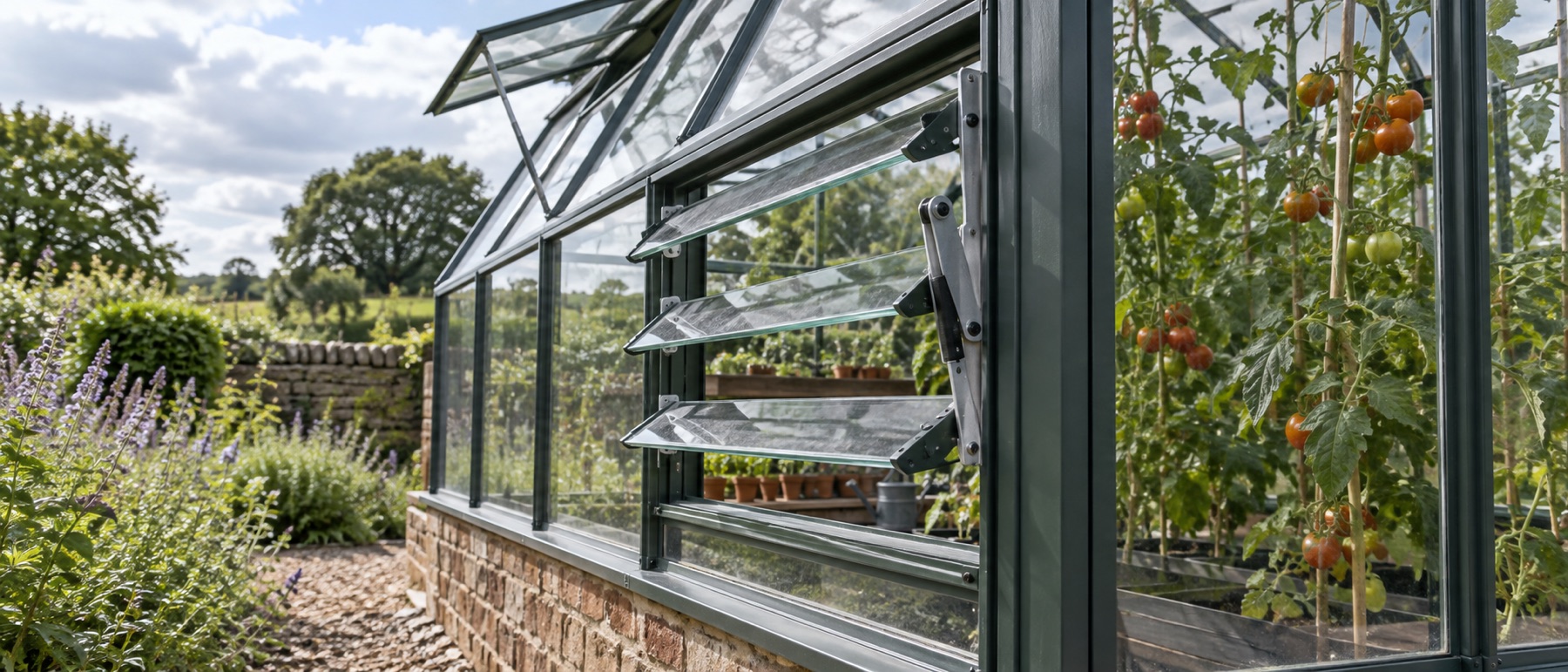
Identify an existing compatible louvre or maker-approved opening.
Pair the low inlet with a functioning roof outlet.
Check blades, seals and insect mesh do not jam the travel.
Use only an opener specified for that louvre mechanism.
What a low louvre actually contributes
Warm air rises inside a greenhouse. A roof vent offers an exit; a low-level louvre offers replacement air. Both are needed for a reliable passive flow path. A door can perform the inlet job, but it may be inconvenient or insecure to leave open. A louvre gives more controlled access to outside air when fitted in an appropriate side bay.
The RHS ventilation guidance discusses roof and side ventilation together. It does not follow that every greenhouse needs the same number of louvres: the effective opening area, structure size, aspect, prevailing wind and crop density all matter. Start by reading the specific kit's ventilation specification and noting how the greenhouse behaves on warm days.
Decide whether a retrofit is possible
First identify the greenhouse make, model and exact glazing bay. A louvre assembly may replace a particular pane in a particular frame; similarly sized panes in different systems can use different retainers. Consult the maker's accessories list or ask them to confirm a specific louvre kit. Do not assume a generic vent fits because its outer dimensions look close.
Check inside clearances as well. Staging, tomato strings, shelves and door swing can interfere with blades or operating arms. Outside, shrubs or fence panels can leave a nominal vent ineffective. Install the vent where air can reach the plants, not behind a solid obstruction. If the greenhouse is already built, protect and handle glazing in accordance with the maker's instructions; specialist help is sensible for uncertain glass or frame changes.
Manual versus automatic opening
A manual louvre can work perfectly when someone regularly adjusts it. An automatic opener is helpful if the vent is often shut at the start of a bright day. Its temperature-responsive mechanism opens progressively and has fitting, travel and lifting limits. Crucially, a louvre opener is not a roof-vent opener. The product shown below should only be considered for a confirmed compatible louvre; check the actual hardware before buying.
An opener does not directly measure humidity, and it cannot guarantee cooling if the roof outlet is closed. Test full travel after installation, including whether seals, insect mesh or nearby plants block the blades. Recheck after storms and before leaving home. For the wider airflow strategy, see the greenhouse ventilation guide and the overheating guide.
Before asking a supplier about a retrofit
+Send the greenhouse model, its approximate age, the manual or part drawing and photographs of the proposed bay from both sides. Include the clear opening dimensions, glazing thickness and retainer type if you can establish them safely. Ask whether the kit requires replacement panes, extra seals or a model-specific opener; a vent assembly alone may not complete the conversion.
Make a note of inside staging depth and the space outside the bay. Have the supplier confirm the compatible kit in writing before removing glazing. If you cannot identify the frame, do not cut it to suit a guessed part: first establish whether a supported conversion is available.
Use the readings, not the hardware count
Place a thermometer and hygrometer at crop height, away from direct sun and dripping glazing. Compare temperature peaks and persistent morning condensation before and after opening the louvre. If the change is small, the free area may be inadequate or the path may be blocked. In winter, balance short fresh-air periods against frost risk rather than sealing the greenhouse for weeks. The humidity guide gives a practical moisture-check routine.
Helpful products
Compatible louvre operation
The featured automatic opener is for a compatible louvre mechanism, not a substitute roof-vent actuator. Confirm frame, travel and load before ordering.
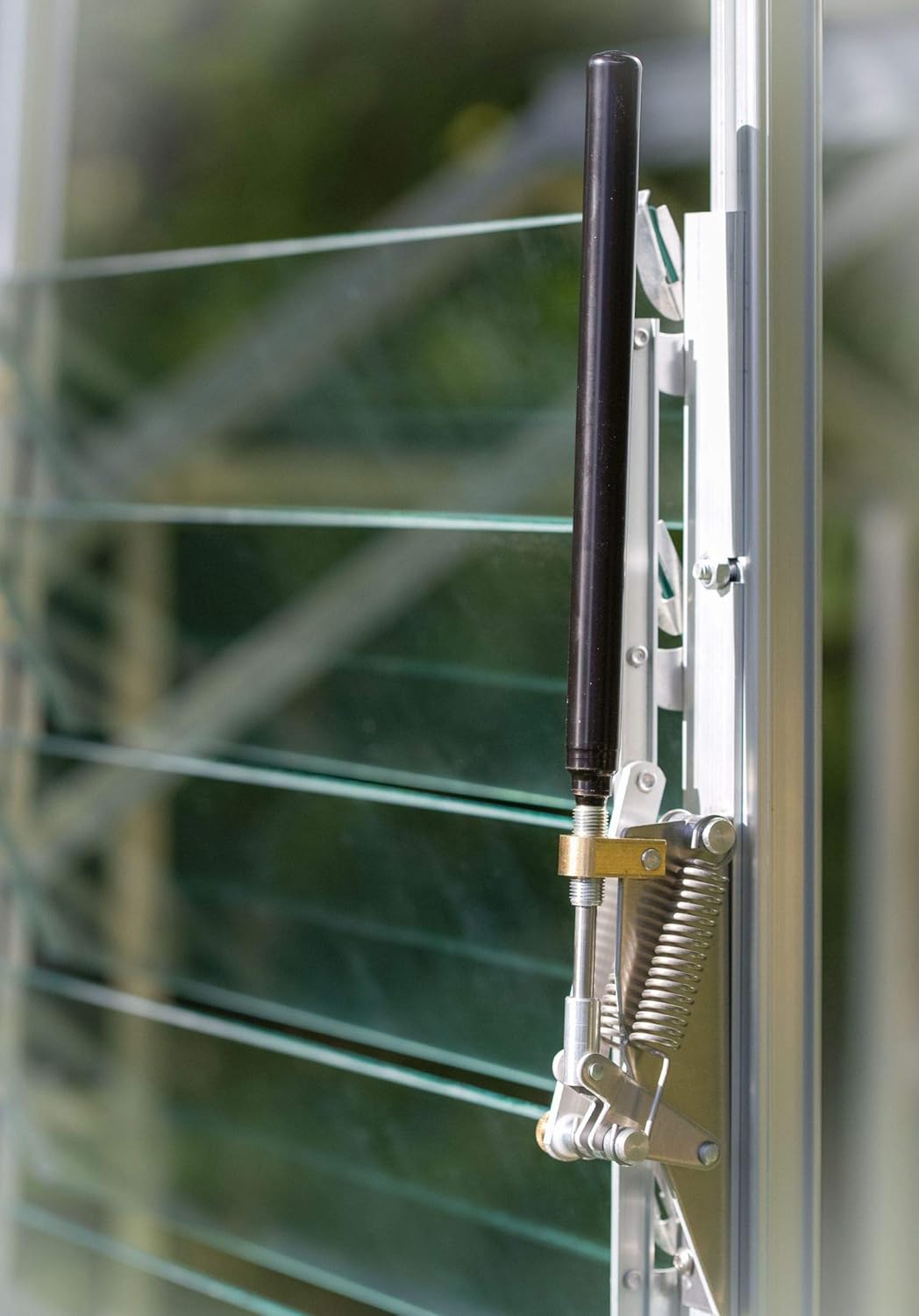
Gardening Naturally automatic louvre vent opener
Best for: automating a compatible louvre
A wax-cylinder opener made for many standard greenhouse louvre vents. It automates low-level air intake rather than lifting a roof window, so it can support a more complete high-and-low ventilation path.
What stands out
- Automates low-level inlet air
- No battery or mains supply
- Made for standard louvre mechanisms
Keep in mind
- Does not operate a roof vent
- Louvre compatibility must be confirmed
- louvre-vent format
- wax cylinder
- 17–25°C stated range
- no electricity

Brannan max/min thermometer and hygrometer
Best for: temperature plus humidity at a glance
An analogue dial instrument combining current humidity with current, maximum and minimum temperature. It adds a quick humidity indication without requiring an app, account or wireless connection.
What stands out
- No app or pairing
- Shows humidity as well as temperature
- Easy to scan from the aisle
Keep in mind
- Humidity is current rather than logged
- Manual reset and reading required
- analogue display
- max/min temperature
- current humidity
- wall mountable
Common questions
Frequently asked questions
What is a greenhouse louvre vent for?
It commonly provides a controllable low-level air inlet. With a high roof outlet open, it can support a flow path that carries warmed air out of the greenhouse.
Can I fit a louvre vent to any greenhouse?
No. A retrofit must match the glazing bay and frame and be approved by the greenhouse maker. Never cut a panel or frame without the specified kit and instructions.
Will an automatic roof opener work on a louvre?
Usually not. Louvre blades use a different linkage and travel. Buy an opener expressly compatible with the exact louvre and verify the maker's fitting dimensions.
Should a louvre stay open in winter?
Adjust it for crop needs and weather. Short ventilation on suitable mild days may help reduce dampness, but a permanently open low vent can chill tender plants.
Does insect mesh reduce louvre airflow?
It can. Fine mesh, dirt and obstructions lower effective free area, so check that the blades still open fully and monitor the greenhouse response.