
Scheduled irrigation
Greenhouse watering-timer guide
Choose a greenhouse watering timer by water source, pressure, dripper layout and crop demand; learn why a timer cannot fix an unsuitable irrigation system.
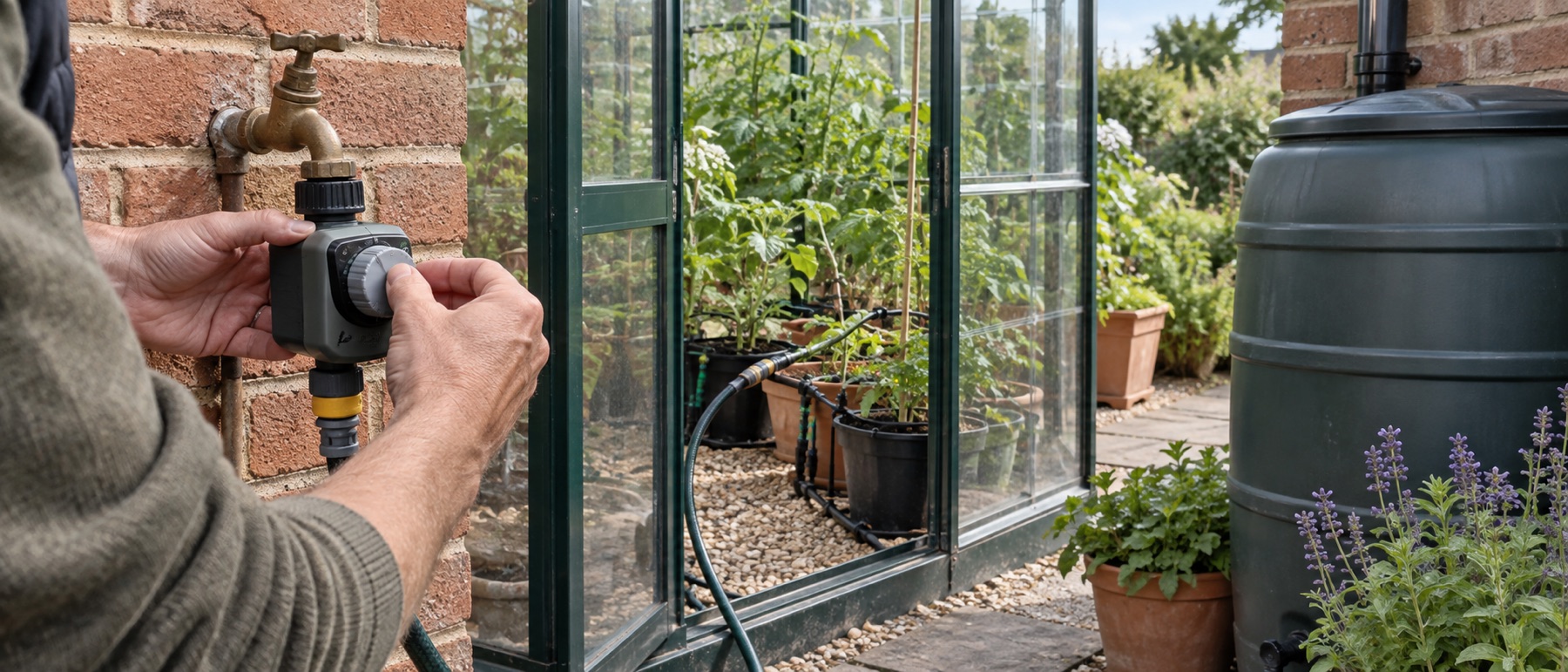
Confirm tap or butt supply and pressure before selecting a controller.
Group containers with similar demand into practical zones.
Measure output and compost wetting over several real cycles.
Check batteries, filters, leaks and a backup before travel.
Identify the system the timer will control
The common mistake is buying a timer before choosing the water source. A tap timer is a valve: it opens and closes a supply. It cannot pressurise a water butt or distribute water evenly through poorly designed tubing. Write down whether you have a mains tap, a raised gravity reservoir or a pump drawing from stored rainwater. Check the published pressure and fitting requirements of the entire chain—controller, filter, regulator, hose and emitters.
The Hozelock Select controller below offers 16 preset programmes, but those choices do not tell you how long your tomato bags need to be watered. It is a controller alone. The Hozelock 20-pot kit includes a Select controller and drippers for a compatible tap-fed supply. A water-butt pump system such as the Irrigatia SOL-C36Q is a different architecture, with its own solar-powered control. See the water-butt irrigation guide before treating them as equivalents.
Set a schedule from measured water, not a guess
Map each pot and estimate a starting irrigation zone. Place an emitter near each root ball, secure tubing and run a manual test. Catch the output from several emitters in measuring jugs for a known duration. If the farthest outlet is much weaker, address pressure, kinks or layout first; programming a longer cycle can overwater the nearest pots.
Check the compost beneath the surface after a cycle and again before the next one. A small seed tray, a hanging basket and a mature growbag rarely need the same dose. Divide them into separate circuits or keep the odd containers on a hand-watering routine. The greenhouse drip-irrigation guide covers emitters and zones in more detail. Avoid a timer schedule that leaves standing water or constantly wet foliage in a closed greenhouse.
Plan for failure, not just convenience
Fit fresh batteries at an appropriate interval, clean the filter, check joints for leaks and inspect each outlet. Test the system through several normal days and one warmer day before relying on it. If the controller has a manual function, use it to confirm valve and flow rather than assuming a programmed display proves water reached the plants.
Water storage and supply reliability matter too. A pump cannot draw from an empty butt; a tap may be unavailable under restrictions; a smart controller may lose connection. The RHS watering-methods guidance also highlights appropriate backflow separation for permanent mains irrigation. Check current water-company rules and use a qualified plumber for an uncertain connection. For holidays, give a trusted person a clear check-and-refill plan using the watering-while-away guide.
When a working timer still leaves dry pots
Separate a control fault from a distribution fault. First use the manual cycle and check that the valve or pump runs. Then inspect the supply level, filter, tubing and representative outlets. If every emitter is weak, the supply or pressure may be unsuitable; if only one is weak, check that branch for blockage, a kink or a displaced dripper.
If measured output is adequate but compost stays dry in part of a container, reconsider emitter position and how the water wets the root zone. Do not simply double every programme: that can flood the containers that were already receiving enough. Record the change, retest the outlets and observe the next few cycles before leaving the system unattended.
Review through the season
As crops grow, containers fill with roots and weather changes, the same timed dose may become insufficient or excessive. Inspect leaves and root-zone moisture rather than only the clock. Keep a short record of schedule changes and which zone they affect. Automation should make a measured watering plan repeatable, not replace plant observation.
Helpful products
Different ways to schedule watering
The Select controller is a tap timer; the Hozelock kit adds pot drippers; the Irrigatia unit is a water-butt pump system. They are not interchangeable without matching the supply.

Hozelock Select watering controller
Best for: simple tap-fed watering schedules
A battery-operated tap controller with 16 preset programmes and manual watering. It schedules supply from a suitable tap or compatible low-pressure arrangement; a timer alone cannot create water pressure.
What stands out
- No Wi-Fi required
- Straightforward preset selection
- Manual operation for testing
Keep in mind
- Fittings and available pressure must match the system
- Does not include drippers, pipe or backflow protection
- 16 preset programmes
- battery operation
- manual watering function
- tap-mounted controller
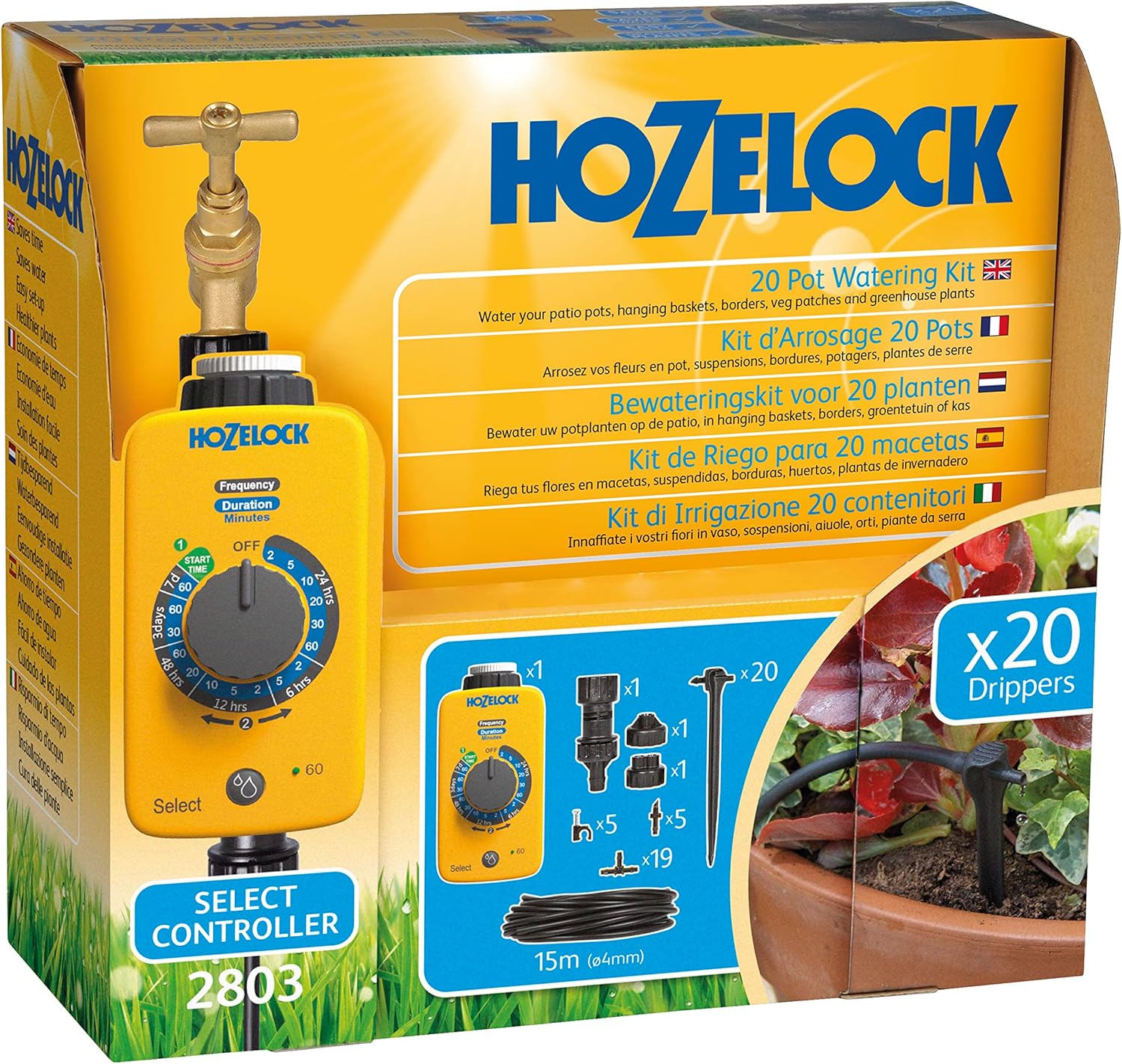
Hozelock 20-pot drip watering kit with Select Controller
Best for: timed watering for up to 20 pots
A complete mains-water drip kit for up to 20 containers, with a tap controller, supply pipe and individual drippers. The controller offers preset schedules while emitters place water close to roots.
What stands out
- Timer and distribution parts included
- Flexible cut-to-fit tubing
- Manual watering function
Keep in mind
- Requires a compatible pressurised tap supply
- Backflow protection and pressure must be checked
- up to 20 containers
- Select Controller
- 16 preset programmes
- root-zone drippers

Irrigatia SOL-C36Q solar watering kit
Best for: solar water-butt drip watering
A solar-powered water-butt irrigation kit with a pump, water-level sensor, 15m of tubing and 20 included drippers. It adjusts watering with available daylight but still needs reservoir capacity and a full-system trial.
What stands out
- Designed to draw from a water butt
- No mains tap required for the pump
- Weather-responsive scheduling
Keep in mind
- Shade and poor solar placement affect operation
- Reservoir volume and dripper layout need testing
- solar-powered pump
- 20 included drippers
- 15m tubing
- water-level sensor
Common questions
Frequently asked questions
Can I use a tap timer on a water butt?
Only if the exact timer is rated for the available low pressure and the rest of the system works at that head. A timer cannot create pressure; test the flow with the butt partly empty.
Is a smart Wi-Fi timer necessary in a greenhouse?
No. A simple battery controller can suit a small, stable layout. Connectivity adds remote features but also relies on power, signal and configuration.
How often should a greenhouse timer run?
There is no universal schedule. Pot size, crop, compost, weather and emitter flow determine demand. Start with measured output and adjust after checking root-zone moisture.
What if the timer fails while I am away?
Arrange a trusted person to check the greenhouse, especially in hot weather. Test the full system for days beforehand and keep enough water available for the likely conditions.
Does a timer include backflow protection?
Do not assume so. Check the proposed mains connection, product instructions and current water-supplier requirements; permanent systems may need a suitable air-gap or break-tank arrangement.