
Position and light
Putting a greenhouse near trees
Decide whether a greenhouse can work near trees by assessing seasonal shade, root protection, falling debris, access and foundation design.
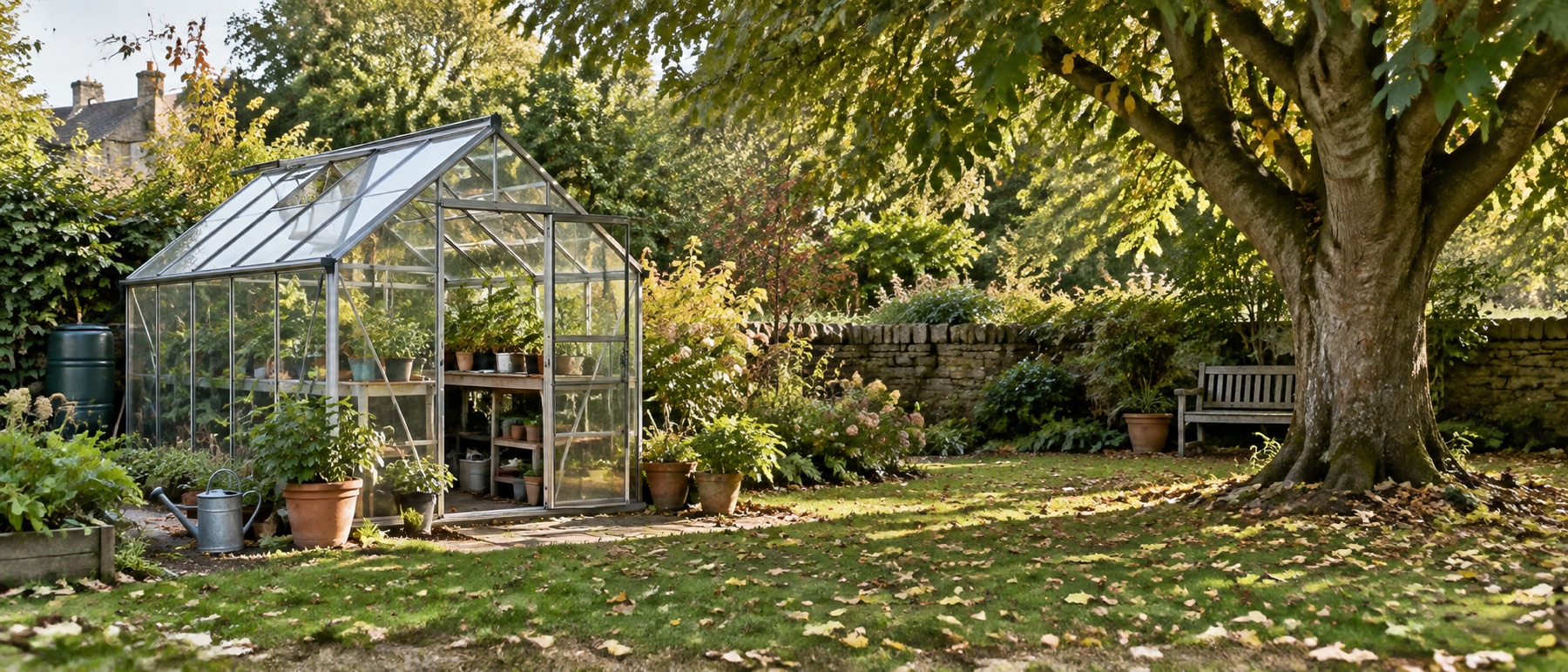
Observe the shade pattern in more than one season.
Never assume roots stop at the canopy edge.
Check for protected trees before pruning branches or cutting roots.
Leave access to clear gutters and safely remove fallen debris.
Look at the whole tree, not just its trunk
A greenhouse beside a tree may seem sheltered and pleasantly shaded in midsummer. The same canopy can block low winter sun, shed leaves into vents and gutters and drip onto the roof long after rainfall. A branch that is clear today may rub glazing as it grows or moves in wind.
Sketch the canopy and proposed greenhouse at ground level. Visit the position in the morning, at midday and in the afternoon. If the decision is being made in winter, remember that a deciduous tree will have a much denser summer canopy; if made in summer, consider the low winter sun. The RHS greenhouse ventilation and shading guidance explains why managed shade cannot replace ventilation.
Protect roots before digging
Tree roots are not contained within a neat circle under the crown. Forest Research's guidance on roots and trenching describes damage from excavation and soil compaction. A concrete slab excavation, heavily compacted sub-base or repeated vehicle traffic can affect a nearby tree even when the greenhouse does not touch the trunk.
Do not assume a shallow base is harmless. Ask a qualified arboriculturist about root protection where a mature or valuable tree is close. A local planning or tree officer can identify special controls. In England, government guidance on protected trees notes that cutting roots of a tree covered by a Tree Preservation Order requires consent. Rules and processes differ elsewhere in the UK, so check locally.
Consider glazing and branch risk
Light leaves are a maintenance issue; substantial dead or overhanging branches are a safety question. Have suspect limbs assessed before installing a glazed structure beneath them. Never improvise pruning next to power lines or climb above glass.
A mature tree also drops twigs, fruit and pollen, which can obstruct gutters and roof vents. If the greenhouse is close enough for regular debris, preserve clear access to clean the roof safely from outside. Do not design a location that requires standing on the greenhouse or leaning a ladder on glazing.
Plan light for the crop
Seedlings, tomatoes and other productive crops benefit from good light, especially during shorter UK days. Dappled afternoon shade can be useful during a hot spell but may reduce spring growth if it covers much of the structure. Compare the actual seasonal shadow with the crops you intend to raise, rather than assuming all shade is good or bad.
A thermometer and vent can help manage temperature, but neither creates missing sunlight. For a heavily shaded plot, a more open site or a smaller structure positioned away from the canopy may be more worthwhile than investing in a large greenhouse under the tree. Our position guide helps compare options.
Decide on the foundation only after the site
If the tree can be retained safely and the greenhouse location remains viable, select the exact model and ask whether an acceptable base and anchor system can be built without injuring important roots. A standard concrete slab is not automatically the right choice near a tree. A professional may recommend moving the greenhouse rather than changing the foundation.
Also consider roots and branches over time. A raised path or accessible approach needs to stay even as the tree grows. Leave room for tree inspection and greenhouse maintenance. The base comparison and clearance guide are useful once the tree constraints are known.
Helpful products
Choose a footprint after checking the tree
A smaller greenhouse may avoid excavation near roots, while a larger one needs a more open site. These models illustrate the range; do not choose a base before assessing the tree.
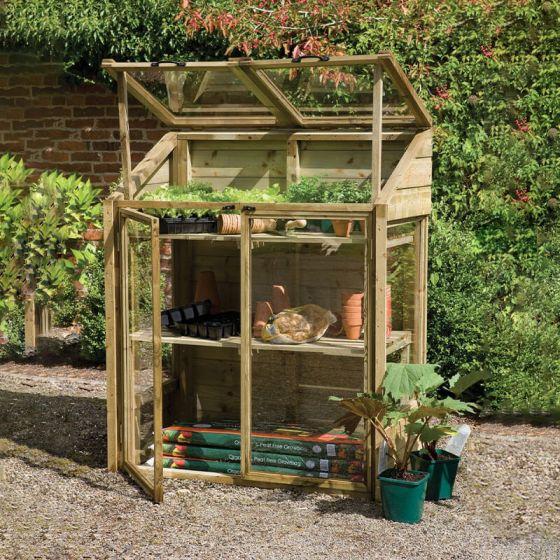
Forest Wooden Mini 4 × 2 growhouse
Best for: the smallest fixed footprint
A 1.2m-wide timber growhouse with two front doors, two independently opening glazed lids and two internal shelves. It trades walk-in access for a genuinely shallow 0.62m footprint.
What stands out
- Very shallow footprint
- Shelves and growbag-level space
- Independent lids for flexible access
Keep in mind
- Not walk-in
- Capacity falls quickly as plants grow tall
- 1.20 × 0.62m
- pressure-treated timber
- two shelves
- split lid
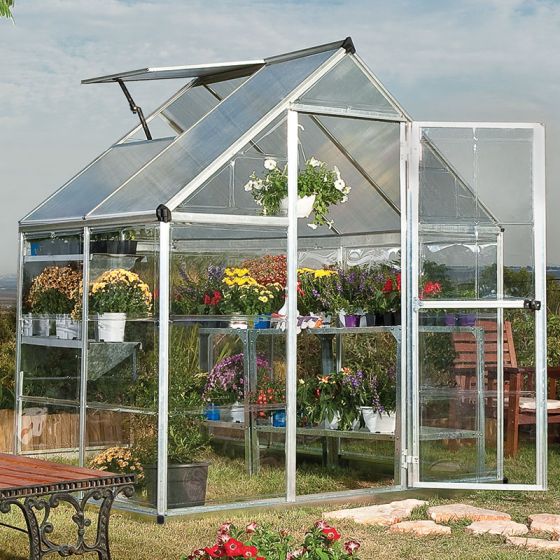
Palram Canopia Hybrid 6 × 4 greenhouse
Best for: a compact first walk-in greenhouse
A compact walk-in with a 1.85 × 1.25m base, diffusing twin-wall roof panels and clear polycarbonate sides. It is the most balanced fit here for a small garden that can still keep a central path.
What stands out
- Compact walk-in footprint
- Clear sides and diffusing roof
- Steel perimeter base included
Keep in mind
- Single 565mm door
- One roof vent means summer airflow needs planning
- 1.85 × 1.25m base
- aluminium
- polycarbonate
- one roof vent
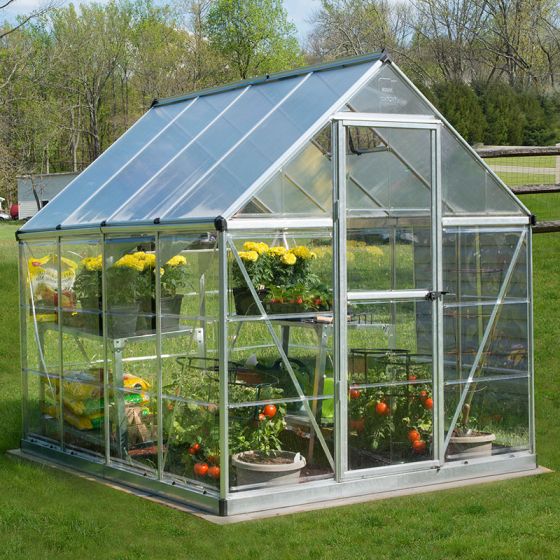
Palram Canopia Hybrid 6 × 8 greenhouse
Best for: more useful growing length
The same 1.85m width extended to 2.46m at the base. The extra length makes a more workable layout for staging plus floor crops if the site can spare the footprint and access around it.
What stands out
- Length for staging and tall crops
- Clear walls and diffusing roof
- Perimeter base included
Keep in mind
- Needs much more prepared base
- Door remains 565mm wide
- 1.85 × 2.46m base
- aluminium
- polycarbonate
- integrated gutters
Common questions
Frequently asked questions
Can I put a greenhouse under a tree?
It is usually a difficult site. Canopy shade, dripping leaves and branches affect light and maintenance, while foundation works can harm roots. Assess the specific tree and choose an open alternative where possible.
Do tree roots only reach the edge of the canopy?
No. Roots can extend beyond the visible crown. Treat excavation and ground compaction near a mature tree as potentially damaging and seek arboricultural advice where needed.
Can a tree protect a greenhouse from overheating?
Seasonal shade can reduce summer sun, but its timing and density are variable. Ventilation and suitable shading remain important, and winter light may be reduced.
Can I cut roots to fit a greenhouse base?
Do not do so without assessment. Cutting roots may destabilise or harm a tree and can require consent if the tree is protected or in a conservation area.
What if branches already overhang the proposed roof?
Check the tree's condition and protection status, then ask a competent tree professional about safe options. Do not place glazing where falling limbs present an obvious risk.