
Small-space growing
Cold frame vs mini greenhouse
Decide between a low cold frame and mini greenhouse for seedlings, hardening off, herbs and patio growing, with real product dimensions and access differences.
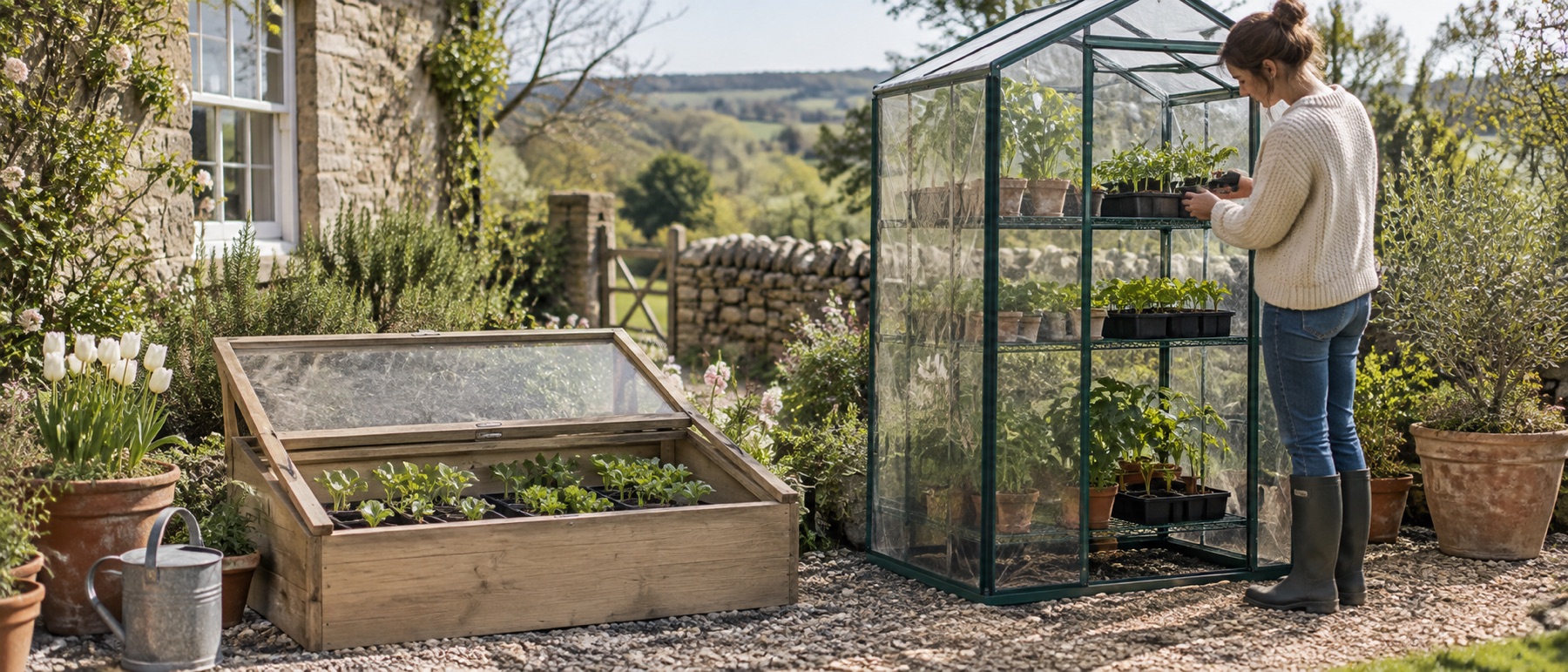
A cold frame's low profile suits seedlings moving towards outdoor conditions.
A mini greenhouse offers more levels but can overheat and crowd rapidly.
Compare lid and door clearance, not only the closed footprint.
Neither is reliable frost protection for tender plants without monitoring.
Understand the difference in use
A cold frame is a low glazed or clear-covered box, usually opened from above. It can shelter seedlings close to outdoor beds and make the transition from protected growing to open air easier to manage. A mini greenhouse is a broader category: it may be a low growhouse with doors and shelves, a tall cabinet against a wall or a very small walk-in. The distinction is usable height and access, not simply whether the enclosure has transparent panels.
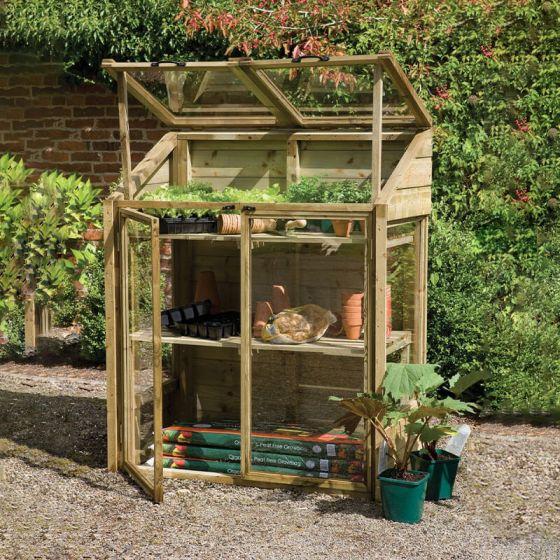
For a concrete comparison, the Forest Large Wooden Cold Frame is about 1.09 × 0.63m and only 254mm high at the front and 364mm at the back. The Forest Wooden Mini 4 × 2 is about 1.20 × 0.62m on the ground but has front doors, two shelves and opening lids. Similar ground depth does not mean similar growing capacity.
Choose a cold frame for transition and low crops
The Forest cold frame has two independently opening lids with props. That allows one side to be opened while the other remains more sheltered. It is a practical format for hardening off trays, protecting low salads and acclimatising plants before they are planted outside. Because plants sit close to the ground, there is no shelf system to manage.
The limit is height. Seedlings can quickly meet the lid, and mature tomatoes or other tall crops are not realistic long-term occupants. Put the frame where you can open both lids safely, reach the back and prevent wind from lifting an unsecured lid. Check the timber support and drainage; a low box can stay damp if placed on a poorly drained patch.
Choose a mini greenhouse for layers and longer stays
The Forest Mini 4 × 2 uses two shelves and a lower bay to hold trays, pots and compact crops within a shallow footprint. Its front doors and split lid allow access from more than one direction. The Forest Victorian 5 × 2 goes further upwards, with adjustable shelf space and roof vents. These features make a mini greenhouse useful when you want several batches of seedlings or herbs near the house.
Height does not eliminate planning. A tray of seedlings may fit neatly on a shelf in March, but those plants need wider spacing and bigger pots by May. Draw the growing-on space before filling every level. Vent a small enclosure promptly on bright days and check that opening doors do not block a narrow path.
Temperature and ventilation
Both enclosures can warm rapidly in sun and cool sharply overnight because their internal air volume is small. A cold frame often has simple lid positions; a mini greenhouse may add roof vents and doors. Neither design is a passive guarantee of frost protection. Use a max/min thermometer and local forecast, then move vulnerable plants when necessary.
Hardening off is a gradual process. Open the enclosure for suitable periods, protect plants from severe wind and unexpected cold, and increase exposure as they adjust. Do not assume leaving a lid permanently ajar creates a safe compromise in every weather condition.
Site, stability and working clearance
Mark the closed footprint, then the full lid or door sweep. A low frame can fit beneath a window but still conflict with an outward-opening sash. A tall cabinet may project little yet need secure positioning and enough height below eaves. Follow the maker's fixing guidance; pots and wet compost are not a reliable anchoring system.
If your site is a balcony, roof terrace or narrow elevated deck, assess loading and wind separately. The ability to physically place a structure there does not establish that it is safe.
A simple decision
Buy a cold frame if the main job is hardening off and short-term shelter for low plants. Buy a mini greenhouse if the main job is several shelf levels, upright containers or a longer period of protected growing. Some gardeners benefit from both: seedlings begin in a mini greenhouse and move through a cold frame towards the beds. Start with the job you actually need this season rather than accumulating two small structures without a plant-flow plan.
For more options see our mini greenhouse shortlist and mini greenhouse buying guide.
The RHS greenhouse-alternatives guidance gives a useful overview of the jobs these small enclosures serve. Before moving protected plants into the garden, follow the hardening-off guide rather than assuming a cover has prepared them for full outdoor exposure.
Helpful products
A like-for-like small-space comparison
The Forest cold frame and mini growhouse occupy similar ground depth but offer very different height and access.

Forest Large Wooden Cold Frame
Best for: hardening off in a low enclosure
A low pressure-treated timber cold frame, about 1.09 × 0.63m, with styrene glazing and two independently opening lids held by props. It is designed for low plants and hardening-off rather than tiered shelving.
What stands out
- Two lids allow separate access
- Low profile suits hardening off
- Pressure-treated timber
Keep in mind
- No vertical growing space
- Lids need open-space clearance
- 1.09 × 0.63m
- 254mm front / 364mm back
- styrene glazing
- two opening lids
Forest Wooden Mini 4 × 2 growhouse
Best for: the smallest fixed footprint
A 1.2m-wide timber growhouse with two front doors, two independently opening glazed lids and two internal shelves. It trades walk-in access for a genuinely shallow 0.62m footprint.
What stands out
- Very shallow footprint
- Shelves and growbag-level space
- Independent lids for flexible access
Keep in mind
- Not walk-in
- Capacity falls quickly as plants grow tall
- 1.20 × 0.62m
- pressure-treated timber
- two shelves
- split lid

Forest Victorian 5 × 2 tall wall greenhouse
Best for: vertical growing space on a shallow patio
A 1.47 × 0.72m tall timber greenhouse with a back panel, double doors, adjustable shelving, two roof vents and one automatic vent opener. It uses height rather than garden depth.
What stands out
- Shallow footprint with full-height storage
- Adjustable and folding shelves
- One automatic vent opener included
Keep in mind
- Not walk-in
- Supplied unpainted
- 1.47 × 0.72m base
- pressure-treated timber
- styrene glazing
- two roof vents
Common questions
Frequently asked questions
Is a cold frame the same as a mini greenhouse?
No. A cold frame is generally a low enclosure with top access, while mini greenhouses include taller cabinets and compact walk-ins with doors, shelves or vents.
Can I start seeds in a cold frame?
Yes for suitable seeds and conditions, but low temperatures and limited height constrain what can stay there. Many gardeners start tender seedlings elsewhere and use the frame for hardening off.
Which is better for hardening off?
A cold frame's low profile and opening lids are well suited to gradually exposing young plants to outdoor conditions. A mini greenhouse can also work if its ventilation allows a controlled transition.
Will a cold frame prevent frost damage?
It can offer some shelter but is not a guarantee against freezing temperatures. Check forecasts and measure conditions at plant level; move tender plants or provide suitable additional protection when needed.
Can I grow tomatoes in a cold frame?
A low frame is usually too short for a mature tomato crop. A reconfigurable taller mini greenhouse may suit compact tomato varieties if it provides adequate height, light, water and ventilation.