
Glazing buying guide
Toughened-glass greenhouse guide
Learn how to choose a toughened-glass greenhouse, including pane size, safety, frame and base requirements, ventilation, cleaning and current UK examples.
Our recommendations
Toughened-glass greenhouses to compare
These examples cover compact aluminium, longer 6 × 8 and premium timber formats.
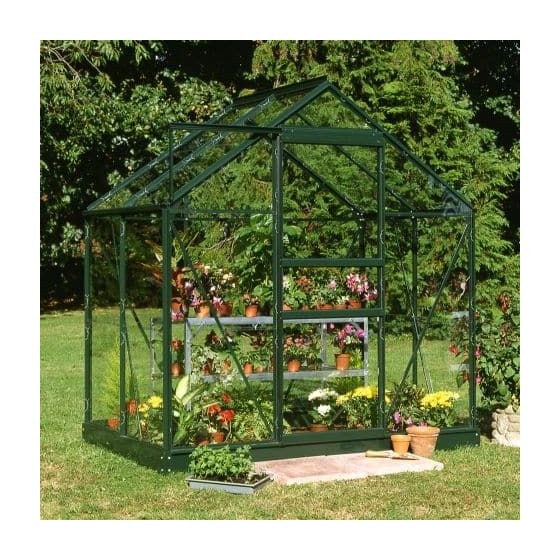
Halls Green Frame 6 × 4 greenhouse
Best for: toughened glass in a compact plot
A traditional-looking 6 × 4 with a green aluminium frame and large panes of toughened glass. It is the clearest fit if you want glass in a small footprint and accept a separate base.
What stands out
- Large-paned toughened glass
- Low-maintenance coated aluminium
- Roof vent and gutters included
Keep in mind
- Matching base costs extra
- Heavy panes need careful assembly
- 1.93 × 1.33m base
- green aluminium
- toughened glass
- optional base

Halls Green Frame 6 × 8 greenhouse
Best for: a traditional 6 × 8 glass greenhouse
A 1.93 × 2.57m aluminium greenhouse with large-paned toughened glass, a 600mm sliding door, roof vent and integral gutters. It brings a traditional glass finish to the more useful 6 × 8 format.
What stands out
- Large panes of toughened glass
- 600mm sliding door
- Roof vent and integral gutters
Keep in mind
- Matching base costs extra
- Large glass panes require careful handling
- 1.93 × 2.57m base
- green aluminium
- toughened glass
- optional base

Coppice Ashdown 6 × 6 wooden greenhouse
Best for: a premium full-size timber greenhouse
A full-size oiled and pressure-treated timber greenhouse with a 1.905 × 1.93m footprint, 3mm toughened glass, a 720mm hinged door, two roof vents and two-shelf staging. Professional installation is included in the listed package.
What stands out
- Professional installation included
- 720mm glazed door
- Staging and two roof vents included
Keep in mind
- Premium price level
- Wood requires annual retreatment
- 1.905 × 1.93m footprint
- pressure-treated timber
- 3mm toughened glass
- two roof vents
| Model | Published size | Frame | Door and vents | Base and installation |
|---|---|---|---|---|
| Halls Green Frame 6 × 4 | 1.93 × 1.33m base | Coated aluminium | 600mm sliding door; one roof vent | Matching base optional |
| Halls Green Frame 6 × 8 | 1.93 × 2.57m base | Coated aluminium | 600mm sliding door; one roof vent | Matching base optional |
| Coppice Ashdown 6 × 6 | 1.905 × 1.93m footprint | Pressure-treated timber | 720mm hinged door; two roof vents | Professional installation included; no floor |
Why toughened glass is popular
Toughened glass preserves the qualities that make a traditional greenhouse appealing: clear views, strong light and a surface that stays transparent with straightforward cleaning. Its main advantage over horticultural glass is its behaviour under stress. It is made stronger through heat treatment and, if it breaks, fragments into smaller pieces rather than long knife-like shards.
That does not make it harmless or impossible to break. The edges remain vulnerable, panes are heavy and a distorted frame can introduce stress. The safety benefit works best when the entire structure is well installed.
Large panes versus traditional overlaps
Large-pane glazing has fewer overlaps to trap algae and creates an uninterrupted view of the garden. It also removes many individual clips and can make the building look more architectural. Cleaning is quicker because a squeegee can travel across a broad flat surface.
Traditional small panes are easier to carry one at a time and individual replacements can be modest in size. Overlaps collect dirt, reduce visual clarity and add more edges. If the product uses overlapping panes, check the correct orientation and clips so rain sheds outward.
The frame and base must stay square
Glass is rigid. It does not forgive an aluminium frame twisted onto an uneven foundation or a timber frame that has moved through persistent damp. Doors that bind and gaps that change width are early warnings that the geometry is wrong.
Prepare the foundation to the technical drawing, not the nominal “6 × 4” or “6 × 8” label. Check both diagonals to confirm the base is square, then check level in several directions. Anchor only by the approved method and recheck alignment as the glazing is fitted.
An optional metal base should be included in the budget where the manufacturer recommends it. It can simplify the frame-to-foundation connection, but it still needs a stable paved, perimeter or concrete support.
Plan the delivery and glazing day
Large toughened panes may not turn through a narrow house, covered passage or sharp side gate. Confirm the package dimensions and delivery point before ordering. Prepare a flat protected area where glass can be stored in the orientation the supplier specifies.
Glaze on a calm day with the number of helpers and protective equipment stated in the instructions. Do not rest a pane on a vulnerable corner or force it into a frame opening. If a pane appears wrong, stop and verify the part number and frame alignment.
Light, summer heat and ventilation
Clear glass admits abundant direct light. That benefits early sowings and winter crops, but a closed greenhouse can overheat quickly in sun. Roof vents are important because hot air rises; a door adds a large temporary opening but may not provide even airflow throughout a long house.
Compare the size and distribution of vents rather than their number alone. The RHS ventilation guidance covers roof and side openings alongside shading. Automatic opening is useful, but still check the available airflow and keep a way to operate openings manually. Plan removable shading for hot periods rather than permanently sacrificing winter light.
Cleaning and inspection
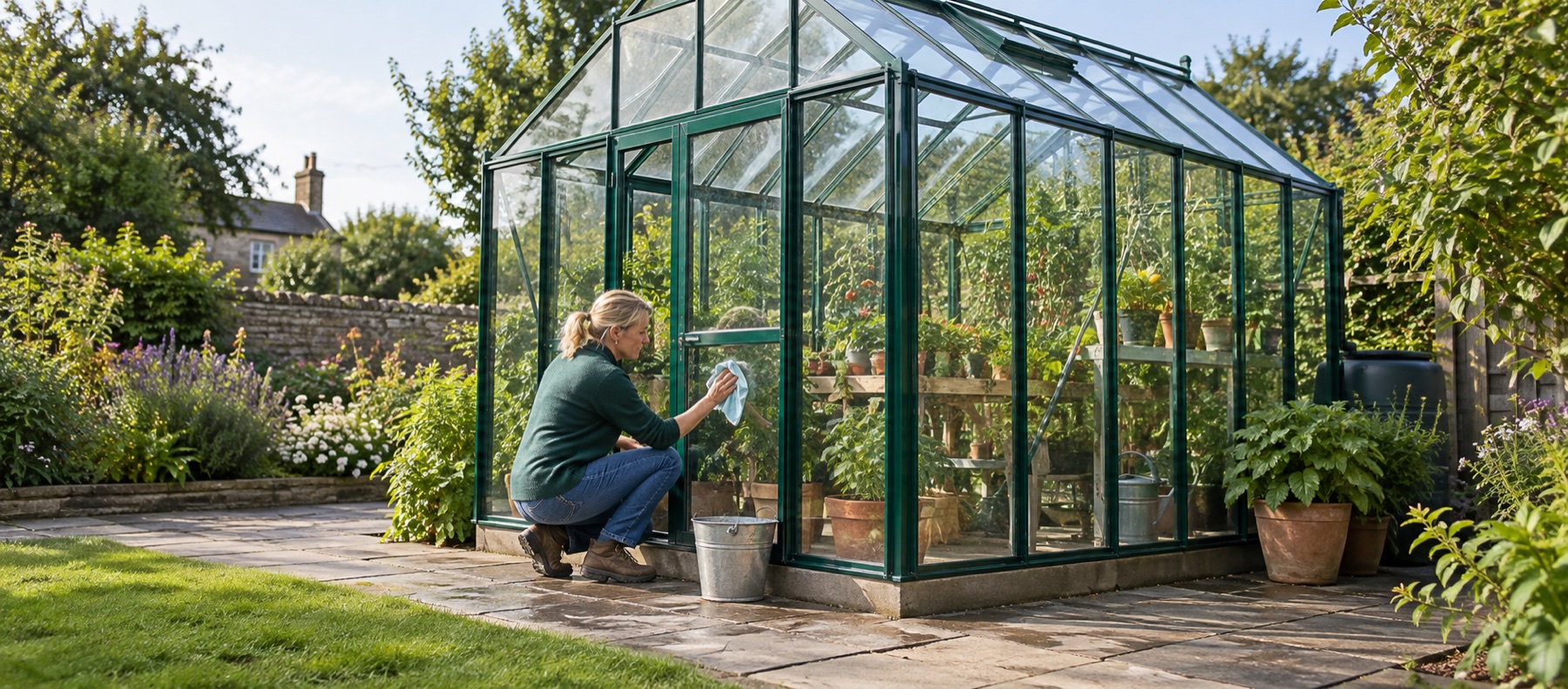
Wash glass with a soft brush, sponge or squeegee and a compatible cleaner. Clear algae at clips, seals and lower rails without disturbing the pane. Avoid abrasive pads and sudden temperature changes, such as very hot water on cold glazing.
While cleaning, look for:
- chipped edges or unusual contact between glass and metal;
- loose clips, caps or gaskets;
- blocked gutters and drainage points;
- movement at anchors and base corners;
- stiff vents and door tracks.
An isolated chip should be assessed promptly. Do not attempt to drill, grind or trim toughened glass.
Replacement panes and identification
Keep the manual, order reference and glazing schedule. “6 × 4 toughened glass” is not a replacement specification: pane dimensions and edge details vary between model families and revisions. Measure only as the supplier instructs and confirm whether the replacement needs a particular stamp, thickness or shape.
Availability matters when comparing brands. A modest greenhouse with a clear replacement-parts route may be a better long-term purchase than a cheaper model with undocumented glazing.
Who should choose toughened glass?
It suits gardeners who want maximum visual clarity, strong winter light and a traditional finish, particularly when the greenhouse is prominent from the house. It is also the appropriate glass choice in areas where people regularly pass, work or play.
Choose polycarbonate instead when weight, shatter resistance, diffusion or difficult assembly access outweighs clarity. Our glass versus polycarbonate greenhouse guide explains the trade-offs.
Final buying checks
Confirm that the quoted variant really includes toughened glass, because the same frame may be sold with several glazing options. Record the pane size, thickness, base arrangement, vent count, door width, gutter system, delivery exclusions and replacement route. With a level base and patient installation, toughened glass offers the clearest and most durable-looking greenhouse finish for many UK gardens.
Before purchase, compare the glass and polycarbonate trade-offs with the glass-replacement guide. Understanding the future pane and access requirements can change which frame and glazing package makes sense.
Common questions
Frequently asked questions
What is the difference between toughened and horticultural glass?
Toughened glass is heat-treated for greater strength and to fragment into many smaller pieces if it fails. Horticultural glass is thinner and can break into long sharp shards. Toughened panes cost more but are preferable around doors, paths and family activity.
Can toughened greenhouse glass be cut to size?
No. Cutting or drilling after toughening would destroy the stress pattern and cause the pane to fail. Order a replacement made to the exact required dimensions and specification.
Is toughened glass unbreakable?
No. It is stronger and has a safer breakage pattern than ordinary horticultural glass, but impacts, edge damage, frame distortion and incorrect installation can still cause failure.
Are large panes better than overlapping panes?
Large panes give a clearer view, fewer dirt-catching overlaps and a cleaner appearance. They are heavier and more awkward to handle, so the access route and assembly team need planning.
Does toughened glass keep a greenhouse warm?
A single pane of toughened glass has limited insulating value. It transmits useful light but loses heat rapidly after sunset. Draught control, thermal screens or bubble insulation and careful heating strategy matter for winter use.