
Glazing buying guide
Polycarbonate greenhouse buying guide
Choose a polycarbonate greenhouse by comparing panel type, UV protection, retention, insulation, cleaning, ventilation and base requirements.
Our recommendations
Polycarbonate greenhouse formats to compare
These examples use hybrid clear-and-diffusing panels across compact, longer and lean-to footprints.
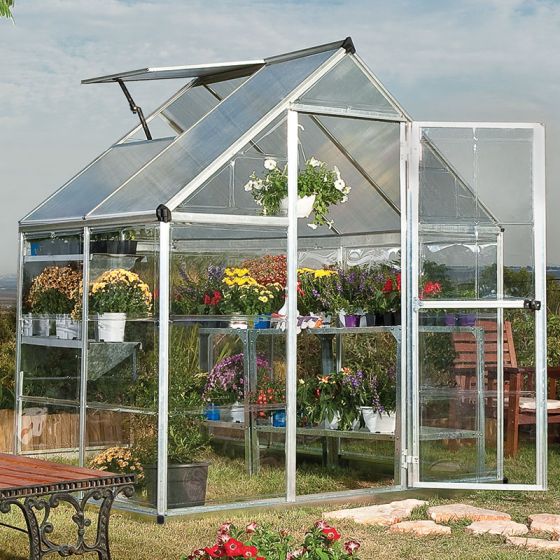
Palram Canopia Hybrid 6 × 4 greenhouse
Best for: a compact first walk-in greenhouse
A compact walk-in with a 1.85 × 1.25m base, diffusing twin-wall roof panels and clear polycarbonate sides. It is the most balanced fit here for a small garden that can still keep a central path.
What stands out
- Compact walk-in footprint
- Clear sides and diffusing roof
- Steel perimeter base included
Keep in mind
- Single 565mm door
- One roof vent means summer airflow needs planning
- 1.85 × 1.25m base
- aluminium
- polycarbonate
- one roof vent
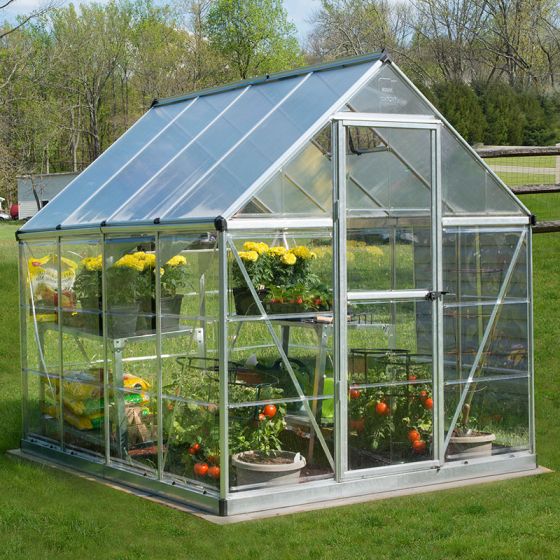
Palram Canopia Hybrid 6 × 8 greenhouse
Best for: more useful growing length
The same 1.85m width extended to 2.46m at the base. The extra length makes a more workable layout for staging plus floor crops if the site can spare the footprint and access around it.
What stands out
- Length for staging and tall crops
- Clear walls and diffusing roof
- Perimeter base included
Keep in mind
- Needs much more prepared base
- Door remains 565mm wide
- 1.85 × 2.46m base
- aluminium
- polycarbonate
- integrated gutters
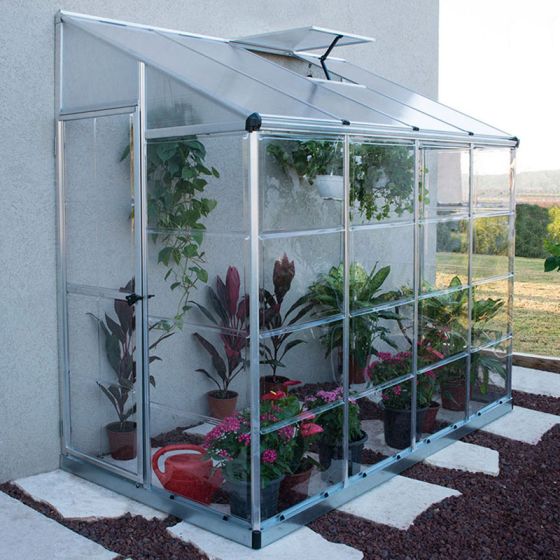
Palram Hybrid Lean-To 8 × 4 greenhouse
Best for: a long, narrow wall-side plot
A long, shallow walk-in lean-to with a side door, diffusing twin-wall roof and clear side panels. It turns roughly 1.25m of projection into a useful 2.44m run against a suitable wall.
What stands out
- Makes use of wall length
- Side door suits the narrow layout
- Perimeter base and wall kit included
Keep in mind
- Needs a suitable wall
- 1.21m width limits two-sided staging
- 2.44 × 1.25m overall
- lean-to
- polycarbonate
- wall-mount kit
| Model | Published footprint | Panel arrangement | Base | Access and ventilation |
|---|---|---|---|---|
| Palram Hybrid 6 × 4 | 1.85 × 1.25m base | Twin-wall roof; clear side panels | Steel perimeter base included | 565mm door; one roof vent |
| Palram Hybrid 6 × 8 | 1.85 × 2.46m base | Twin-wall roof; clear side panels | Steel perimeter base included | 565mm door; one roof vent |
| Palram Hybrid Lean-To 8 × 4 | 2.44 × 1.25m overall | Twin-wall roof; clear side panels | Perimeter base included | Side door; roof vent |
Not all polycarbonate glazing is the same
The word “polycarbonate” can describe thin clear panels, twin-wall sheets with insulating channels and thicker multiwall systems. Their light transmission, rigidity and replacement requirements differ. A useful product specification should identify the panel type and thickness, not simply call the greenhouse shatterproof.
Hybrid designs often use diffusing twin-wall panels in the roof and clearer panels in the walls. The roof softens direct overhead sun while the sides preserve outward views. This can be a practical balance, although every panel still depends on the frame's channels and retainers.
Twin-wall, multiwall and clear panels
Twin-wall sheets contain parallel internal channels. Those trapped air spaces slow heat transfer and scatter light. The channels must run so condensation can drain, and their ends need the correct combination of sealed and breathable tapes or caps.
Clear single-wall polycarbonate resembles glass from a distance and keeps the interior visible. It has less insulating air space and may flex more depending on thickness and support. Moulded panels can include specific edges that slide into a proprietary frame; they should not be replaced with generic sheet without approval.
UV protection and panel orientation
Sunlight degrades untreated plastics. Greenhouse-grade panels therefore use a UV-protective layer, often on one face. Installing that face inward shortens useful life and can lead to discolouration or embrittlement.
The temporary protective film normally identifies the UV side. Leave it in place until each panel's orientation is confirmed, then remove it at the stage specified in the instructions. Do not assume both faces are equivalent unless the manufacturer says so.
Panel retention matters in wind
Polycarbonate's low weight is helpful during delivery and assembly, but it also means wind can lift a poorly secured panel. The best defence is the complete system: straight frame channels, all specified clips or capping bars, undamaged panel edges, a square base and anchors that connect the frame to a stable foundation.
Do not use improvised screws through unsupported sheet. Polycarbonate expands and contracts with temperature, and a fixed hole can crack or leak if movement is not allowed. Use only manufacturer-approved reinforcements.
Before forecast high winds, close and latch doors and vents, remove loose objects and inspect known panel edges. A missing clip is easier to replace before a storm than after a panel has flexed out of its track.
Light, shade and temperature
Diffusing panels scatter incoming light so it reaches more leaf surfaces and creates fewer hard shadows. That is useful for dense staging and summer crops. It does not prevent overheating: even translucent glazing traps solar heat, and a closed greenhouse can reach damaging temperatures quickly.
Roof vents should release rising hot air, while the door or low-level vents admit replacement air. A single vent on a longer greenhouse may need supplementing. Removable external shading can reduce peak summer gain without permanently reducing winter light.
Twin-wall panels retain more heat than single glass, but gaps around doors, vents and panel edges still dominate in cold weather. If winter heating is planned, calculate it for the whole structure rather than using the panel's insulation claim alone.
Cleaning without damage
Polycarbonate is more prone to scratching than glass. Rinse loose grit first, wash with a soft sponge and compatible mild solution, then rinse clean. Work from a safe position; greenhouse roofs are not designed to carry a person's weight.
Avoid abrasive powders, stiff brushes, blades and solvents unless the manufacturer explicitly permits them. A pressure washer can drive water into channels and dislodge panels or seals. Clean gutters separately so dirty water is not forced back into panel ends.
Condensation inside the channels
A small amount of condensation can occur as temperature and humidity change. Correct panel orientation and end tapes let moisture drain while limiting dust and insects. Persistent algae or dirt inside the channels often points to failed sealing or incorrect installation.
Do not seal every end with an arbitrary household tape. Multiwall systems commonly require different treatment at the upper and lower edges. Replace failed tape with the specified type and refit caps so drainage paths remain open.
Base, assembly and replacements
Light glazing does not mean the greenhouse can sit loosely on soil. The base must remain level and anchored so the frame cannot rack. An included steel perimeter base is useful, but it still needs the approved connection to paving, concrete or ground anchors.
During assembly, avoid creasing sheets or crushing their channels. Keep protective film on while panels are moved and store them flat, out of wind. Record panel codes and dimensions from the manual so replacements can be ordered accurately later.
Who should buy polycarbonate?
It is a strong choice for self-builders, family gardens and sites where glass delivery would be awkward. It also suits gardeners who value diffused light and modestly improved heat retention more than crystal-clear views.
Choose toughened glass when transparency, scratch resistance and a traditional appearance lead the decision. Compare both in our glass versus polycarbonate greenhouse guide.
Final buying checks
Confirm panel construction and thickness, UV-face instructions, retention details, replacement availability, door width, vent provision, included base and anchor method. The best polycarbonate greenhouse is not simply the thickest panel: it is a coordinated frame-and-panel system that can stay square, sealed and secure on your site.
The Palram polycarbonate care guide gives material-specific precautions; check that it covers your sheet. Use our polycarbonate cleaning guide and replacement-glazing guide if ongoing care or repair access is part of the buying decision.
Common questions
Frequently asked questions
What thickness polycarbonate is best for a greenhouse?
Thickness alone does not determine quality. Panel structure, UV protection, span, frame support and retention all matter. Use the panel specified for the exact frame rather than substituting a thicker sheet that may not fit its channels.
Which way round does greenhouse polycarbonate go?
UV-protected multiwall panels normally have a marked outward face. The channels also need to run in the drainage direction and the ends require the tapes or caps stated in the instructions. Preserve the protective film markings until orientation is confirmed.
Can polycarbonate panels blow out?
They can if the frame is twisted, retainers are incomplete, panel edges are damaged or the whole greenhouse is poorly anchored. Assemble every clip and cap, verify panel engagement and inspect the structure before and after severe weather.
How do I clean a polycarbonate greenhouse?
Rinse off grit, then use a soft cloth or sponge with a cleaner approved by the manufacturer. Avoid abrasive pads, solvents and pressure washers. Do not push dirt or water into the open channels of multiwall panels.
Is polycarbonate better than glass for seedlings?
Diffused polycarbonate can distribute light evenly and reduce sharp hotspots, while clear glass admits more total light during dim periods. Good cleanliness, staging position and ventilation are essential with either material.