
Bench-top watering
Capillary matting in a greenhouse
Set up capillary matting on a level greenhouse bench, choose pots that wick properly and avoid dry patches, saturated compost and algae.
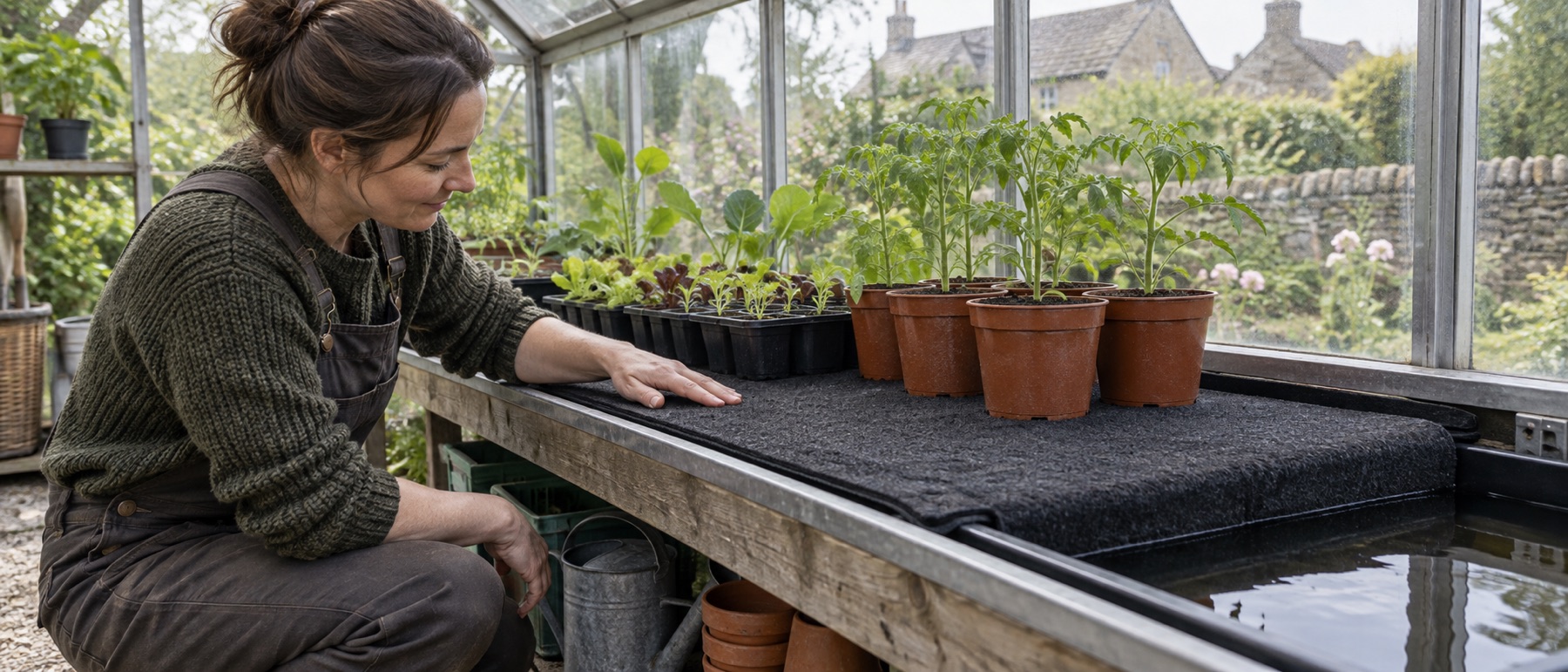
Make the bench level and waterproof if its surface requires protection.
Check every pot base has open holes and direct mat contact.
Keep the mat moist from a controlled reservoir or regular top-up.
Lift pots occasionally to check rooting, salts and algae.
What capillary matting does well
A capillary mat is a water-transport surface, not a pump or a universal self-watering guarantee. It can help a group of similarly sized pots take up moisture from below while leaving leaves dry. This can be useful on a greenhouse bench where top watering every small pot is fiddly. The RHS houseplant growing guide describes capillary watering as one option for a collection of pots; the same physical principle applies in a greenhouse when the setup is suitable.
For large tomato growbags, deep floor beds and containers with closed bases, drip irrigation or careful hand watering is usually a better fit. The drip guide covers those layouts; capillary matting is primarily a bench-top method for pots and trays.
Build a level, clean bench
Measure the usable staging area, including any lip or obstruction. Put the mat on a flat surface with any waterproof tray or lining the bench manufacturer requires. Uneven support creates dry high spots and wet low spots. Make sure the water source—manual top-up, wicking reservoir or a designed tray—keeps the full mat evenly damp without leaving a stagnant pool over the pot bases. A wide mat may require more than one feed point.
Use clean containers with unobstructed drainage holes. Place the pot bottom directly on the mat; tall feet, a gravel layer beneath the pot or a raised tray can interrupt contact. Moisten dry compost from above at the start if needed so the capillary path is established, then check that moisture reaches the root ball. Do not assume all potting mixes wick at the same rate.
Test the moisture pattern
After a day, lift pots at both ends and the centre of the bench. Feel the mat and check compost below the surface. If one pot is dry, inspect its drainage and contact before adding more water to the whole mat. If several are saturated, reduce the reservoir input or separate those plants onto another bench. Mature plants in hot weather will use water faster than young plants on a cloudy day; an unchanged reservoir can empty unexpectedly.
Root growth into the mat, algae and mineral-salt deposits can develop with long use. Lift and rotate pots as appropriate, clean trays and replace worn matting. Follow plant-specific watering needs; constant wetness is not desirable for every crop. The greenhouse hygiene guide covers keeping benches and reusable equipment clean.
Use it responsibly for absences
Calculate how much water a full bench uses over representative days and test the reservoir as it nears empty. Protect the supply from tipping, leaks and contamination. A mat may keep small pots more even for a short absence, but a hot spell can change demand dramatically. The watering-while-away guide explains backup checks. For sensitive seedlings, use fresh mains water rather than assuming stored rainwater is suitable: the RHS water-storage guidance advises avoiding water-butt water for seedlings because of damping-off risk.
Helpful products
Two ways to supply water from below
Choose matting for a measured bench or a reservoir tray for a smaller group of pots; these are alternative setups, not parts of one kit. Trial the wetting of your own pot mix before leaving either unattended.

Gardening Naturally capillary matting, 60cm × 1.5m
Best for: bench-top moisture supply
A 60cm by 1.5m capillary mat intended to distribute moisture beneath pots and trays that can draw water through their bases. It needs a level support and a reliably replenished water supply.
What stands out
- Simple bench-top system
- Moistens compatible pots from below
- Can be cut to match staging
Keep in mind
- Uneven benches cause dry spots
- Pots with blocked drainage or raised feet may not wick
- 60cm × 1.5m selected variation
- capillary matting
- cut-to-fit format

Garland G70 large self-watering plant tray
Best for: contained capillary watering
A 57 × 38.5cm tray with an 8-litre reservoir, raised support platform and capillary matting. Its claimed maximum duration depends on plant demand and should never replace a full trial before an absence.
What stands out
- Contained reservoir and mat
- Defined footprint for a bench
- No mains connection needed
Keep in mind
- Pot bases must contact the wet mat
- Water duration varies with heat, crop and pot count
- G70 model
- 57 × 38.5 × 5cm external
- 8L maker-stated reservoir
- capillary mat supplied
Common questions
Frequently asked questions
How does capillary matting water pots?
Water moves through the damp mat and into a suitable potting mix through open drainage holes in a pot base that touches the mat.
Why are some pots still dry?
Common causes are an uneven or dry mat, raised pot feet, blocked drainage holes, a coarse mix that is not wicking well or insufficient reservoir supply. Check contact and test each pot.
Can capillary matting overwater plants?
Yes. A mat kept too wet can leave some mixes saturated, especially when plants use little water. Group plants with similar needs and inspect the root zone regularly.
Can I put seed trays on capillary matting?
Many trays can use bottom moisture if their bases make contact and the compost wicks properly. Trial the arrangement and use clean, appropriate water for sensitive seedlings.
Is capillary matting enough while I am on holiday?
Only after testing reservoir capacity, wicking and plant demand under realistic warm conditions. Arrange someone to inspect and refill it if the absence is long.